Bachelor's Degree Program

High Tech Manufacturing

High Tech Manufacturing

full-time

Modern manufacturing processes are becoming increasingly complex and require interdisciplinary knowledge. Sound know-how in the fields of smart manufacturing, automation, robotics, AI and additive manufacturing is essential. Our practice-oriented degree program combines technical expertise with sound business and management skills. As a result, you will be ideally equipped to successfully shape the entire development process - from the product idea and conception to prototype implementation and potential series production.

Department
Engineering
Topics
Mobility
Networking
Technologies

Highlights

  • Specialization in production engineering, mechanical engineering, automation, mechatronics, additive manufacturing as well as business and management skills

  • State-of-the-art infrastructure: hands-on learning in the Phoenix Contact automation lab and the Additive Manufacturing Science and Education Lab (AMSEL)

  • Research: focus on Industry 5.0, digital twins, AR/VR, simulations and robot-assisted manufacturing, process optimization, product development and additive manufacturing

  • Practical experience in innovative student teams such as Os.Car Racing Team, Res.Q Bots and Cosmic Coasters, with automotive, robotics and aerospace applications


    Facts

    Final degree

    Bachelor of Science in Engineering (BSc)

    Duration of course
    6 semesters
    Organisational form
    full-time

    Tuition fee pro semester

    € 363,361

    + ÖH contribution + costs for optional additional services, if applicable2

    ECTS
    180 ECTS
    Language of instruction
    German

    Application Winter semester 2026/27

    01. November 2026 - 30. June 2027

    Study places

    38

    1 Tuition fees for students from third countries € 727 per semester. Details on tuition fees can be found in the general fee regulations.
    2 The costs depend on the additional services selected from the University of Applied Sciences Campus Vienna, such as work clothing, licenses, tutorials, or excursions.


    Before the studies

    Are you passionate about engineering and innovation? Help shape the digital revolution! In this engineering degree program, you will develop pioneering technologies, drive forward automation, production optimization and additive manufacturing and find sustainable solutions for the production of the future. Be part of a generation that lives and breathes resource conservation and the circular economy and shape a technological, sustainable and efficient future with us!

    Why you should study with us

    Participate in interdisciplinary student or research projects

    This way, fun and experience are guaranteed!

    Practical training on campus

    Modern laboratory equipment and high-tech research facilities enable practice-oriented teaching.

    Unique job opportunities


    Obtain additional certificates while still studying and increase your market value.

    Relevant admission requirement

    You need a general university entrance qualification, proven by

    • Austrian secondary school leaving certificate (AHS, BHS, vocational higher education entrance qualification) or
    • Austrian certificate of a limited higher education entrance qualification for the respective group of studies or
    • equivalent foreign certificate or
    • certificate of completion of at least three years of study with 180 ECTS credits at a recognized domestic or foreign post-secondary educational institution,

    or a relevant professional qualification with additional examinations.


    Further details on the limited higher education entrance qualification
    • Relevant field: Engineering or natural sciences
    • Further information on the limited higher education entrance qualification can be found on the website Erwachsenenbildung.at of the Federal Ministry of Education, Science and Research.

    Language requirements for admission

    The required language level according to the Common European Framework of Reference for Languages (CEFR) is at least

    • German - level B2.

    Legalization of foreign documents

    Applicants may require legalization of documents from countries other than Austria in order for them to have the evidential value of domestic public documents. Information on the required legalizations can be found here in PDF format.

    Translation of your documents

    For documents that are neither in German nor English, a translation by a sworn and court-certified interpreter is required. Your original documents should have all the necessary legalization stamps before translation so that the stamps are also translated. The translation must be firmly attached to the original document or a legalized copy.

    Online application - uploading documents

    As part of your online application, upload scans of your original documents including all required legalization stamps. For documents not issued in German or English, scans of the corresponding translations must also be uploaded. The head of the study program decides on the equivalence of international (higher) education qualifications. Therefore, your documents can only be checked as part of the ongoing application process.

    Applicants with a German "Fachhochschulreife" (German advanced technical college entrance qualification)

    The German "Fachhochschulreife" (German advanced technical college entrance qualification) is not formally equivalent to the Austrian general university entrance qualification. Whether access to the Bachelor's degree program is possible via a relevant professional qualification and which additional examinations must be taken for this is decided by the head of the degree program or study program after reviewing the application documents in the course of the admission procedure. In your online application in the selection field "Relevant admission requirement", please select the item “Foreign limited higher education entrance qualification”.

    Your path to studying at Hochschule Campus Wien (HCW) begins with your registration on our application platform. In your online account, you can start your application directly or activate a reminder if the application phase has not yet started.

    Documents for your online application

    Proof of identity

    • passport or
    • identity card or
    • Austrian driving license (proof of citizenship required) or
    • residence permit (proof of citizenship required)

    Change of name - proof

    • e.g. marriage certificate - only required if your current name does not match the name on your proof of identity or on the documents required to prove the admission requirements

    Relevant admission requirement for the bachelor's degree program

    The relevant admission requirement is a general university entrance qualification or a relevant professional qualification.

    • Austrian secondary school leaving certificate (AHS, BHS, vocational higher education entrance qualification) or
    • Austrian certificate of a limited higher education entrance qualification for the respective group of studies or
    • equivalent foreign certificate or
    • certificate of completion of at least three years of study with 180 ECTS credits at a recognized domestic or foreign post-secondary educational institution or
    • proof of relevant professional qualification

    If you do not currently have a certificate, please upload your complete certificate (all pages) from the last completed school level.


    Proof of language skills German B2

    For admission, German language skills of at least level B2 of the Common European Framework of Reference for Languages (CEFR) must be provided.

    The following applies as proof:

    • secondary school leaving certificate from a German-language school
    • completion of at least three years of studies in German
    • supplementary examination pre-study course - German B2
    • German certificate (not older than 3 years), for example:
      • Austrian German Language Diploma: ÖSD Certificate B2
      • Goethe Institute: Goethe Certificate B2
      • telc: German B2
      • German language test for university admission for foreign applicants: DSH-2
      • German Language Diploma of the Standing Conference of the Ministers of Education and Cultural Affairs of the Länder in the Federal Republic of Germany: DSD II
      • Test of German as a foreign language (Test DaF): Level TDN 4 in all parts
      • Language Center of the University of Vienna: Course and successfully passed exam at level B2

    Proof of a higher language level is also valid.


    Curriculum vitae in tabular form in German


    Letter of motivation in German


    Proof for entering the 3rd semester, if applicable

    • proof (e.g. Transcript of Records, proof of academic success) of the studies you have already completed

    Legalizations and translations, if applicable

    • see tab “Foreign documents and degrees” above

    Your application is valid once you have completely uploaded the required documents. If you do not have all the documents at the time of your online application, please submit them immediately upon receipt by email to the administration of your study program (see section “Contact”).

    After completing your online application, you will receive an email confirmation with information on the next steps.


    The admissions process includes a written test and an interview with the admissions committee.

    • Goal
      The goal is to offer a study place to those persons who complete the multi-stage admission procedure with the best results. The test procedures are based on the skills required for the intended profession.
    • Procedure
      The written admission test includes a series of test requirements and tests your logical thinking skills and basic scientific knowledge. (Duration of written test: approx. 60 minutes)
      Afterwards, all applicants will have an oral interview in which you will receive feedback on the results of the written test. In addition, you will answer questions about yourself and explain your motivation for choosing this course of study. (Duration of the interview per candidate: approx. 15 minutes).
      If you have not yet reached the required entry level for the study program, you will receive recommendations after admission on how to best prepare yourself subject-specifically.
    • Criteria
      Admission criteria are based solely on performance. You will receive points for your written test scores and oral interview. This results in the ranking of the candidates*.
      Geographical assignments of the applicants have no influence on the admission.
      The admission requirements must be met.
      The entire process as well as all test results and evaluations of the admission procedure are documented and archived in a traceable manner.

    Do you still have questions about the study program?

    Make an appointment with the administration office manufacturing@hcw.ac.at for a a personal consultation via Zoom.


    During the studies

    Innovative practical orientation

    The degree program offers you a practical, future-oriented education in the fields of manufacturing technology, mechanical engineering, automation, mechatronics, additive manufacturing, AI, machine learning as well as business and management skills. Thanks to our close cooperation with leading companies from industry and technology - such as Phoenix Contact, a global pioneer in electrical engineering and automation - you will benefit from state-of-the-art research and technology laboratories that reflect the latest industry standards.

    Project-oriented learning

    A central component of the degree program is the strong focus on project-based learning. You will go through the entire product development cycle - from concept design and the development of functional prototypes to production and practical application. For example, students develop innovative robot solutions, plan technical systems or research projects to optimize existing technologies and also implement them. In these practical projects, you can implement technical concepts in real-life scenarios and develop your skills in a dynamic team environment.

    High-tech manufacturing and additive manufacturing

    In the AMSEL (Additive Manufacturing Science and Education Lab) you will learn how to use modern AM technologies such as Fused Layer Modeling (FLM), Digital Light Processing (DLP) and Masked Stereolithography (MSLA). In our AM Lab, selective laser sintering (SLS) and hot lithography are available as industrial equipment for project and research work. 

    Trends in materials research: sustainability

    We focus on sustainable materials such as bioplastics and promote their recycling in terms of a functioning circular economy. By using recyclable materials and returning waste to the production process, we actively contribute to waste avoidance, conserve valuable resources and reduce CO₂ emissions. Another future-oriented project, in collaboration with the department Building and Design, is C3PO - Concrete! 3D Printed Objects, which researches the 3D printing of concrete components through automation using robotics in order to make the construction industry more efficient and environmentally friendly. 

    Unique in Austria

    The Bachelor's degree program High Tech Manufacturing is unique in that it combines theoretical principles with intensive practical application. You will be optimally prepared for the objectives of sustainable, human-centered and resilient manufacturing as well as for the challenges of future technologies such as smart manufacturing, mechatronics and robotics.

    Industry cooperation and network development

    The job and career fair engineering brings you into direct contact with companies and industry partners. We are also a member of the Mechatronics Platform Austria. This opens up networking opportunities with leading companies and research institutions. Take the opportunity to expand your professional network and get to know potential employers. These partnerships offer you access to exclusive internships, R&D projects and cooperation opportunities that facilitate the transition from university to industry.
     

    The degree program teaches skills in four central areas: technological fundamentals, modern manufacturing and production technologies, mechatronics and automation as well as business thinking, leadership and management.

    Basic studies (1st  - 2nd semester)
    In the first semesters, you will acquire a sound knowledge of mathematics, mechanics, manufacturing processes, electronics, computer science, materials science, materials testing and design. This forms the basis for further engineering subjects.

    Advanced studies (3rd - 4th semester)
    The third and fourth semester focus on practice-oriented topics such as production planning, high-tech processes, logistical processes, business administration as well as leadership and management.

    Practical phase (5th semester)
    The fifth semester is dedicated to the professional internship, in which students apply their knowledge in practice and gain valuable professional experience. The fifth semester also marks the start of the preparation and writing phase for the bachelor's thesis.

    Future technologies (6th semester)
    In the sixth semester, the focus is on modern communication and control systems, automated production systems and innovative developments.
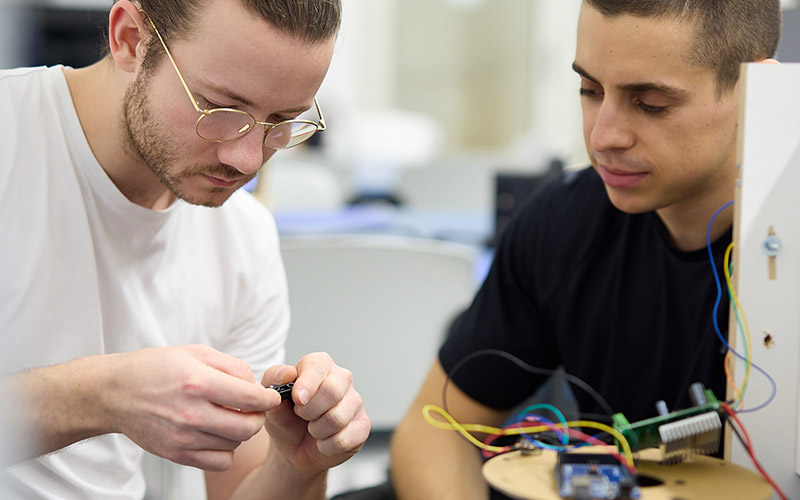
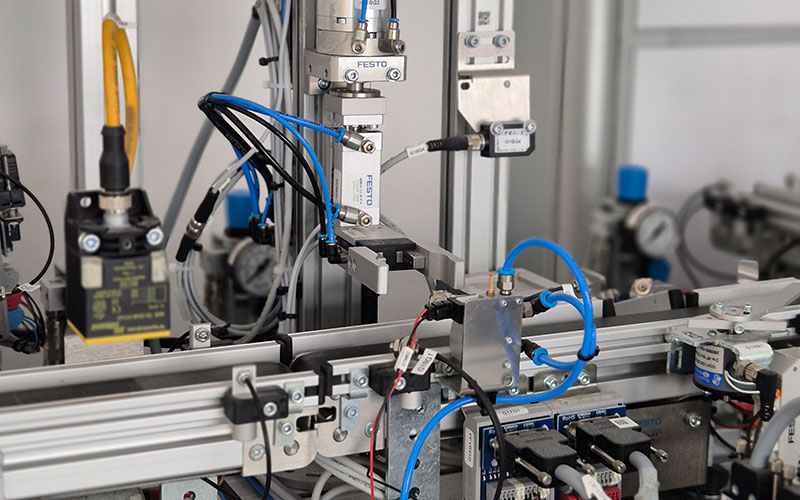
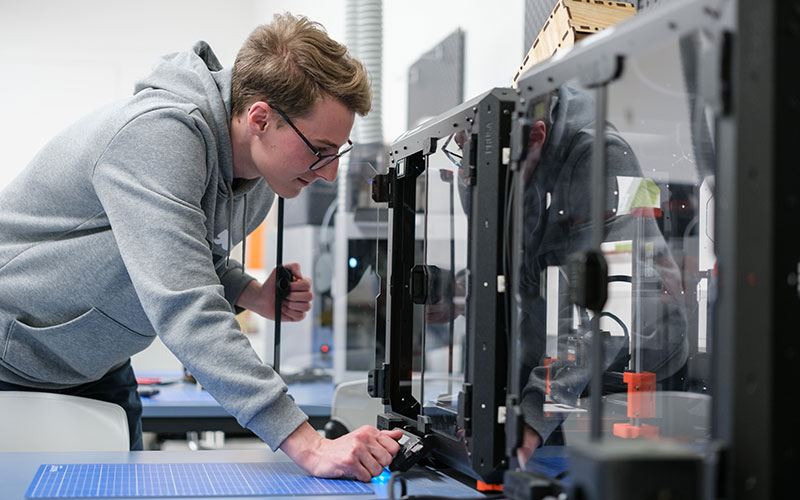
    Insights into the study program

    <
    >
    Studierende arbeiten im Labor

    Studying with practical relevance - bringing engineering to life

    Developing solutions together in the lab: This is where know-how, modern engineering and personal supervision come together - a study environment with practical relevance that prepares you for the challenges of tomorrow.

    Technisches Gerät

    Technology that you develop yourself

    From concept to functional prototype - your studies make engineering tangible.

    Studierender arbeitet an einem technischen Equipment

    Study meets application - learning in the AMSEL lab

    State-of-the-art equipment in the Additive Manufacturing Science and Education Lab enables practical work directly during your studies - here you can develop ideas that could become reality tomorrow.

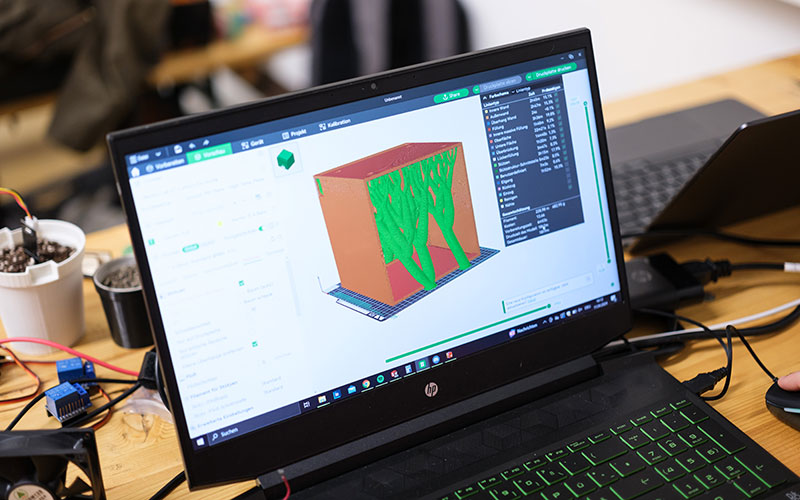
    Laptopansicht mit zukunftsweisender Technologie

    Experience digital technologies directly

    Digital product development, simulation - the use of modern tools and real hardware provides know-how for forward-looking technologies.

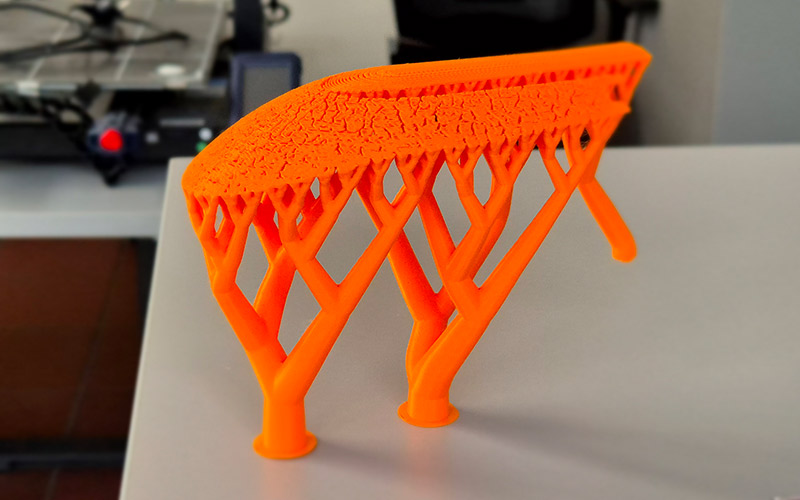
    Kunststoffmodell

    From the idea to the finished component

    Students develop, optimize, and produce innovative designs using state-of-the-art additive technologies such as fused layer modeling — in a practical, creative, and sustainable manner.

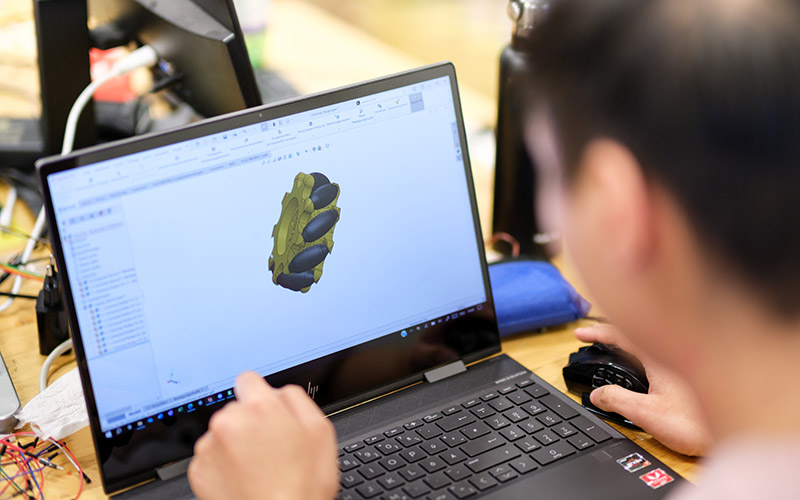
    Studierender gestaltet digitalen Prototyp

    Concept becomes a digital prototype

    Students use CAD and modern manufacturing to design the technology of tomorrow - interdisciplinary, digital and with an eye on the challenges of the future.

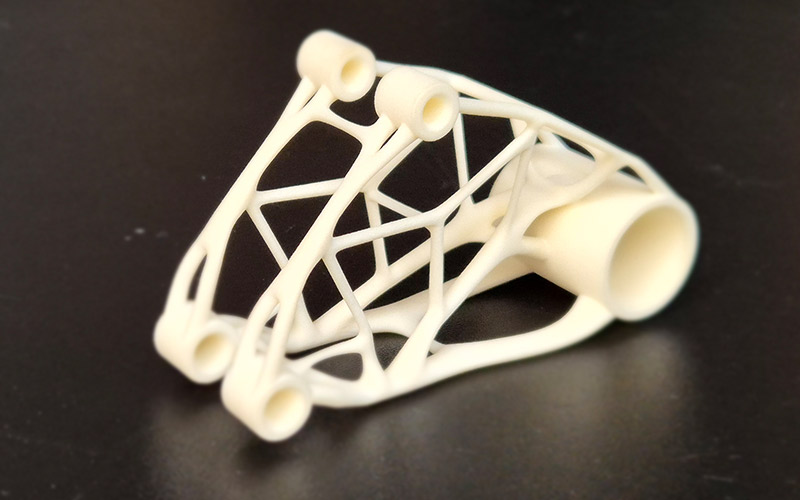
    Bauteil aus Kunststoff

    Lightweight construction meets high-tech

    Topology-optimized components — such as this prototype deflector in the chassis of a Formula student vehicle, manufactured using selective laser sintering — are created using state-of-the-art software and in-depth technical expertise. During their studies, students develop innovative solutions for resource-efficient production.

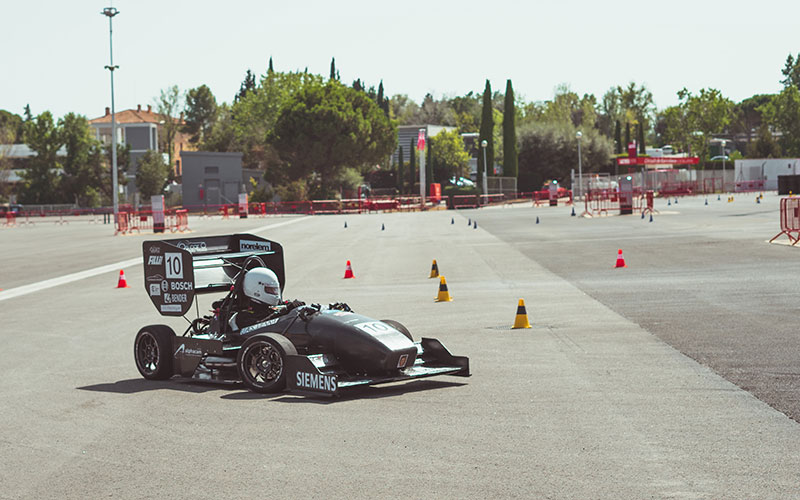
    Rennauto

    Full speed ahead - innovation in motion

    Become part of the Os.Car Racing Team and bring your know-how to the race track. Team spirit, technical skills and real implementation power count here - from the idea to the finished car.

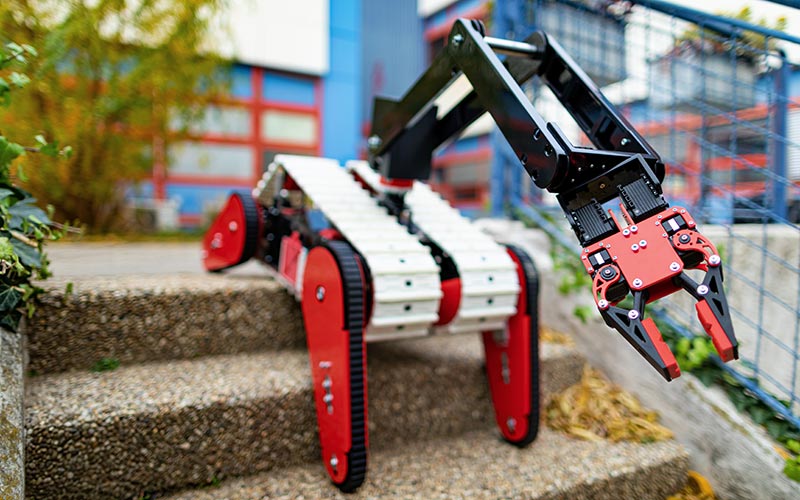
    Roboter

    Working together for intelligent solutions

    In the Res.Q Bots RoboCup team, you will work on innovative developments in robotics with a focus on rescue robots for use in disaster scenarios. Whether programming, sensor technology or strategy - here you will contribute your knowledge, think ahead as a team and compete with the best in international competitions.

    Person hält Tablet in der Hand Kind schreibt auf einem Blatt Papier

    Realizing innovative projects during the studies - SensoGrip shows how it's done

    The project SensoGrip, carried out in cooperation with the degree programs Health Assisting Engineering, Occupational Therapy, and Technical Informatics, demonstrates how technological developments can be made tangible. Innovative applications such as these serve as illustrative examples during the studies and convey practical knowledge with direct reference to the application - in this case for children with graphomotor weaknesses.

    Curriculum

    Module Manufacturing basics

    Manufacturing basics

    4 SWS   6 ECTS

    Learning results

    • The graduate is able to assign the manufacturing processes for the processing of metals and other common materials and machine parts and commodities according to form, surface and material to suitable manufacturing processes in order to be able to assess the selection of these processes according to the economic efficiency of their use.

    • With this overview of the use of tools, fixtures and machines for metal-cutting and non-cutting production, the graduate can independently produce workpieces in practical laboratory exercises.

    4 SWS
    6 ECTS
    Basic machining methods in production engineering | ILV

    Basic machining methods in production engineering | ILV

    2 SWS   3 ECTS

    Content

    Introduction to engineering fundamentals and key manufacturing processes: Moulds and surfaces: Measuring methods. Gauges. Engineering surfaces (geometric shapes, appearance, roughness characteristics). Processes: Primary forming, joining (welding) forming (bending, deep drawing); metal cutting forming (turning, milling, drilling). Plastics processing ; tools. Machines.

    Learning results

    • The graduate is able to assign the manufacturing processes for the processing of metals and other common materials and machine parts and commodities according to form, surface and material to suitable manufacturing processes in order to be able to assess the selection of these processes according to the economic efficiency of their use.

    • With this overview of the use of tools, fixtures and machines for metal-cutting and non-cutting production, the graduate can independently produce workpieces in practical laboratory exercises.

    Teaching method

    Integrated course

    Examination

    Continuous assessment: LV final exam

    Teaching language

    Deutsch

    2 SWS
    3 ECTS
    Mechanical workshop | UE

    Mechanical workshop | UE

    2 SWS   3 ECTS

    Content

    Students are divided into groups WITH and WITHOUT "prior mechanical knowledge". Students without prior knowledge receive an introduction to the basic machining processes (turning, milling, grinding, drilling, etc.) in theory and practice and produce a workpiece. The remaining students work on a small project task.

    Learning results

    • The students know the manufacturing processes for machining metals and other common materials and gain an overview of the use of tools, fixtures and machines for metal-cutting and non-cutting manufacturing.

    • The procedures are taught in practical laboratory exercises and the students produce workpieces independently.

    Teaching method

    Laboratory

    Examination

    Continuous assessment: course - permanent evaluation

    Teaching language

    Deutsch

    2 SWS
    3 ECTS
    Module Mathematics and electrical engineering

    Mathematics and electrical engineering

    3 SWS   4 ECTS

    Learning results

    • The students acquire the basic competences which are indispensable for dealing with technical applications in automation and production engineering. Furthermore, the ability to model and define boundary conditions for the subsequent resolution of complex production process flows as well as the well-founded problem-solving competence should be created.

    • Students acquire basic skills in dealing with numbers and functions, concepts of differential and integral calculus with one variable and their correct interpretation and application to problems in engineering. In addition, students master the use of a computer algebra system to perform numerical and symbolic calculations and graphical representations. Furthermore, they know vectors, matrices and determinants, and solve systems of linear equations in the context of practical problems. They also gain an overview of the theory of ordinary differential equations, in particular linear differential equations of the first order.

    • The students are able to solve the basic problems of descriptive and evaluative statistics by means of statistical analyses with the help of a statistics program package. In the exercises, students learn to apply the knowledge acquired in the lecture to concrete problems. Students are also able to apply the topic of complex numbers, especially in connection with electrical engineering applications.

    • Graduates are able to solve advanced problems in electrical engineering with reference to mechanical engineering and production technology. The focus is on electrical machines, motors and their control.

    3 SWS
    4 ECTS
    Higher mathematics for engineers | ILV

    Higher mathematics for engineers | ILV

    3 SWS   4 ECTS

    Content

    • Sets and Intervals
    • Number Sets and Complex Numbers
    • Absolute Value and Power Functions
    • Polynomials, Equations, and Inequalities
    • Functions and Inverse Functions
    • Matrices and systems of linear equations
    • Vectors
    • Eigenvalues and Eigenvectors
    • Linear Dynamic Systems

    Learning results

    • Students are able to explain basic mathematical concepts, number sets, sets, and functions, and apply them to mathematical and engineering problems. Students are able to independently apply standardized mathematical methods and computational rules to specific mathematical problems in order to calculate exact analytical solutions. Students are able to systematically solve various types of equations and inequalities and interpret the results correctly.

    • Students are able to use matrices, vectors, and systems of linear equations to model and solve mathematical and technical problems. Students are able to calculate eigenvalues and eigenvectors and analyze their significance for mathematical models and technical systems. Students are able to mathematically analyze linear dynamic systems, describe their behavior, and interpret the results in the context of engineering applications.

    Teaching method

    A combination of theory-based lectures, guided computational examples, and active problem-solving. Students independently apply mathematical methods to problems and present their solutions to the class.

    Examination

    Continuous assessment: Final Written Exam

    Teaching language

    Deutsch

    3 SWS
    4 ECTS
    Module Mechatronics

    Mechatronics

    9 SWS   12 ECTS

    Learning results

    • The focus is on building up basic knowledge of computer science, from internal hardware and software processes and functions in individual computers to the structured design of computer networks.

    • The students are able to identify and evaluate problems and tasks, to prepare possible solutions and solutions in a structured manner and to use general tools for implementation in a programming language. They also learn about different forms of programming (procedural, event-driven, object-oriented, etc.).

    • Students will be able to correctly use the different data transmission methods, types of computer architectures, operating systems with their advantages and disadvantages in practice.

    • Students develop an understanding of the scope of application of database systems, can recognize and assign requirements to databases.

    • Graduates can help shape the functional design, layout and construction of machines and components with regard to stationary and moving masses and their static and dynamic properties. They will be able to take into account links to the electrical control of machines and components.

    • Graduates will be able to identify interfaces to applications in the field of mechanical engineering and solve simple calculation examples.

    • Graduates will be able to define basic terms in the field of electrical engineering/electronics and characterize and analyze electrical networks.

    • Graduates will be able to describe the causes and effects of dominant electric and magnetic fields as well as the basics of electromagnetic fields.

    • Graduates will be able to apply the structure and properties of elementary electronic components and the basic circuits built with them.

    • In addition, the graduate takes into account the most important interaction mechanisms as they are practically applied in sensors, actuators and generally in systems for the conversion of electrical into non-electrical energy (and vice versa).

    9 SWS
    12 ECTS
    Introduction to computer science | ILV

    Introduction to computer science | ILV

    2 SWS   3 ECTS

    Content

    Historical overview of the development of computer science (from the beginnings to modern times); basics of computer architecture (structure and functioning);
    Computing with binary numbers (Boolean algebra, combinatorial logic);
    Structure and functioning of processor and memory;
    Number representation (How do "modern" computers manage stored data);
    Structure and functioning of "modern" calculators;
    Operating system (structure, differences and how it works).

    Learning results

    • Students are able to gain basic knowledge of computer science, of internal hardware and software operations and functions in individual computers.

    • Students will be able to analyze the design and internal structure of electronic computers (types of computer architectures) and the management of data (storage and processing). Furthermore, students will be able to consider Boolean algebra and work with integrated circuits (IC). This includes the calculation and basic construction of logic circuits.

    • Also, students can consider the basic principle of operating systems (structure and the main components).

    Teaching method

    Integrated Lecture
    (Lecture/Drawings/Presentations)

    Examination

    Final exam: Written exam

    Teaching language

    Deutsch

    2 SWS
    3 ECTS
    Fundamentals of Electronics and Electrical Engineering I | ILV

    Fundamentals of Electronics and Electrical Engineering I | ILV

    3 SWS   4 ECTS

    Content

    Basic electrical properties of active components (semiconductor; diode, structure and operating principles, types of diodes, rectifier circuits, bipolar and fieldeffect-transistors, structure and operating principles) and passive components (resistor, coil/inductor and capacitors).

    Introduction, fundamental terms and definitions; electrical charge, currents, voltages and power; electrical resistance, Ohm's law; electrical circuits, Kirchhoff's circuit laws, electric circuits elements, resistor networks, network analysis, electrical field, electrical properties of materials, capacitor, magnetic field, magnetic properties of materials, inductance, coil, transformer;
    Structure and properties of real resistors, capacitors, coils, transformers;
    Main properties of electromagnetical fields

    Accompanying to the theoretical nature of the lectures, practical examples are shown in the exercises

    Learning results

    • The graduate can define the structure and properties of elementary components and the basic circuits built with them.

    • The graduate can characterise and analyse the basic terms from the field of electrical engineering/electronics and electrical networks.

    Teaching method

    Lecture with laptop and beamer, additional explanations on the whiteboard, calculation exercises

    Examination

    Final exam: Final written exam

    Teaching language

    Deutsch

    3 SWS
    4 ECTS
    Mechanics | ILV

    Mechanics | ILV

    4 SWS   5 ECTS

    Content

    THEORY: Equilibrium conditions in statics; force systems; support reactions in beams; determination of the centre of gravity in lines and surfaces; statics of plane trusses; friction; internal forces in beams; fundamentals of stress calculation.

    Introduction to the fundamentals and laws of kinematics and kinetics, the theory of motion (translation and rotation) of rigid bodies and masses, oscillations and vibration behaviour of dynamic systems.

    CALCULATIONS: Equilibrium conditions in statics; force systems; support reactions in beams; determination of the centre of gravity in lines and surfaces; statics of plane trusses; friction; internal forces in beams; fundamentals of stress calculation Introduction to the fundamentals and laws of kinematics and kinetics, the theory of motion (translation and rotation) of rigid bodies and masses, oscillations and vibration behaviour of dynamic systems. Within the framework of integrative exercises, the mathematical calculation methods are learned and deepened using examples.

    Learning results

    • Students are able to check the mechanics.

    • Students are able to calculate the mechanics.

    Teaching method

    Lecture and calculation exercise

    Examination

    Final exam: One test after the STATICS

    One test after the DYNAMICS

    BOTH have to be positiv - the combination of both tests leads to the final score

    Teaching language

    Deutsch

    4 SWS
    5 ECTS
    Module Materials and construction

    Materials and construction

    6 SWS   8 ECTS

    Learning results

    • Students will be able to analyse the fundamentals of the representation of spatial, in particular technical structures by means of technical drawing.

    • Furthermore, the students are able to consider the basic rules of ergonomic product and component design as well as industrial design in their application. The acquisition of skills is rounded off by practical exercises in the in-house workshop.

    • The students are able to work together and acquire social skills to do so. In this module, students are also prepared for participation in the Formula Student competition.

    • Graduates will be able to define the basic materials from the fields of metals, plastics and ceramics and their application and use in machines and systems.

    6 SWS
    8 ECTS
    Materials chemistry | VO

    Materials chemistry | VO

    1 SWS   2 ECTS

    Content

    The course teaches the chemical fundamentals required to understand materials and their technical application. Central concepts from measurement methods and SI units, atomic structure, periodic table and types of bonding to stoichiometry, thermochemistry, chemical equilibrium and selected contents of inorganic and organic chemistry related to materials are covered. Building on the theoretical concepts, typical calculation and application examples (e.g. from corrosion/passivation, plastics and material classes) are worked on.

    Main topics

    • Fundamentals and measurement methodology: error calculation, significant digits, SI units and derived quantities
    • Atomic structure and electron structure: atomic models, electron configuration, quantum numbers (basics)
    • Periodic table and periodicity: trends in chemical/physical properties, element groups
    • Bond types and material properties: Ionic bonding, covalent bonding, metal bonding, van der Waals forces
    • Stoichiometry and substance quantity calculation: reaction equations, molar concept, concentrations, yield/limiting reactants
    • Energy conversion in chemical reactions: Thermochemistry, enthalpy of reaction, calorimetry, exothermic/endothermic
    • Chemical equilibrium: law of mass action, equilibrium constant, Le Chatelier principle
    • Inorganic chemistry (relevant to materials): Acids/bases, redox reactions, corrosion/passivation, galvanic effects
    • Organic chemistry (introduction, material-related): functional groups, basic classes, polymers and plastic classification
    • Fundamentals of material physics: states of aggregation, crystalline/amorphous, defects, multi-material systems and structure-property relationships
    • Fields of application: Examples from industrial processes and material selection

    Learning results

    • After completing the course, students will be able to handle measured variables and measurement results correctly (SI units, significant digits, basic error measures/uncertainties), balance reaction equations and carry out stoichiometric calculations (amount of substance, mass, concentration, limiting reactants, yield) with confidence.

    • After completing this course, students will be able to explain atomic structure, electron structure and the periodicity of chemical properties, differentiate between types of bonding and derive and comparatively evaluate the relationship between bonding and structure and the properties of materials (metals, ceramics, polymers).

    • After completing this course, students will be able to analyze chemical reactions in terms of energy and dynamics (thermochemistry/reaction enthalpy, calorimetry, chemical equilibrium with mass action law and apply inorganic and organic concepts (acid-base, redox, functional groups/polymer and plastic classes) to material and process-relevant applications (e.g. corrosion/passivation, material selection).

    Teaching method

    Lecture

    Examination

    Final exam: LV final exam

    Teaching language

    Deutsch

    1 SWS
    2 ECTS
    Introduction to the geometry of constructions | ILV

    Introduction to the geometry of constructions | ILV

    1 SWS   1 ECTS

    Content

    Basic Knowledge of drawings and constructions in 2D and 3D. Drawing without Tools. Detail drawings.

    Learning results

    • Students will be able to apply the fundamentals of the representation of spatial, in particular technical structures by means of technical drawing. They are able to make freehand sketches. In addition to learning drawing techniques, the spatial imagination, the depiction of real bodies in the 2D representation, the conversion into a 3D (thinking) model are to be developed and the cross-connections to the fundamentals of geometry are to be established.

    • Furthermore, students are able to apply the basic rules of product and component design as well as industrial design in practice.

    Teaching method

    Integrated course

    Examination

    Continuous assessment: Exam at the end

    Teaching language

    Deutsch

    1 SWS
    1 ECTS
    Introduction to automotive engineering | VO

    Introduction to automotive engineering | VO

    1 SWS   1 ECTS

    Content

    Engine-Technology

    Internal Combustion Engine, Electric Engines

    Brake-Systems

    Disc Brake Systems, Drum Brake Systems

    Electronic Assists (ABS, ESP etc)

    Suspension-Systems

    Basics, function, construction, tuning

    Frame and Body

    Technologies, setting, tuning


    Learning results

    • Students analyze basic drive concepts and calculate simple parameters of combustion and electric drives, taking into account technical and safety-relevant framework conditions.

    • Students explain the design and function of drum and disc brakes and assess the effect of ABS, ESP and assistance systems with regard to driving dynamics and safety.

    • Students describe suspension components and calculate basic relationships between toe, camber and caster, taking into account target parameters for vehicle dynamics.

    • Students explain car body structures and select suitable materials for simple applications, taking into account weight distribution, lightweight construction and production-related requirements.

    Teaching method

    Presentation


    Examination

    Continuous assessment

    Teaching language

    Deutsch

    1 SWS
    1 ECTS
    Fundamentals of materials science, specifications, properties, areas of application | VO

    Fundamentals of materials science, specifications, properties, areas of application | VO

    2 SWS   3 ECTS

    Content

    Material properties: mechanical-technological, physical, chemical, manufacturing properties as well as environmental compatibility and recycling management; Metallic materials: systematics and labelling, pure metals and their application, metal alloys and their application, extraction of metallic materials (metallurgical processes), steel and iron materials, their production, classification, application and heat treatment Non-ferrous metals (heavy and light metals) - heat treatment of metallic materials; Polymer materials: Classification and identification Thermoplastic, thermoset and elastomeric materials; Glass and ceramic materials: classification and identification; Oxide ceramic materials, composite materials: classification and identification Fibre reinforced materials, hard metals, polymer composites ; Natural and alternative materials: Wood and paper materials.

    Learning results

    • The aim of the course is to acquire the professional and scientific skills that enable students to recognize, formulate and work on questions relevant to the professional field on the basis of scientific methods. - Specifically, in the field of materials science, this concerns a well-founded, science-based overview of materials, their origin, properties and areas of application. - The most important abbreviations for materials can be assigned and used with confidence. Material selection and material behavior can also be critically evaluated under complex boundary conditions. - Basic knowledge can be linked at a scientific level with advanced content such as material testing, failure mechanisms and sustainability aspects. - Theoretical principles can be applied independently to new, unknown problems in compliance with good scientific practice.

    • - In an operational environment, students are able to recognize materials used, assess their manufacturing properties and select suitable materials for constructions. - Students will be able to apply and assess material considerations relevant to mechanical and plant engineering in a practical manner, taking into account relevant standards, economic production and ecological effects.

    Teaching method

    Lecture

    Examination

    Final exam: LV final exam

    Teaching language

    Deutsch

    2 SWS
    3 ECTS
    Social Competence I | SE

    Social Competence I | SE

    1 SWS   1 ECTS

    Content

    Cooperation in a diverse, globalised, highly technical and fast-moving society requires, in addition to subject and methodological competences, distinctive social and personal competences. This course therefore aims to make an explicit contribution to the development and promotion of the students' social and personal competences on the one hand and to contribute to good, effective, efficient, appreciative and respectful cooperation in the year group on the other. Topics include team building, communication, systemic thinking, diversity management, etc.

    Learning results

    • The graduates are able to reflect on their social behaviour after having dealt intensively with social competences and their own as a person or as a group.

    • The graduates can change their social behaviour by taking a first developmental step so that the cohort sees itself as a group (sense of belonging, values, rules, identity, etc.) and can work together well and efficiently.

    Teaching method

    Lecture, discussion, exercises, outdoor exercises, videos, Moodle platform, video conference platform via Zoom or ms-teams

    Examination

    Final exam

    Teaching language

    Deutsch

    1 SWS
    1 ECTS

    Module Manufacturing basics

    Manufacturing basics

    3 SWS   4 ECTS

    Learning results

    • The graduate is able to assign the manufacturing processes for the processing of metals and other common materials and machine parts and commodities according to form, surface and material to suitable manufacturing processes in order to be able to assess the selection of these processes according to the economic efficiency of their use.

    • With this overview of the use of tools, fixtures and machines for metal-cutting and non-cutting production, the graduate can independently produce workpieces in practical laboratory exercises.

    3 SWS
    4 ECTS
    High Tech Manufacturing Process | VO

    High Tech Manufacturing Process | VO

    3 SWS   4 ECTS

    Content

    Classical manufacturing methods such as primary forming, forming, etc. Latest developments in the field of manufacturing technology. Practical examples from various production areas. Cost awareness.

    Learning results

    • Students receive a basic overview of conventional and novel manufacturing processes.

    • On the basis of the material taught, students are able to select the optimum production method in the company, to assess its costs and to consider appropriate combinations or improvements to production processes.

    Teaching method

    Lecture

    Examination

    Final exam: LV final exam

    Teaching language

    Deutsch

    3 SWS
    4 ECTS
    Module Mechanical Engineering

    Mechanical Engineering

    4 SWS   5 ECTS

    Learning results

    • After gaining a basic overview of materials, their origin, special properties and use, students will be able to recognise materials used in operational processes, assess their manufacturing properties and select appropriate materials for designs.

    • Students will be able to calculate and design the most important machine elements for machines and systems in a practice-oriented manner, taking into account relevant standards and with regard to economic production and ecological effects.

    • Students will be able to determine the correct handling of the most important chemical substance groups based on their knowledge of their use and properties. Furthermore, they are able to inform themselves about the relevant legal requirements and put themselves in a position to take an active role in the design and management of production processes involving the use of chemicals.

    4 SWS
    5 ECTS
    Applied Physics | ILV

    Applied Physics | ILV

    2 SWS   2 ECTS

    Content

    • Fundamentals of physics

    • Kinematics

    • Dynamics

    • Rotational movements

    • Work and energy

    • Fundamentals of thermodynamics

    • Fundamentals of fluid mechanics

    • Fundamentals of optics

    Exercise component
    In the accompanying exercise phases, simple model applications and practical technical problems are mathematically derived and solved.

    Learning results

    • Students analyze physical systems using mathematical models and identify the relevant influencing variables for technical applications.

    • Students evaluate the suitability of physical models and approximations with regard to their areas of validity in real technical problems, apply physical principles independently to new engineering problems and derive quantitative solutions.

    Teaching method

    Integrated LV with calculation exercises

    Examination

    Continuous assessment: Multi-part performance assessment in this ILV is based on two components, both of which must be assessed positively:

    1) the final written examination accounts for 70% of the grade

    2) continuous participation, mainly solving and presenting practical examples, contributes 30% to the grade


    Teaching language

    Deutsch

    2 SWS
    2 ECTS
    Basics machine elements | ILV

    Basics machine elements | ILV

    2 SWS   3 ECTS

    Content

    Introduction to machine elements, such as shaft-hub connections, roller bearings, plain bearings, springs, seals, belt drives, etc.
    Introduction to mechanical drive and transmission elements (design and mode of action), such as couplings, gear drives, power and form-locking active drives, etc.
    Mechanical engineering calculations.

    Learning results

    • Students learn about the most important machine elements for machines and systems. Taking into account relevant tables, machine elements are designed and calculated and designed with regard to economic production and ecological effects.

    Teaching method

    integrated course

    Examination

    Final exam: exam at the end of semester

    Teaching language

    Deutsch

    2 SWS
    3 ECTS
    Module Mathematics and electrical engineering

    Mathematics and electrical engineering

    7 SWS   11 ECTS

    Learning results

    • The students acquire the basic competences which are indispensable for dealing with technical applications in automation and production engineering. Furthermore, the ability to model and define boundary conditions for the subsequent resolution of complex production process flows as well as the well-founded problem-solving competence should be created.

    • Students acquire basic skills in dealing with numbers and functions, concepts of differential and integral calculus with one variable and their correct interpretation and application to problems in engineering. In addition, students master the use of a computer algebra system to perform numerical and symbolic calculations and graphical representations. Furthermore, they know vectors, matrices and determinants, and solve systems of linear equations in the context of practical problems. They also gain an overview of the theory of ordinary differential equations, in particular linear differential equations of the first order.

    • The students are able to solve the basic problems of descriptive and evaluative statistics by means of statistical analyses with the help of a statistics program package. In the exercises, students learn to apply the knowledge acquired in the lecture to concrete problems. Students are also able to apply the topic of complex numbers, especially in connection with electrical engineering applications.

    • Graduates are able to solve advanced problems in electrical engineering with reference to mechanical engineering and production technology. The focus is on electrical machines, motors and their control.

    7 SWS
    11 ECTS
    Applied differential and integral calculus | ILV

    Applied differential and integral calculus | ILV

    2 SWS   3 ECTS

    Content

    Basic concepts of differential and integral calculus in one variable: Convergence, continuity, derivative, definite and indefinite integral, differentiation and integration in practice (e.g. in signal processing). Basic principles of differential and integral calculus in several variables. Applications in science, technology and economics. Practical treatment of the course contents in the exercise.

    Learning results

    • Students will be able to apply the fundamental knowledge that is essential for understanding technical applications in automation and production engineering. Furthermore, the ability to model and later resolve complex production engineering process flows as well as a sound problem-solving competence should be created.

    • Students are able to apply basic knowledge in dealing with numbers and functions, the fundamental concepts of differential and integral calculus in one and two variables and their correct interpretation and application to problems in engineering. In addition, students master the use of a computer algebra system to perform numerical and symbolic calculations and graphical representations. In the exercises, students learn to apply the knowledge acquired in the lecture to practical examples and concrete problems.

    Teaching method

    Integrated lectures and exercises

    Examination

    Final exam: Exercises have to be prepared during the semester, a written exam at the end of the semester will serve as the assessment of choice.

    Teaching language

    Deutsch

    2 SWS
    3 ECTS
    Electronics Lab | UE

    Electronics Lab | UE

    2 SWS   3 ECTS

    Content

    The theoretical knowledge regarding Basics of Electrical Engineering and Electronics gained in the preceding lectures is applied in a practical way. Students solve exercises involving the construction and measuring of basic circuits while documenting the measurements and insights in the shape of lab protocols.

    Learning results

    • The graduate can take into account the properties of the most important electronic components in the construction of basic circuits and verify them by measurement. In addition, he/she can take into account the most important interaction mechanisms as they are used in sensors, actuators and generally in systems for the conversion of electrical into non-electrical energy (and vice versa).

    • The graduate is able to measure electronic circuits with suitable measuring methods and devices with their mode of operation and mechanisms of action.

    Teaching method

    Laboratory

    Examination

    Continuous assessment

    Teaching language

    Deutsch

    2 SWS
    3 ECTS
    Basics Electronics and Electrical Engineering II | ILV

    Basics Electronics and Electrical Engineering II | ILV

    2 SWS   3 ECTS

    Content

    Continuation and consolidation of the contents of Fundamentals of Electronics and Electrical Engineering I

    Learning results

    • The graduate can implement the structural elements with their properties of components and the circuits built with them.

    • The graduate can characterize and analyze different electrical networks.

    Teaching method

    Frontal lecture in combination with e-learning elements

    Examination

    Continuous assessment

    Teaching language

    Deutsch

    2 SWS
    3 ECTS
    Sensors and actuators | VO

    Sensors and actuators | VO

    1 SWS   2 ECTS

    Content

    Measurement quantities and their units; application principles of the conversion of non-electrical quantities of various kinds such as mechanical, thermal, optical, chemical, and biological quantities into electrical quantities (and vice versa) as well as other electrical/magnetic quantities.

    Learning results

    • The graduate is able to define the basic physical concepts and mechanisms relevant for technical applications. In addition, an understanding of the physical principles applied in electrical systems of automation technology and environmental technology should be created.

    • The graduate is able to analyse the most important interaction mechanisms as they are used in sensors, actuators and generally in systems for the conversion of electrical energy (and vice versa).

    Teaching method

    Lecture with Laptop, Beamer and additional explanations on whiteboard.
    Parts of the lectures' contents have to be acquired by the students on their own by means of e-learning.

    Examination

    Continuous assessment

    Teaching language

    Deutsch

    1 SWS
    2 ECTS
    Module Mechatronics

    Mechatronics

    2 SWS   3 ECTS

    Learning results

    • The focus is on building up basic knowledge of computer science, from internal hardware and software processes and functions in individual computers to the structured design of computer networks.

    • The students are able to identify and evaluate problems and tasks, to prepare possible solutions and solutions in a structured manner and to use general tools for implementation in a programming language. They also learn about different forms of programming (procedural, event-driven, object-oriented, etc.).

    • Students will be able to correctly use the different data transmission methods, types of computer architectures, operating systems with their advantages and disadvantages in practice.

    • Students develop an understanding of the scope of application of database systems, can recognize and assign requirements to databases.

    • Graduates can help shape the functional design, layout and construction of machines and components with regard to stationary and moving masses and their static and dynamic properties. They will be able to take into account links to the electrical control of machines and components.

    • Graduates will be able to identify interfaces to applications in the field of mechanical engineering and solve simple calculation examples.

    • Graduates will be able to define basic terms in the field of electrical engineering/electronics and characterize and analyze electrical networks.

    • Graduates will be able to describe the causes and effects of dominant electric and magnetic fields as well as the basics of electromagnetic fields.

    • Graduates will be able to apply the structure and properties of elementary electronic components and the basic circuits built with them.

    • In addition, the graduate takes into account the most important interaction mechanisms as they are practically applied in sensors, actuators and generally in systems for the conversion of electrical into non-electrical energy (and vice versa).

    2 SWS
    3 ECTS
    Introduction Microcontroller Programming | ILV

    Introduction Microcontroller Programming | ILV

    2 SWS   3 ECTS

    Content

    With the networking of even the smallest micro-computer systems, the Internet of Things, the use of this special form of embedded systems has gained in importance. The basis for this are simple microcontrollers which are in contact with the environment through electronic actuators and sensors. In this course, programs with basic functions are to read and process sensor data and control actuators.
    The course covers in particular the following contents:

    • Simple microcontroller programming based on ARM-mbed (or Arduino)
    • Digital input/output (LEDs, buttons)
    • DC voltage, ohmic resistor, pull-up/down, level adjustment
    • Analog Input/Output (AD/DA)
    • Peripheral functions
    • System-on-a-Chip
    • Basic concepts of applied computer science (program, algorithm, programming)
    • Introduction to programming (in C)
    • Evaluation and implementation of algorithms

    Learning results

    • Students will be able to use microcontrollers to solve simple problems.

    • Students are able to independently develop algorithms and implement them in a common programming language.

    Teaching method

    Integrated Lecture

    Examination

    Continuous assessment: Immanent exam

    Teaching language

    Deutsch

    2 SWS
    3 ECTS
    Module Materials and construction

    Materials and construction

    7 SWS   7 ECTS

    Learning results

    • Students will be able to analyse the fundamentals of the representation of spatial, in particular technical structures by means of technical drawing.

    • Furthermore, the students are able to consider the basic rules of ergonomic product and component design as well as industrial design in their application. The acquisition of skills is rounded off by practical exercises in the in-house workshop.

    • The students are able to work together and acquire social skills to do so. In this module, students are also prepared for participation in the Formula Student competition.

    • Graduates will be able to define the basic materials from the fields of metals, plastics and ceramics and their application and use in machines and systems.

    7 SWS
    7 ECTS
    Design exercises | ILV

    Design exercises | ILV

    4 SWS   4 ECTS

    Content

    • Introduction to SolidWorks and Its Fundamentals
    • Parametric 3D Modeling and Design
    • Assembly Modeling and Design
    • Technical Drawings and Standard-Compliant Drawing Derivation
    • Technical Documentation of Design Projects
    • Practical Application of Design Methods
    • Translating theoretical principles into practical designs
    • Selection and design of technical components
    • Project-based design and technical decision-making

    Learning results

    • Upon successful completion of this course, students will be able to apply the basic functions and methods of the SolidWorks CAD software confidently and effectively. This includes, in particular, the design and construction of three-dimensional parts and assemblies, the creation of technical drawings and drawing derivations that comply with standards, as well as the proper dimensioning and documentation of the designed models.

    • In addition, students work independently on design projects, going through the entire design process—from the technical analysis and interpretation of the project requirements, through the development and evaluation of suitable solutions and iterative decision-making, to the preparation and technical presentation of the results achieved.

    • .

    Teaching method

    • Practical Learning
    • Guided CAD Exercises
    • Demonstration and Replication of Design Steps
    • Independent Design
    • Task- and project-based work
    • Learning by Doing

    Examination

    Continuous assessment: Regular submission of small assignments

    Project submission, including a presentation of the results

    Final exam on a computer using CAD software


    Teaching language

    Deutsch

    4 SWS
    4 ECTS
    Social Competence II | SE

    Social Competence II | SE

    1 SWS   1 ECTS

    Content

    Cooperation in a diverse, globalised, highly technical and fast-moving society requires, in addition to technical and methodological skills, distinctive social and personal skills. In this course, the contents of the course "Social Competence I" will be expanded and deepened. The focus is on the topics of communication, conflict and leadership.

    Learning results

    • The graduates have dealt with successful/unsuccessful communication, conflict management and leadership, and have learned to know and apply models and instruments from these subject areas. In addition, a further contribution was made in terms of group development (consolidation of the group structure of the year).

    Teaching method

    Lecture, discussion, exercises, videos, Moodle platform, video conference platform via Zoom or ms-teams

    Examination

    Final exam

    Teaching language

    Deutsch

    1 SWS
    1 ECTS
    Materials Testing Procedure | ILV

    Materials Testing Procedure | ILV

    2 SWS   2 ECTS

    Content

    Overview of all applied methods of destructive and non-destructive materials testing, in-depth treatment of tensile and compression tests, metallography/crystallography, hardness testing methods, X-ray and ultrasonic testing, surface testing methods.

    Learning results

    • After completing the course, students will have an overview of applied materials testing methods.

    Teaching method

    integrated course

    Examination

    Final exam: exam at the end of semester

    Teaching language

    Deutsch

    2 SWS
    2 ECTS

    Module Design of components

    Design of components

    4 SWS   5 ECTS

    Learning results

    • Students will be able to define functional design, layout and construction of machines and components in terms of stationary and moving masses or their static and dynamic properties.

    • Students are able to assess representations of spatial, in particular technical structures by means of technical drawing. They are able to make freehand sketches and learn how to use common computer graphics programs (CAD). In addition to learning standards and drawing techniques, the spatial imagination, the depiction of real bodies in the 2D representation (whether paper or screen), the conversion into a 3D (thinking) model should be developed and the cross-connections to the fundamentals of geometry and mathematics established.

    • Furthermore, the students are able to consider the basic rules of ergonomic product and component design as well as industrial design. The acquisition of skills is rounded off by practical exercises in the in-house workshop. This module also prepares students for participation in the Formula Student competition.

    Examination

    : Written part of the exam: theoretical questions and analytical calculations

    Practical part of the exam: performing a finite element calculation with Simcenter.

    Both parts of the examination must be positive independently of each other!

    4 SWS
    5 ECTS
    Strength of materials and finite element methods | VO

    Strength of materials and finite element methods | VO

    2 SWS   3 ECTS

    Content

    The theoretical basics of strength theory and the finite element method and the practical application with Simcenter and NX Nastran are taught. Contents are internal forces, tension, elastostatics, strains, finite elements, dimensioning.

    Learning results

    • After completing the course, students are able to solve simple problems in strength of materials theory independently.

    Teaching method

    Theory lecture, analytical calculations on the whiteboard, practical FEA on PC

    Examination

    Module exam

    Teaching language

    Deutsch-Englisch

    2 SWS
    3 ECTS
    Exercise for Strength of materials | UE

    Exercise for Strength of materials | UE

    2 SWS   2 ECTS

    Content

    The theoretical basics of strength theory and the finite element method and the practical application with Simcenter and NX Nastran are taught. Contents are internal forces, stress, elastostatics, loads, finite elements, dimensioning.

    Learning results

    • The graduate is able to independently solve simple problems in strength of materials theory.

    Teaching method

    Exercise

    Examination

    Module exam

    Teaching language

    Deutsch

    2 SWS
    2 ECTS
    Module Business Administration and Logistics

    Business Administration and Logistics

    4.5 SWS   6 ECTS

    Learning results

    • The graduate can define the functions and tasks of business administration in the company and their close contexts to the legal area.

    • The graduate can analyse the structure and elements of corporate accounting and evaluate the business aspects of production processes.

    • Furthermore, the graduate can apply the functions of accounting, bookkeeping. The procedures of cost accounting and their interrelationships are familiar, the methods of investment appraisal and profitability calculation are mastered and can be applied.

    • Graduates are able to create up-to-date logistics concepts and implement them in practice.

    4.5 SWS
    6 ECTS
    Introduction to logistics | ILV

    Introduction to logistics | ILV

    1.5 SWS   2 ECTS

    Content

    Basics of logistics and the supply chain, logistics terms and concepts

    Basics and concepts of logistics

    History and trends in logistics

    Storage systems and conveyor technology

    Picking & Pick-by-X systems

    Supply chain management, ABC analysis

    Modern transport systems, driverless transport systems

    Robotics and Cobots

    ERP, SCM systems

    Digital logistics planning

    Learning results

    • After completing the course, students will have: - become familiar with the basics and concepts of logistics and the supply chain - become familiar with the history and trends in logistics - Understand intralogistics concepts and warehouse concepts - familiarized themselves with modern transport systems, in particular driverless transport systems - Understanding of digitalization, tracking methods and networking in logistics - Familiarization with concepts of external logistics and supply chain management - Familiarization with optimization methods for logistics processes - Familiarization with digital software for logistics planning

    Teaching method

    Integrated course

    Examination

    Continuous assessment: Practice-oriented group work (presentation, discussion) & submission of an innovation concept

    Teaching language

    Deutsch

    1.5 SWS
    2 ECTS
    Ethics and sustainability | SE

    Ethics and sustainability | SE

    1 SWS   1 ECTS

    Content

    * Basic ethical definitions and contexts

    * Basic ethical positions in general and applied ethics

    * Ethical reflection and argumentation

    * Technology and technologies and their ethical implications.

    * Technology and its impact on (improved) living conditions, sustainability and the well-being of people and the environment.

    * New development trends and their ethical relevance: artificial intelligence and its opportunities/limitations; automated decision-making processes and their challenges; autonomous mobility (vehicles).

    * MEESTAR model and its implementation in ethically relevant decision-making processes in dealing with technology.

    Learning results

    • Students gain insight into, access to and application of ethical reflection in the context of technology and technology production in the context of social responsibility.

    • Graduates have basic knowledge and skills in ethics, argumentation strategies and their application in concrete research and development processes.

    • Basic ethical knowledge and skills enable graduates to critically discuss their own activities and actions in their specific field of activity as well as development processes and trends, to form a competent and well-founded judgment and thus contribute to the promotion of best practice in science. Graduates are able to use the MEESTAR model competently and have an overview of the functions and tasks of ethics committees.

    Teaching method

    Lectures with discussion of case studies

    Example applications by work order

    Examination

    Continuous assessment: Written assignment of an ethical dilemma in the field of HTM. Details will be announced in the course and made available online in Moodle.

    Teaching language

    Deutsch

    1 SWS
    1 ECTS
    Fundamentals of business administration | VO

    Fundamentals of business administration | VO

    2 SWS   3 ECTS

    Content

    Perspecitives of business administration:

    • Entrepreneural perspective
    • Financial perspective
    • Strategic perspective
    • Customer perspective
    • Production- and process perspective
    • Employee perspective

    Learning results

    • The graduate can use the basic knowledge to gain an overview of the goals and functions of business administration in the company (including their embedding in the legal context).

    • The graduate is able to define the essential characteristics and work content of the individual business management sub-areas as well as the interrelationships between the business management sub-areas.

    • The graduate will be able to work transdisciplinarily with other departments through an understanding of the big picture of business and knowledge of business vocabulary.

    Teaching method

    lecture

    Examination

    Final exam: final exam

    Teaching language

    Deutsch

    2 SWS
    3 ECTS
    Module Factory planning and control systems

    Factory planning and control systems

    6 SWS   7 ECTS

    Learning results

    • The graduate masters the basics of capacity and inventory management; key figures for the assessment of production systems: Costs, quality, time, service, flexibility; factors influencing safety capacities, safety times and safety stocks; methods of factory planning, e.g. factory simulation.

    • Furthermore, the graduate can define the tasks of a production planner or project manager in work preparation, as well as the tasks of test planning and time determination methods. The final examination is intended to lead to the award of a certificate for the basic process, which has been internationally agreed by the MTM Association.

    • The graduate can analyze logistics functions and tasks and their integration into company processes as well as their use in the supply chain. He*she knows the logistical methods and instruments in inbound, outbound and production logistics, information systems and the main approaches to optimizing the supply chain.

    • Graduates will be able to assess the most important systems in automated production and their areas of application from both a technical and economic perspective.

    • The graduate will be able to use and network the basics of programming a PLC with STEP 7 in an environment with actuators in order to ensure an optimal automated production process.

    • The graduate can reproduce the basics of electrical measurement technology and corresponding devices, especially in relation to automated measurement systems.

    • Graduates will be able to assess the significance and function of control systems. This should enable them to determine the structure of a control system based on a task and to determine and differentiate its use from control systems.

    • Graduates will be able to analyze the basic structure, functionality and areas of application of industrial robots.

    6 SWS
    7 ECTS
    Production planning CAD/CAM | ILV

    Production planning CAD/CAM | ILV

    2 SWS   2 ECTS

    Content

    Students gain insight into the basics of Computer Aided Manufacturing (CAM), as well as methods for cost management in product development with a focus on CAD/CAM.

    Furthermore, students gain a basic understanding of the tasks in production planning or project management and in work preparation with special consideration of CAM and LW3D, as well as an understanding of sustainable product development.

    Learning results

    • Students will be able to define manufacturing processes (mass, variety, series and individual production) - production and logistics (site planning, warehouse ratios, production planning) - cost management in integrated product development - ergonomic workplace design - planning of manufacturing systems (schematic/layout, digital factory) - basic features of supply chain management SCM (supply chain).

    • In the practical part the graduate can acquire further competences about: - DFM (design for manufacturability): product development with reference to manufacturing - MBD (model based definition) drawing-free 3D data for manufacturing - PMI (product manufacturing information) drawing-free manufacturing information in the 3D model (3D-pdf, STEP242, eDrawings, dwf, JT...) - CAD/CAM: basics of creating CNC commands from the design (exercise with Solidworks CAM, 21/2 D milling 3D milling, turning), basics of additive manufacturing in the CAD model - sustainability analysis. Upon successful completion, students can request a certificate of "successful participation in the SolidWorks CAM basic training".

    Teaching method

    Integrated course

    Lecture, practical exercise on DFM, MBD, PMI, CAD/CAM, sustainability

    Examination

    Final exam: Final inspection, standard (LV final inspection) Recognition of problem areas on components in relation to manufacturing, creation of a G-code and post-processor code on an example with SolidWorks CAM

    Teaching language

    Deutsch

    2 SWS
    2 ECTS
    Production Management | ILV

    Production Management | ILV

    2 SWS   2 ECTS

    Content

    • Fundamentals and historical development of production, production systems and industrial manufacturing
    • State of the Art production systems / Lean Production, Integrated PPS, industry 4.0 in production Process, material and information flow design in production, Elemination of waste in production
    • Product Development Procedures PEP (VDA, ISO), Process Management, Quality Management, Maintenance Concepts
    • Standards and KPIs in production
    • Assembly as core element of production, primary-secondary analysis
    • Work Science, Ergonomics and Human factors
    • The human factor in production today and in the future
    • Assistance systems and robots in the area of production
    • Visions and strategic concepts for production systems Use of software and digital tools in production management
    • Energy management

    Learning results

    • After completing the course, students will be able to describe the history and state of the art of production systems, production management and methods and tools.

    • Students can explore future concepts and new technologies in relation to production

    • Students will be able to analyze lean production and holistic production systems.

    • Students are able to consider the human factor in production and can classify the use of assistance systems, digitalization and Industry 4.0/5.0 concepts.

    • Students will be able to investigate new digital software tools in relation to production.

    Teaching method

    • Integrated course,
    • Practice-oriented group work (e.g. process design & analysis, presentation, concept development, application of tools)
    • Written test

    Examination

    Continuous assessment: Practice-oriented group work, presentation and written test

    Teaching language

    Deutsch

    2 SWS
    2 ECTS
    Control systems | ILV

    Control systems | ILV

    2 SWS   3 ECTS

    Content

    Concept of a programmable logic controller, creating programs, diagnosing hardware faults (replacing modules), targeted troubleshooting, adapting machine/system to new conditions, rapid localisation of faults (emergency operation), efficient programming, shortening the engineering phase, outlook on operation and monitoring, basis of decentralised peripherals, operation and monitoring (locally and via the Internet), soft PLC, real-time behaviour, safety controllers, exercises: PLC programming, maintenance diagnostics

    Learning results

    • Graduates will be able to assess the basic structure and operation of programmable logic controllers (PLCs).

    • Graduates will be able to apply the possibilities of parameterization and the programming languages used for this purpose.

    • Graduates will be able to carry out a targeted approach to software error search and troubleshooting. They have the ability to carry out simple program changes in existing programs.

    • Graduates will be able to assess the structure of different control systems and their hardware and software components.

    • The students can modify and adapt the communication structures used at the process and field level for new applications if necessary.

    • Graduates will be able to discuss the role and significance of control systems in the context of Industry 4.0.

    Teaching method

    Integrated course

    Examination

    Continuous assessment: Immanent examination character

    Teaching language

    Deutsch

    2 SWS
    3 ECTS
    Module Construction project
    5 SWS
    5 ECTS
    Construction project | SE

    Construction project | SE

    5 SWS   5 ECTS

    Content

    In the design project, large designs are generated and documented in group projects. The design is broken down into sub-areas and completed by students in independent individual work. Special emphasis is placed on the interconnection of the sub-projects, the formation of interfaces and the documentation of the respective progress. Project management methods are to be incorporated into the practice-oriented training.

    Learning results

    • The students can apply their understanding of the process of a scientific approach to a defined task, writing scientific project documentation, interdisciplinary work in the field of design and manufacturing in groups, presentation of intermediate and final results. The topic of sustainability is also addressed: how can constructions be created so that, for example, repairs to components are made possible in the simplest possible way?

    • The graduate - can create and comprehensibly present a concept for a design project or can plan, prepare and present the work in all the necessary phases using the necessary content-related and formal criteria - can critically reflect on their own research process - can recognise and articulate problems relating to deviation from the research logic structure, discuss possible solutions if necessary and react adequately to current organisational and research practice circumstances - interdisciplinary work is learned and supported, e.g. coordination processes between design and production.

    Teaching method

    Seminar

    Students work in independent groups and present their interim results at regular intervals.

    Examination

    Continuous assessment: Project submission

    Teaching language

    Deutsch

    5 SWS
    5 ECTS
    Module Science and technology

    Science and technology

    4.5 SWS   7 ECTS

    Learning results

    • The students acquire the basic competences which are indispensable for the understanding of technical applications in automation and production engineering. Furthermore, the ability to model and define boundary conditions for the subsequent resolution of complex production process flows as well as the well-founded problem-solving competence should be created.

    • Students acquire basic knowledge in dealing with numbers and functions, fundamental concepts of differential and integral calculus with one variable and their correct interpretation and application to problems in engineering.

    • In addition, students master the use of a computer algebra system to perform numerical and symbolic calculations and graphical representations. Furthermore, they can use their knowledge of vectors, matrices and determinants, and solve systems of linear equations in the context of practical problems. They also gain an overview of the theory of ordinary differential equations, in particular first order linear differential equations.

    • In addition, they are able to carry out basic problems of descriptive and evaluative statistics by means of statistical evaluations with the help of a statistics program package. In the exercises, students learn to apply the knowledge acquired in the lecture to concrete problems.

    • Graduates will be able to describe the most important methods and processes of manufacturing technology for the production of solid bodies from various materials such as metal, plastic and ceramics.

    • The graduate can carry out a well-founded independent analysis of production-related issues based on the technological, economic and organizational contexts of modern production.

    • Graduates will be able to analyze the functions, designs and areas of application of modern machine tools and machining centers.

    • Graduates will be able to assess the areas of application and the limits of various machine tools in terms of costs, production time and quality.

    • Furthermore, the graduate can reproduce the most important methods of generative manufacturing and has know-how in the use of rapid prototyping technologies.

    4.5 SWS
    7 ECTS
    Application of higher mathematics | ILV

    Application of higher mathematics | ILV

    1.5 SWS   2 ECTS

    Content

    (1) Introduction to the general theory of differential equations (DEs), first- and second order linear differential equations, qualitative methods for non-linear differential equations, application of differential equations; 
    (2) Fourieranalysis

    Learning results

    • The students become acquainted with differential equations; they are able to solve first- and second order linear differential equations and learn the basics of fourier analysis.

    Teaching method

    Integrated Lecture

    Examination

    Final exam: Lecture (VO): final exam, Exercises (UE): intrinsic exam type

    Teaching language

    Deutsch

    1.5 SWS
    2 ECTS
    Machine, tool and fixture construction | ILV

    Machine, tool and fixture construction | ILV

    2 SWS   3 ECTS

    Content

    Machine tools: basic structure, mechanical properties, areas of application, accuracy and tolerances in tool making; multi-machine systems and machining centres; tool systems and chip removal devices; position measuring systems and control devices; introduction to CNC technology; manufacturing processes for injection moulding tools; movement sequences in fixture construction. Current trends and technical developments.

    Learning results

    • The graduate is able to reproduce the most important methods and processes of manufacturing technology for the production of solid bodies from different materials such as metal, plastic and ceramics.

    • The graduate is able to carry out a well-founded independent analysis of technical production issues on the basis of the technological, economic and organisational contexts of modern production.

    • The graduate is able to analyse the modes of operation, the designs and the areas of application of modern machine tools and machining centres, including the associated fixture construction.

    • The graduate can assess the areas of application as well as the limits of various machine tools with regard to costs, production time and quality.

    • Furthermore, the graduate can reproduce the most important methods of generative manufacturing and has know-how in the use of rapid prototyping technologies.

    Teaching method

    Integrated lecture

    Examination

    Final exam: LV final exam

    Teaching language

    Deutsch

    2 SWS
    3 ECTS
    Statistics and probability | ILV

    Statistics and probability | ILV

    1 SWS   2 ECTS

    Content

    Introduction to descriptive statistics, inferential statistics and
    hypothesis testing. Probability theory, probability distributions. 
    Introduction to a software environment for statistical computing.
    Application of the lecture content.

    Learning results

    • The students are able to solve the basic problems of descriptive and evaluative statistics and also perform statistical evaluations with the help of a statistics program package. In the exercises, students learn to apply the knowledge acquired in the lecture to concrete problems.

    Teaching method

    Integrated lecture

    Examination

    Final exam: Lecture (VO): final exam, Exercises (UE): intrinsic exam type

    Teaching language

    Deutsch

    1 SWS
    2 ECTS

    Module Business Administration and Logistics

    Business Administration and Logistics

    3 SWS   4 ECTS

    Learning results

    • The graduate can define the functions and tasks of business administration in the company and their close contexts to the legal area.

    • The graduate can analyse the structure and elements of corporate accounting and evaluate the business aspects of production processes.

    • Furthermore, the graduate can apply the functions of accounting, bookkeeping. The procedures of cost accounting and their interrelationships are familiar, the methods of investment appraisal and profitability calculation are mastered and can be applied.

    • Graduates are able to create up-to-date logistics concepts and implement them in practice.

    3 SWS
    4 ECTS
    Cost accounting and controlling | ILV

    Cost accounting and controlling | ILV

    2 SWS   3 ECTS

    Content

    Basics of accounting, derivation of costs from accounting (cost element accounting), allocation of costs to internal service areas (cost centre accounting), determination of cost-covering prices (cost unit accounting), determination of cost unit and period success, corporate processes, the controlling principle (the control loop of controlling), tasks and instruments of controlling, self-controlling of employees, projects, departments
    Strategic controlling: Portfolio management; scenario technique; ABC analysis
    Operational controlling: key figures / benchmarking, weak point analyses, variance analyses
    Budgeting / Reporting

    Learning results

    • The graduate has an overview of the functions and tasks of business administration in the company and their close contexts to the legal area.

    • The graduate can analyse the structure and elements of corporate accounting and assess the business aspects of production processes.

    • Furthermore, graduates can apply the functions of accounting, bookkeeping. The procedures of cost accounting and their interrelationships are familiar, the methods of investment appraisal and profitability calculation are mastered and can be applied.

    Teaching method

    Integrated course

    Examination

    Final exam: LV-final examination, partial examinations

    Teaching language

    Deutsch

    2 SWS
    3 ECTS
    Logistics in the High Tech Industry | ILV

    Logistics in the High Tech Industry | ILV

    1 SWS   1 ECTS

    Content

    - In-depth examination of logistics and supply chain topics
    - High tech in logistics with physical systems (robotics, cobots, AGVs)
    - Trends in logistics
    - Digital software systems (use of software, assistance systems and AI) in logistics
    - Green tech and sustainability in logistics (SDG, climate protection, use of high tech)
    - Global, regional and local aspects of logistics and supply chain - Legal aspects (Supply Chain Act, ESG, CSRD, standards) - Practical excursion to a logistics company Logistics and supply chain
    - Legal aspects (Supply Chain Act, ESG Regulation, CSRD, standards)
    - Practical excursion to a logistics company

    Learning results

    • After completing this course, students will be able to... - deal with central topics of logistics and supply chain in depth and assess current trends in a well-founded manner - classify high-tech solutions (e.g. robotics, cobots, AGVs) for logistics and recognize their potential for process optimization - analyze modern digital software systems, assistance systems and AI applications and use them in logistics processes - evaluate and develop green tech concepts and sustainability strategies (e.g. SDG, climate protection, use of high-tech) in logistics contexts - differentiate between global, regional and local aspects of the supply chain in terms of economic efficiency and sustainability - understand legal frameworks (Supply Chain Act, ESG Regulation, CSRD, standards) and apply them to specific logistics scenarios - gain insights into real company processes through practical excursions and critically reflect on what they have learned (subject to the implementation of the excursions)

    Teaching method

    Integrated course

    Examination

    Continuous assessment: Immanent performance assessment

    Practice-oriented group work (presentation, discussion)

    Teaching language

    Deutsch

    1 SWS
    1 ECTS
    Module Factory planning and control systems

    Factory planning and control systems

    6 SWS   8 ECTS

    Learning results

    • The graduate masters the basics of capacity and inventory management; key figures for the assessment of production systems: Costs, quality, time, service, flexibility; factors influencing safety capacities, safety times and safety stocks; methods of factory planning, e.g. factory simulation.

    • Furthermore, the graduate can define the tasks of a production planner or project manager in work preparation, as well as the tasks of test planning and time determination methods. The final examination is intended to lead to the award of a certificate for the basic process, which has been internationally agreed by the MTM Association.

    • The graduate can analyze logistics functions and tasks and their integration into company processes as well as their use in the supply chain. He*she knows the logistical methods and instruments in inbound, outbound and production logistics, information systems and the main approaches to optimizing the supply chain.

    • Graduates will be able to assess the most important systems in automated production and their areas of application from both a technical and economic perspective.

    • The graduate will be able to use and network the basics of programming a PLC with STEP 7 in an environment with actuators in order to ensure an optimal automated production process.

    • The graduate can reproduce the basics of electrical measurement technology and corresponding devices, especially in relation to automated measurement systems.

    • Graduates will be able to assess the significance and function of control systems. This should enable them to determine the structure of a control system based on a task and to determine and differentiate its use from control systems.

    • Graduates will be able to analyze the basic structure, functionality and areas of application of industrial robots.

    6 SWS
    8 ECTS
    Factory simulation | ILV

    Factory simulation | ILV

    2 SWS   3 ECTS

    Content

    • Methods and laws of factory planning
    • Analytical methods, process simulation
    • "Optimal" utilization of a production process
    • Stabilization of production processes: Influence of set-up, quality and maintenance
    • Basics of simulation and application of simulation based on case studies

    Learning results

    • Students will be able to apply the basics of capacity and process management. They can assess production systems using key figures (e.g. costs, quality, time, flexibility) and are able to calculate and interpret them.

    • Through specific application examples, students can deepen their insight into the influence of safety capacities, safety times and safety stocks on process key figures.

    • After completing the course, students will be able to distinguish analytical methods for process calculation from simulation methods.

    • Based on the fundamentals of computer simulation, students are able to independently model simple systems and conduct simple simulation studies. The results can be interpreted and meaningfully presented to an audience.

    Teaching method

    integrated class

    Examination

    Final exam: homework, written exam, project work

    Teaching language

    Deutsch

    2 SWS
    3 ECTS
    Measurement and control technology | ILV

    Measurement and control technology | ILV

    2 SWS   2 ECTS

    Content

    Measurement technology Basic terms, digital storage oscilloscopes, PC measurement technology.
    Basic terms and definitions; representation of signals in the time and frequency domain; Fourier transform
    modulation methods, multiple access; time response of linear systems; impulse response, step response, stability; sampling and reconstruction; frequency response of linear systems, transfer function, Laplace transform Introduction and basic terms, classification of controlled systems, modelling, P, PI and PID controllers, stability criteria.

    Learning results

    • The graduate is able to assess the most important systems of an automated production and their areas of application from both a technical and an economic point of view. He/she will be able to use the basics of programming a PLC with STEP 7 in an environment with actuators and network them in order to guarantee an optimal sequence of an automated production.

    • He/she can take into account the basics of electrical measurement technology as well as corresponding devices, especially with regard to automated measurement systems.

    • The graduate is able to determine the structure of a control system based on a task and to determine and delimit its use in relation to control systems.

    • He/she is able to explain the basic structure, mode of operation and areas of application of industrial robots.

    Teaching method

    Integrated course

    Examination

    Continuous assessment: Immanent examination character

    Teaching language

    Deutsch

    2 SWS
    2 ECTS
    Robots and handling technology | ILV

    Robots and handling technology | ILV

    2 SWS   3 ECTS

    Content

    Design and application of industrial robots; Kinematic types and coordinate systems; Basic programming knowledge of ABB industrial robots in the program language RAPID; Control and path planning; Possibilities and limitations of today's simulation technology; Grip types and their usability; Safety and its use around industrial robots in automated systems; Trends and latest developments in the field of robotics

    Learning results

    • The graduate acquires knowledge in the fields of industrial robotics, concerning manipulator and robot control. This is shown in the views of mechanics, electrical engineering and information technology.

    • He/she has mastered the basics of ABB robot programming in the RAPID programming language and can use and optimise these further in a real application with peripherals in order to guarantee the required optimum process sequence of an automated production system.

    • She*he can use the basic mathematical calculation path of industrial robots for research or high-end applications.

    • The graduate can define the influence and function of motion and path planning of current industrial robots. The understanding of the applicability of robot systems in automation technology is to be fueled. The technical and economic influences are sufficiently known.

    • He/she can describe the objectives, possibilities and limitations of simulation technology. With its application, the graduate can optimally use and evaluate the ABB simulation software RobotStudio. He/she will be introduced to the basic procedures of simulation technology and their prospects for the future.

    Teaching method

    Lecture and Exercises

    Examination

    Final exam: Written final exam for lecture and exercise

    Teaching language

    Deutsch

    2 SWS
    3 ECTS
    Module -

    -

    6.5 SWS   10 ECTS

    Learning results

    • Students are familiarized with the essential terms, methods and basic elements of process management. The process lifecycle and the roles of process management are worked out in depth and consolidated using practical examples. Furthermore, students learn to recognize the differences between process management and project management. Product and development lifecycle, based on various, current process maturity models provide an insight into the processes of product development and product transfer to manufacturing.

    • The graduate is able to implement projects using a systemic-constructivist project management approach.

    • The graduate is able to carry out projects using the most important methods and instruments (performance, deadline, cost/resource planning, project organisation, communication structures) for individual and multi-project management. Furthermore, the central processes of project management are known and can be co-designed. Practical deepening of knowledge about the use of methods and tools of project management by means of case studies or projects, which are carried out at the cooperation partners of the FH Campus Wien.

    • The graduate can carry out projects based on a fundamental understanding of a process-oriented organisation up to the identification, modelling, introduction, measurement and control of processes. Furthermore, the graduate can assess the effectiveness of processes and contribute to continuous improvement.

    6.5 SWS
    10 ECTS
    Introduction to interdisciplinary Projects | ILV

    Introduction to interdisciplinary Projects | ILV

    1 SWS   4 ECTS

    Content

    Development of a project according to the specifications of the supervisor. Independent work with the tools already learned.

    Learning results

    • The students can combine the knowledge acquired in the previous semesters and carry out a design and subsequent optimisation with an accompanying business case on the basis of a project specification.

    Teaching method

    Individual supervision and support of the students in the execution of their project work. Individual discussion appointments, presentation of the project progress to the plenum.

    Examination

    Continuous assessment: Seminar paper

    Teaching language

    Deutsch

    1 SWS
    4 ECTS
    Introduction to scientific work for selected research questions | SE

    Introduction to scientific work for selected research questions | SE

    2 SWS   2 ECTS

    Content

    Explanation of the requirements for and the implementation of the process of scientific work. Explanation of the structure of scientific reports, citation methods, literature search, analysis of articles, style in scientific reports.

    • Formulation of the research question
    • Presentation and reflection of the concept for the bachelor thesis.
    • Accompaniment, support and encouragement of the students in questions of scientific theory, research practice and formal aspects of their work, scientific theories and methods.
    • Preparation of the bachelor thesis (topic selection from the fields of technology development and work organisation, automation technology and factory planning)
    • Presentation of the bachelor thesis

    Learning results

    • The graduate can independently carry out the process of scientific work and the writing of scientific articles, interdisciplinary work in the field of design and manufacturing.

    • The student can formulate a scientific question and create a concept for the bachelor thesis and present it in a comprehensible way.

    • He/she will be able to plan, produce and present the work in a concrete manner at all the necessary stages on the basis of the necessary content and formal criteria.

    • Students will be able to critically reflect on their own research process and identify and articulate problems regarding deviation from the research logic structure, discuss possible solutions where appropriate, and respond adequately to current organisational and research practice circumstances.

    Teaching method

    Seminar

    Examination

    Continuous assessment: Immanent examination character

    Teaching language

    Deutsch

    2 SWS
    2 ECTS
    Project management in interdisciplinary Projects | SE

    Project management in interdisciplinary Projects | SE

    2 SWS   2 ECTS

    Content

    • Application of Project Management theories.
    • Each Student designs a Project handbook.
    • Most important methods, Tools and instruments are trained.

    Learning results

    • Students are able to apply essential project management tools.

    • In practice, students will be able to handle, (co-)design, improve and use PM tools.

    Teaching method

    Workshops, presentations and discussions

    Examination

    Final exam: Project Handbook / Presentation

    Teaching language

    Deutsch

    2 SWS
    2 ECTS
    Processes in product development | VO

    Processes in product development | VO

    1.5 SWS   2 ECTS

    Content

    Product and development lifecycle and their sub-processes;

    • management processes: Management, Project Management, Quality Management, Risk Management
    • engineering processes: Requirements Engineering, Analysis and Design, Implementation, Integration, Verification, Testing, Maintenance
    • Support processes: Documentation, configuration management, verification and validation, joint review, audit
    • Customer processes: Acquisition, supplier selection and monitoring, customer support
    • System integration processes: Manufacturing Preparation, Trail Run, Final Assembly, Customer Release and Approval
    • Process maturity models and process evaluation

    Learning results

    • Students are familiarized with the essential terms, methods and basic elements of process management. The process lifecycle and the roles of process management are worked out in depth and consolidated using practical examples.

    • Furthermore, students will be able to define the differences between process management and project management.

    • Product and development lifecycle, using various current process maturity models provide insight into the processes of product development and product transfer to manufacturing.

    • The graduate is able to implement projects using a systemic-constructivist project management approach.

    • The graduate is able to use essential methods and instruments (performance, schedule, cost/resource planning, project organisation, communication structures) for individual and multi-project management. Furthermore, the central processes of project management are known and can be co-designed.

    • Practical deepening of knowledge about the use of methods and tools of project management on the basis of case studies or projects, which are carried out at the cooperation partners of the FH Campus Wien.

    • The graduate will be able to evaluate the effectiveness of processes and contribute to continuous improvement based on a fundamental understanding of a process-oriented organization to the identification, modeling, implementation, measurement and control of processes.

    Teaching method

    Lecture

    Examination

    Final exam: LV final exam

    Teaching language

    Deutsch

    1.5 SWS
    2 ECTS
    Module Science and technology

    Science and technology

    7 SWS   8 ECTS

    Learning results

    • The students acquire the basic competences which are indispensable for the understanding of technical applications in automation and production engineering. Furthermore, the ability to model and define boundary conditions for the subsequent resolution of complex production process flows as well as the well-founded problem-solving competence should be created.

    • Students acquire basic knowledge in dealing with numbers and functions, fundamental concepts of differential and integral calculus with one variable and their correct interpretation and application to problems in engineering.

    • In addition, students master the use of a computer algebra system to perform numerical and symbolic calculations and graphical representations. Furthermore, they can use their knowledge of vectors, matrices and determinants, and solve systems of linear equations in the context of practical problems. They also gain an overview of the theory of ordinary differential equations, in particular first order linear differential equations.

    • In addition, they are able to carry out basic problems of descriptive and evaluative statistics by means of statistical evaluations with the help of a statistics program package. In the exercises, students learn to apply the knowledge acquired in the lecture to concrete problems.

    • Graduates will be able to describe the most important methods and processes of manufacturing technology for the production of solid bodies from various materials such as metal, plastic and ceramics.

    • The graduate can carry out a well-founded independent analysis of production-related issues based on the technological, economic and organizational contexts of modern production.

    • Graduates will be able to analyze the functions, designs and areas of application of modern machine tools and machining centers.

    • Graduates will be able to assess the areas of application and the limits of various machine tools in terms of costs, production time and quality.

    • Furthermore, the graduate can reproduce the most important methods of generative manufacturing and has know-how in the use of rapid prototyping technologies.

    7 SWS
    8 ECTS
    Introduction Additive Manufacturing Technologies | ILV

    Introduction Additive Manufacturing Technologies | ILV

    2 SWS   3 ECTS

    Content

    Introduction to additive manufacturing technologies - as used in the High Tech Manufacturing program (basics and application). From design to part, slicing methods, printing simple designs as a model or ready-to-use prototypes. Design of simple components taking into account customary limits (components and machines).

    Learning results

    • The graduate is able to reproduce the most important methods and processes of generative manufacturing for the production of solid bodies from different materials such as metal, plastic and ceramics.

    • The graduate is able to carry out a well-founded independent analysis of technical production issues on the basis of the technological, economic and organisational contexts of modern production.

    • The graduate is able to analyse the modes of operation, the designs and the areas of application of modern machines for generative manufacturing.

    • The graduate can assess the areas of application and the limits of various machines with regard to costs, production time and quality.

    Teaching method

    ILV

    Examination

    Continuous assessment: small project work, written exam

    Teaching language

    Deutsch

    2 SWS
    3 ECTS
    Recycling technologies | ILV

    Recycling technologies | ILV

    2 SWS   2 ECTS

    Content

    • Basics of the recycling economy
    • Stages of the recycling chain
    • Basics of metal recycling
    • Basics of plastics recycling
    • Basics of paper recycling
    • Recycling of glass and ceramics
    • Overview of the recycling of mineral building materials, slags and ashes
    • Recycling of liquid and gaseous substances

    Learning results

    • Students will be able to take into account the current state of the art of recycling technologies in their activities.

    • The students are able to consider the selection of materials in product development from a recycling technology perspective.

    • Students will be able to allocate recycling processes to different products and apply them at different stages of the life cycle.

    Teaching method

    Lecture, group work, distance learning with assignments

    Examination

    Continuous assessment

    Teaching language

    Deutsch

    2 SWS
    2 ECTS
    Thermodynamics | ILV

    Thermodynamics | ILV

    3 SWS   3 ECTS

    Content

    The course teaches the fundamentals of technical thermodynamics and its application in engineering. Based on theoretical concepts, calculation examples are worked on and applied to technical problems.

    Main topics

    • Introduction to thermodynamics: historical development, basic concepts, zero law
    • Thermodynamic systems: open, closed, isolated; state and process variables
    • Thermodynamic state variables: Pressure, temperature, volume, density, internal energy, enthalpy, entropy
    • Real substances and models: ideal gas, van der Waals equation, wet steam, phase diagrams
    • Changes of state: isobaric, isochoric, isothermal, adiabatic, polytropic; reversible and irreversible processes
    • Main laws of thermodynamics (1.-3.): Conservation of energy, entropy, absolute temperature
    • Heat transfer (focus on heat conduction): Fourier's law, thermal resistances, stationary 1D conduction, multilayer components
    • Thermodynamic cyclic processes: Carnot process, Clausius-Rankine cycle, Otto and diesel process; selected examples from simulation technology, materials science and process engineering
    • Application examples in energy technology, process engineering and materials science

    Learning results

    • After completing the ILV, students will be able to name and explain central concepts of thermodynamics (systems, state and process variables) as well as the main theorems (0.-3.) and apply them to given tasks.

    • After completing the ILV, students will be able to select and apply suitable material models and equations of state (ideal gas, real materials, wet steam, gas-steam mixtures) and determine state variables from tables and state diagrams.

    • After completing the ILV, students will be able to apply the first and second main theorems in balance form to closed and open systems and calculate heat, work, energy and entropy flows.

    • After completing the ILV, students will be able to analyze common changes of state and process types (isobaric, isochoric, isothermal, adiabatic, polytropic), calculate relevant thermodynamic quantities and assess reversibility and irreversibility.

    • After completing the ILV, students will be able to calculate steady-state heat conduction in simple geometries using Fourier's law and the thermal resistance model (e.g. flat wall, cylinder; multi-layered components) and evaluate results based on plausibility.

    • After completing the ILV, students will be able to calculate simple cyclic processes (e.g. heat engines, chillers, heat pumps), critically evaluate parameters (e.g. efficiency, quality factor) and work out the differences and similarities between Carnot, Rankine, Otto and diesel processes; they will be able to critically examine the effects of assumptions and approximations in model calculations.

    Teaching method

    Lecture and exercise

    Examination

    Final exam: Two partial examinations are held to reduce the scope of the examination. To successfully complete the course, both partial examinations must be passed (at least 60% each). Each partial examination consists of calculation tasks and theoretical questions. Within each partial examination, both parts (calculation tasks and theory) must each be positive (at least 60%).

    Teaching language

    Deutsch

    3 SWS
    3 ECTS

    Module Digitalization
    3 SWS
    4 ECTS
    Digital twins | ILV

    Digital twins | ILV

    2 SWS   3 ECTS

    Content

    - Fundamentals of digitalization - digital transformation
    - Fundamentals of the digital twin concept in terms of a comprehensive digital twin approach
    - Design and implementation of digital product twins, digital process twins and digital plant twins
    - Areas of application in industrial production
    - Changes and potential benefits for the company through the introduction of a digital twin

    Learning results

    • Students receive a basic overview of the use, benefits and practical application of digital representations (digital twins) in industrial production.

    • Graduates can play an active role in the conceptualization and design of production companies with regard to the digital twin concept (digital representations of products, processes and systems).

    • Graduates will be able to use digital twins as an opportunity to increase transparency, efficiency and flexibility in industrial production. Insight into and discussion of future-oriented corporate concepts will enable graduates to play a creative role in the conceptualization and implementation of digital twins.

    Teaching method

    Filter method:
    - Introduction to the topic: activation and focus on one aspect of the course content
    - Input phase
    - Discussion and processing phase based on case studies in group or individual exercises
    - Presentation of the developed questions by the students
    - Discussion or supplementation of the presented content

    Examination

    Continuous assessment: 50% participation (multiple choice test, group exercises)

    50% seminar paper (written elaboration and presentation)


    Teaching language

    Deutsch-Englisch

    2 SWS
    3 ECTS
    Virtual Reality and Augmented Reality | SE

    Virtual Reality and Augmented Reality | SE

    1 SWS   1 ECTS

    Content

    • General overview - different (visualization) technologies

    • Deployments in practice and market depth - an overview in which areas the technology is used and what is the current and predicted market depth

    • What is VR/AR/MR - insight into the technology, what is currently available on the market or in development

    • The differences between the technologies - what are the differences between AR and VR

    • What does the technology offer - How do we benefit from the technology (advantages) and what obstacles do we face (disadvantages).

    • The functionalities or add-ons (HW and SW side) that enhance the technology.

    • What to look out for and what are the potential improvements

    • Concrete deployments in business - real world examples (live demonstrations or presentations), to try out for yourself.

    • Roundtable event with companies that are using technology productively - I think this is a very good introduction and basis for generating ideas and networking (UAS/companies)

      Student research project (group work): working out and presenting the ideas and use cases for the business

      world.
    • Student research project: eventual realization of the UseCases on devices (mini application)

    • Study work: UI/UX ideas/concepts - related to presented UseCases

    • Student research project: test and evaluate the predefined devices - the devices will be provided

    • Welducation Challenge

    • ...

    Learning results

    • Students can name current VR and AR technologies and describe how they work.

    Teaching method

    Seminar

    Examination

    Continuous assessment

    Teaching language

    Deutsch

    1 SWS
    1 ECTS
    Module Presentation of results

    Presentation of results

    2.5 SWS   3 ECTS

    Learning results

    • Graduates are able to moderate and present.

    2.5 SWS
    3 ECTS
    English Presentations for Experts | UE

    English Presentations for Experts | UE

    2 SWS   2 ECTS

    Content

    Students will learn to express themselves adequately in English in the following content areas:

    • Presentations (professionalizing and perfecting presentation skills).
    • Abstract Writing (writing a bachelor thesis and the corresponding abstract)
    • CV and Covering Letter (writing a CV and covering letter for the application process)

    Learning results

    • Strategies and tips for a professional presentation in English will first be examined theoretically and then practiced practically, based on the presentation of the bachelor thesis.

    • Understanding of the process of writing scientific abstracts is acquired and put into practice by means of the bachelor thesis.

    • The graduates can present their concept of the bachelor thesis and prepare for the question part. They can also write an effective abstract of an article. Furthermore, they are able to write a CV with a letter of motivation.

    Teaching method

    All 4 skills will be trained and enhanced (i.e. reading, listening, writing, speaking).

    Examination

    Continuous assessment: classroom participation

    written abstract

    oral presentation

    written exam

    Teaching language

    Englisch

    2 SWS
    2 ECTS
    Practice support | SE

    Practice support | SE

    0.5 SWS   1 ECTS

    Content

    Reflection of practical activities in the implementation of theoretical teaching/learning contents, feedback, cooperation in teams, discussion about activities of professional practice

    Learning results

    • The students acquire knowledge about the structures, work and handling methods in a relevant company and gain experience in working in an operational environment. In addition to direct technical aspects, they learn methods of logging and documentation in practice.

    • Students acquire the ability to theoretically and practically solve new scientific/technical problems and issues in their field.

    Teaching method

    Seminar

    Examination

    Continuous assessment: LV-immanent examination character

    Teaching language

    Deutsch

    0.5 SWS
    1 ECTS
    Module -

    -

    0 SWS   23 ECTS

    Learning results

    • The students are able to participate in the structures, working and handling methods in a relevant company and gain experience in working in an operational environment. In addition to direct technical aspects, they can apply methods of logging and documentation in practice.

    • Students will be able to theoretically and practically solve new scientific/technical problems and issues in their field.

    23 ECTS
    Professional internship (575 hours) | PR

    Professional internship (575 hours) | PR

    0 SWS   23 ECTS

    Content

    The students complete an internship in a company in the field of manufacturing and production technology. The concrete procedure for carrying out the internship is agreed with the respective company in which the internship takes place. The technical orientation of the work must be in line with the content of the degree programme.

    Learning results

    • The students carry out a relevant practical work in a company in the field of manufacturing. The concrete procedure for carrying out the internship is agreed with the respective company in which the internship is carried out. The technical orientation of the work must be related to the contents of the degree programme.

    • Students acquire the ability to theoretically and practically solve new scientific/technical problems and issues in their field.

    Teaching method

    Internship

    Examination

    Continuous assessment: practical/constructive permanent performance control and documentation

    Teaching language

    Deutsch

    23 ECTS

    Module Automation technology

    Automation technology

    5 SWS   5 ECTS

    Learning results

    • The graduate can define the special requirements of communication systems. He/she can evaluate the essential characteristics of the common representatives of industrial communication systems both in the sensor/actuator level and in the fieldbus level, principles of the design tools for the system design of process automation and process control systems.

    • The graduate has initial practical experience in dealing with automation and control systems. He/she can define the structure of PLC controls and has knowledge of the procedure for adapting and troubleshooting in such control systems.

    • The graduate is able to reproduce the special requirements of automatically running manufacturing processes, in particular work processes, storage, conveying and handling processes. He/she is able to independently solve practical problems of automated machining and forming technology in a technological as well as in an economic-social context.

    5 SWS
    5 ECTS
    Automated manufacturing systems | ILV

    Automated manufacturing systems | ILV

    2 SWS   2 ECTS

    Content

    Automation in the economic-social field of tension; planning of automated manufacturing systems; information flow and information processing in AFS; process monitoring and process safety; basics of automated machining; automated plastics processing; autonomous production cells, autonomy in decentralized order control, multi-agent systems, IMS (Intelligent Manufacturing Systems)

    Learning results

    • The graduate can define the special requirements of communication systems. He/she can consider the essential characteristics of the common representatives of industrial communication systems both in the sensor/actuator level and in the fieldbus level, principles of the design tools for the system design of process automation and process control systems in practice.

    • The graduate has initial practical experience in dealing with automation and control systems. He/she can analyse the structure of PLC controls and the procedure for adapting and troubleshooting in such control systems.

    • The graduate is able to reproduce the special requirements of automatically running manufacturing processes, in particular work processes, storage, conveying and handling processes. He/she is able to independently solve practical problems of automated machining and forming technology in a technological as well as in an economic-social context.

    Teaching method

    Integrated course

    Examination

    Continuous assessment

    Teaching language

    Deutsch

    2 SWS
    2 ECTS
    Automation Lab | UE

    Automation Lab | UE

    3 SWS   3 ECTS

    Content

    The course is held in the form of laboratory exercises. In these exercises, various special topics on the subject of automation technology are dealt with individually or in groups. Essentially, the topics are analog value processing, HMI (Human Machine Interface), stepper motors, communication (industrial Ethernet, redundant structure, configuration of remote accesses, ASi bus ...), web server and drive technology. The topics are presented as required with theory parts and then practically implemented.

    Learning results

    • The aim of the course is the construction and programming of special topics in the field of automation technology as well as the practical implementation in the laboratory (construction, dimensioning, connection of single systems and interconnection of several systems ...).

    • Students should understand the interdisciplinary requirements in an automation project and be able to correctly assess them in practice.

    Teaching method

    Training and lectures

    Examination

    Continuous assessment

    Teaching language

    Deutsch

    3 SWS
    3 ECTS
    Module Digitalization
    1 SWS
    1 ECTS
    Introduction to AI / Machine Learning | VO

    Introduction to AI / Machine Learning | VO

    1 SWS   1 ECTS

    Content

    - Introduction to basic concepts and terminology of Artificial Intelligence (AI), Machine Learning (ML) and Deep Learning (DL)
    - Basic machine learning techniques (supervised, unsupervised and reinforcement learning)
    - "Data life cycle model" (request, acquisition, preparation, use and retirement of data) and data quality for training and use in AI applications
    - In-depth look at generative AI tools and their applications in text, image, audio and video creation - Overview of global players and current developments in the field of AI technologies - Practical use cases for AI in research, business and private applications - Legal framework and standards for AI technologies - Overview of global players and current developments in the field of AI technologies, audio and video
    - Overview of global players and current developments in the field of AI technologies
    - Practice-oriented use cases for AI in research, companies and private applications
    - Legal framework and standards for AI (EU-AI-Act, ISO 42001)
    - Potentials and risks, AI risk assessment
    - Practical testing of selected AI tools for text, image, audio, video and code generation as well as for complex tasks (reasoning, market and literature research) as part of an AI project

    Learning results

    • Students receive a comprehensive introduction to the basic concepts and terminology of artificial intelligence (AI), machine learning (ML) and deep learning (DL). Basic machine learning techniques such as supervised, unsupervised and reinforced learning as well as the entire "data life cycle" (request, acquisition, preparation, use and decommissioning of data) are covered. Special focus is placed on ensuring data quality for effective training and use in AI applications. In addition, students will take an in-depth look at generative AI tools by learning about their possible applications for the creation and optimization of texts, images, audio and video content. An overview of global players and current technological developments completes the program. Using practical use cases from research, business and the private sector, students analyze the potential and risks of AI technologies and develop expertise in AI risk assessment. The legal framework and relevant standards, in particular the EU AI Act and ISO 42001, are covered in detail. As part of an independent AI project, students try out selected AI tools for text, image, audio, video and code generation as well as for processing complex tasks such as reasoning or comprehensive market and literature research.

    • After completing this course, students will be able to... differentiate between basic concepts, techniques and terminology of artificial intelligence (AI), machine learning (ML) and deep learning (DL), understand machine learning processes (supervised, unsupervised, reinforced learning), understand key aspects of the data life cycle model and data quality for training and use in AI applications recognize and evaluate the potentials and challenges of generative AI tools in different media formats (text, image, audio, video) critically classify current global developments and leading players in the field of AI, define and evaluate areas of application of AI tools in realistic scenarios (business, research, private use) understand the implications of legal frameworks, such as the EU AI Act and relevant ISO standards, compare and apply selected AI tools for specific requirements (e.g. text optimization, image generation, audio production, video production, software development and complex analyses) in a practical project and present and discuss their results

    Teaching method

    Lecture
    Distance learning/project

    Examination

    Continuous assessment: Final presentation and project submission

    Teaching language

    Deutsch-Englisch

    1 SWS
    1 ECTS
    Module Presentation of results

    Presentation of results

    2 SWS   2 ECTS

    Learning results

    • Graduates are able to moderate and present.

    2 SWS
    2 ECTS
    Presentation and moderation | UE

    Presentation and moderation | UE

    2 SWS   2 ECTS

    Content

    Presentation and Moderationstechniques

    Learning results

    • The graduates have dealt with the key competences presentation technique (giving presentations in front of a group) and moderation technique (moderating group processes - meetings, workshops, etc. of face-to-face events and video conferences).

    • The graduates have a common understanding of these key competences, have expanded their knowledge and method repertoire for the preparation, implementation and post-processing of presentations and moderations, and can carry out presentations and moderations themselves in a goal-oriented manner.

    Teaching method

    Lecture, discussion, exercises
    Videos, Moodle platform, Zoom video conferencing platform or ms-teams.

    Settings such as individual group work, blended groups, avalanche, world cafe, etc.

    Examination

    Continuous assessment: presentation, case study, Online-test

    Teaching language

    Deutsch

    2 SWS
    2 ECTS
    Module Production planning and control

    Production planning and control

    7.5 SWS   10 ECTS

    Learning results

    • Students will be able to distinguish between physiological and ergonomic principles.

    • They will be able to isolate the influence of physical and mental stress factors on the health of workers and plan appropriate measurement procedures.

    • Students will be able to analyse workplaces with regard to possible ergonomic and safety-related problems and take appropriate measures.

    • The graduate has a good understanding of the procedures of production planning and control and their integration into business processes as well as their use in the supply chain.

    • He/she can consider the structure, functions and areas of application of integrated ERP systems using SAP/R3 as an example in practice.

    7.5 SWS
    10 ECTS
    Enterprise Resource Planning Systems | ILV

    Enterprise Resource Planning Systems | ILV

    1 SWS   2 ECTS

    Content

    Basics of scheduling procedures. In depth the functions and methods for production planning and control in manufacturing companies as well as the interfaces to functions of service logistics.
    Overview of integrated ERP systems and their areas of application (on the benchmark SAP/R3). In-depth study of goods recording and tracing systems in the supply chain. Case study of an integrated ERP system in a manufacturing company.

    Learning results

    • The graduate is able to take into account production planning and control procedures and their integration into corporate processes as well as their use in the supply chain in practice.

    • He/she can analyse the structure, functions and areas of application of integrated ERP systems using SAP/R3 as an example, as well as methods of production control and the use of manufacturing execution systems (MES) in distributed manufacturing systems to optimise resources and throughput times.

    Teaching method

    Integrated course

    Examination

    Final exam

    Teaching language

    Deutsch

    1 SWS
    2 ECTS
    Fundamentals of law, corporate law and environmental law | VO

    Fundamentals of law, corporate law and environmental law | VO

    1 SWS   2 ECTS

    Content

    The basic features of the Austrian legal system are presented in the course. The structure of the legal system and the basics of constitutional law form the first part of the course. In the second part, the basics of contract law are presented, with a focus on company law. In the last part, the basics of environmental law are presented.


    Learning results

    • Graduates are able to recognize fundamental legal issues from the above-mentioned areas of law and solve case studies.

    Teaching method

    Lecture with practical case studies from the areas of law mentioned.

    Examination

    Module exam: Performance is assessed by means of a written examination consisting of around eight questions or short case studies and tests both knowledge and comprehension aspects. The assessment is based on a points system; the examination is deemed to have been passed if 60% or more of the total points are achieved.

    Teaching language

    Deutsch

    1 SWS
    2 ECTS
    Control technology | VO

    Control technology | VO

    2 SWS   2 ECTS

    Content

    Process communication, requirements to sundry layers of communication, industrial communication systems representatives, fieldbus, process automation, process, process control systems, computer-aided engineering.
    Project planning, testing, alarm-logging, trends, digital archiving.

    Learning results

    • The graduate can define the special requirements of communication systems. He/she can consider the essential characteristics of the common representatives of industrial communication systems both in the sensor/actuator level and in the fieldbus level, principles of the design tools for the system design of process automation and process control systems in practice.

    • The graduate has initial practical experience in dealing with automation and control systems. He/she can analyse the structure of PLC controls and the procedure for adapting and troubleshooting in such control systems.

    • The graduate is able to reproduce the special requirements of automatically running manufacturing processes, in particular work processes, storage, conveying and handling processes. He/she is able to independently solve practical problems of automated machining and forming technology in a technological as well as in an economic-social context.

    Teaching method

    Lecture

    Examination

    Continuous assessment

    Teaching language

    Deutsch

    2 SWS
    2 ECTS
    Manufacturing Execution Systems | ILV

    Manufacturing Execution Systems | ILV

    2 SWS   2 ECTS

    Content

    Topics:

    • Prognosis & forecasting
    • Production planning (PP)
    • Supply network planning (SNP)
    • Lot sizing
    • Inventory management

    Implementation using Excel, GLPK (incl. comparision with SAP APO)

    Learning results

    • The graduate is able to consider the procedures of production planning and control and their integration into corporate processes as well as their use in the supply chain in practice.

    • He/she can analyse the structure, functions and areas of application of integrated ERP systems using SAP/R3 as an example, as well as methods of production control and the use of manufacturing execution systems (MES) in distributed manufacturing systems to optimise resources and throughput times.

    Teaching method

    Integrated course

    Examination

    Final exam

    Teaching language

    Deutsch

    2 SWS
    2 ECTS
    Quality management | ILV

    Quality management | ILV

    1.5 SWS   2 ECTS

    Content

    • Basic knowledge on quality management systems, organisational quality, improvement processes as well as reporting methodology. Introduction of quality tools and execution of quality training.
    • What are the tasks of quality management in an enterprise or organisation.
    • What are the quality tasks throughout the product life cycle in respect to customer service and product.

    Learning results

    • Graduates will be able to apply their fundamental understanding of a process-oriented organisation to the identification, modelling, implementation, measurement and control of processes, assess the effectiveness of processes and contribute to continuous improvement.

    Teaching method

    Lecture, Group work

    Examination

    Continuous assessment

    Teaching language

    Deutsch

    1.5 SWS
    2 ECTS
    Module Corporate management

    Corporate management

    5 SWS   5 ECTS

    Learning results

    • The graduate understands the relationships between organization, process and management. He/she is able to design and control the appropriate organizational form and the business processes that take place within this framework for a specific technological company situation.

    • The graduate knows the special features of management leadership and personnel management in technological areas and can successfully apply suitable instruments for this purpose.

    • The graduate has detailed knowledge of the basics, terms, application conditions, operational implementation rules, measurable results and possible obstacles and is able to use this as a basis for further training and/or to involve external experts.

    • Students are familiar with methods of the process-oriented innovation management approach and the associated tools and success factors for innovations. They learn how to recognize trends and future developments; how to develop corporate visions and strategies; how to develop a structured idea generation, evaluation and selection process (methods).

    • They are familiar with the importance of marketing in companies in different sectors and of different sizes. In particular, students should be aware of the tense relationship between development, marketing and sales.

    • Graduates are familiar with the basic principles of law and can find the relevant legal sources on the internet. In public law, students acquire an overview of the cornerstones of the constitution, administration and EU law. In private law, the focus is on commercial law: students develop basic knowledge in the areas of contract law, commercial law, commercial legal protection and other important private law provisions. Graduates gain a systematic and practical overview of labor and social law.

    5 SWS
    5 ECTS
    Entrepreneurship | ILV

    Entrepreneurship | ILV

    2 SWS   2 ECTS

    Content

    • Entrepreneurship basics
    • Current challenges in the start-up sector
    • Idea generation
    • Entrepreneurial Spirit: Building Start-up Teams
    • Elements of founding a company/building a start-up
    • Error culture
    • Pitch preparation

    Learning results

    • Students are familiar with terms from the field of entrepreneurship and idea generation and can apply related tools theoretically and practically.

    • You are able to practice the first steps of a start-up from the beginning to the presentation of the business idea in the form of a pitch

    • Students will be able to identify and apply team structures.

    Teaching method

    Explanation of basic concepts
    Interactive participation of students - Project work in teams

    Final presentation of the project work (pitches)

    Examination

    Continuous assessment

    Teaching language

    Englisch

    2 SWS
    2 ECTS
    Innovationsmanagement | ILV

    Innovationsmanagement | ILV

    2 SWS   2 ECTS

    Content

    • Structured innovation process
    • Innovation and innovation management
    • Innovation strategy with market and product reference
    • Measurement of innovation activities

    Learning results

    • Students will be able to apply the fundamentals of innovation management in practice. This includes prerequisites and procedures for generating ideas and innovations, basic methods in process-oriented innovation management and means for evaluating the success factors of innovations.

    • Students will also have the opportunity to learn (also with the help of external testimonials) the key elements required to bring a successful innovation to market.

    Teaching method

    • Explanation of basic concepts using examples from professional experience.
    • Interactive participation of the students.
    • Small business cases solved in teams.
    • Opportunity to engage with innovative entrepreneurs.

    Examination

    Continuous assessment

    Teaching language

    Deutsch

    2 SWS
    2 ECTS
    Marketing and sales | ILV

    Marketing and sales | ILV

    1 SWS   1 ECTS

    Content

    Role of product marketing in the Company. Creation and customization of products and marketing concepts. The product life cycle, portfolio analysis, product diversification, pricing (costing). Concepts and definitions of marketing mix and sales activities
    Representation of success factors and problem areas.Support tools from the field of Customer Relationship Management (CRM) Possible structures of the sales organization and sales teams.

    Learning results

    • The graduate can define the relationships between organization, process and leadership.

    • Aquire detailed knowledge of the principles, terms, conditions of use, operational implementation rules, measurable results and possible obstacles and be able to retrain later this basis independently and / or involving external experts.

    • The graduate can apply the methods of the process-oriented innovation management approach and the associated tools and success factors for innovations. He/she learns to recognise trends and future developments; the development of corporate visions and strategies; the development of a structured idea generation, evaluation and selection process. -strategies; the development of a structured idea generation, evaluation and selection process (methods).

    • Understand the importance of strategic marketing , operational marketing and sales activities in companies of different market sectors and different sizes.

    Teaching method

    Explanation of basic concepts using examples taken from profesional experience.
    Constant interactive involvement of the students

    Examination

    Continuous assessment

    Teaching language

    Englisch

    1 SWS
    1 ECTS
    Module Scientific work

    Scientific work

    1 SWS   7 ECTS

    Learning results

    • Understanding of the process of scientific work and the writing of scientific articles, interdisciplinary work in the field of design and manufacturing is learned or supported.

    • The graduate can formulate a scientific question.

    • The graduate can create a concept for the bachelor thesis and present it comprehensibly.

    • The graduate is able to plan, prepare and present the work in all the necessary phases on the basis of the necessary content-related and formal criteria.

    • The graduate can critically reflect on his/her own research process.

    • The graduate is able to recognise and articulate problems regarding the deviation from the research logic structure, discuss possible solutions if necessary and react adequately to current organisational and research practice conditions.

    • Interdisciplinary work is learned and supported, e.g. coordination processes between design and production.

    • Project management methods are incorporated into the practice-oriented training (design project).

    1 SWS
    7 ECTS
    Bachelor Thesis | SE

    Bachelor Thesis | SE

    1 SWS   5 ECTS

    Content

    • Formulation of the research question
    • Presentation and reflection of the concept for the bachelor thesis
    • Accompaniment, support and encouragement of the students in scientific-theoretical, research-practical and formal questions of their work, scientific theories and methods
    • Preparation of the Bachelor Thesis
    • Presentation of the Bachelor Thesis

    Learning results

    • .

    Teaching method

    Seminar

    Examination

    Continuous assessment: LV-immanent examination character

    Teaching language

    Deutsch

    1 SWS
    5 ECTS
    Bachelorprüfung | AP

    Bachelorprüfung | AP

    0 SWS   2 ECTS

    Content

    This board examination consists of the following examination parts

    1. Examination discussion on the Bachelor's theses carried out as well as
    2. their interconnections with relevant subjects of the curriculum.


    Cf. section 16 sub-section 1 FHStG

    Learning results

    • The graduate is able to answer practical questions sufficiently comprehensively.

    Teaching method

    Oral examination

    Examination

    Final exam: Oral examination; presentation of the results of the Bachelor thesis by means of PowerPoint slides/posters, questioning by the committee; examiners ask questions about contents from the entire Bachelor course.

    Teaching language

    Deutsch

    2 ECTS

    Number of teaching weeks
    18 per semester

    Times
    20 to 25 hours per week

    Electives
    Selection and participation according to available places. There may be separate selection procedures.


    After graduation

    As a graduate of this program, a wide range of occupational fields and career opportunities are open to you. Find out here where your path can take you.

    With your knowledge of modern manufacturing technologies, you will be in demand in areas such as project and process management, quality management, research and development and supply chain management. You can work in leading positions in manufacturing companies, mechanical engineering or environmental technology, optimize manufacturing processes and contribute to the sustainable design of production. 

    • e-mobility & automotive industry of the future

    • intelligent transportation systems & smart mobility

    • industrial automation & robotics in mechanical engineering

    • additive manufacturing in the plastics, metal and plant industries

    • energy efficiency & sustainability in electrical engineering and electronics

      • smart packaging & sustainable packaging solutions

      • renewable energies & smart grids in the oil and gas sector

      • circular economy & sustainable plastics production

      • green Technologies & resource management in environmental and recycling technology


        Studying made easy

        People smiling at each oter
        Try out studying

        Try out your desired study program, content in German

        >
        Two students holding books
        Buddy Network

        Support for getting started in Engineering

        >
        Personen arbeiten gemeinsam am Laptop
        Bridging courses

        Refresh your technical knowledge? More here

        >
        Woman smiling at the camera
        FiT pre-qualification

        Prepares women interested in Engineering

        >
        Funding & Scholarships
        >
        Time abroad
        >
        Open Lectures
        >
        Center for academic writing
        >
        Intensive German course
        >
        EICC
        >
        Validation
        >
        Accessibility
        >
        queer@HCW
        >

        Networking with graduates and organizations

        We work closely with renowned companies in commerce and industry, with universities, institutions and schools. This guarantees you contacts for internships, employment or participation in research and development. You can find information about our cooperation activities and much more at Campusnetzwerk. It's well worth visiting the site as it may direct you to a new job or interesting event held by our cooperation partners!


        Contact

        Head of Degree Program

        Administration office

        Katharina Weigl-Tanner, BA MA

        Favoritenstraße 226, B.3.32
        1100 Wien
         +43 1 606 68 77-2300
        manufacturing@hcw.ac.at

        Map Main Campus Favoriten (Google Maps)

        Office hours during the semester
        Mo, 1.00 p.m. to 2.00 p.m., virtual office via Zoom
        Tue, 9.00 a.m. to 11.30 p.m.
        Thu, 1.00 p.m. to 4.00 p.m.
        and by appointment

        Join the Zoom meeting:
        Click here to join the Zoom meeting
        Meeting-ID: 946 4349 0729
        Passwort: 670773


        You want to know more? We will help you.


        Have you found all the information you are looking for?

        • Yes
        • No