


DI Marc-Patrick Pfleger, BSc
Senior Researcher

Project Duration: 01.08.2021 to 31.07.2026
For the construction industry, additive manufacturing technologies can bring significant ecological and economic benefits to building and civil engineering and open up entirely new possibilities.
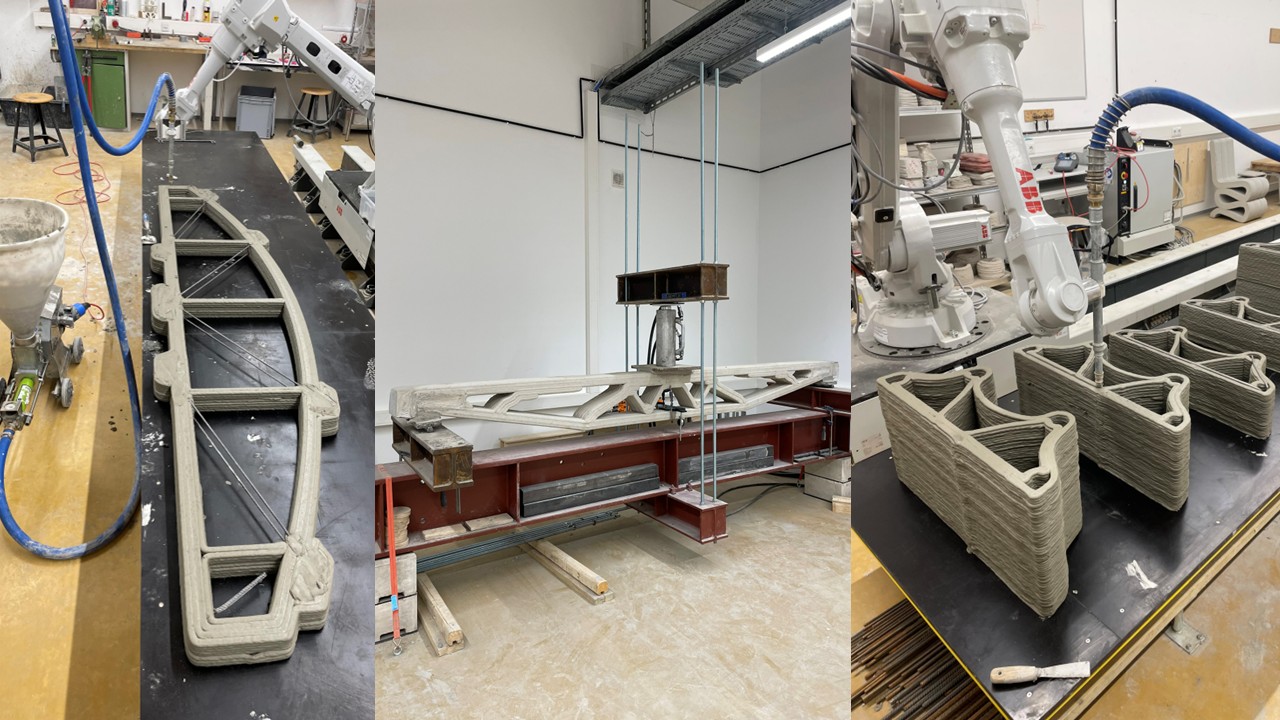
For the construction industry, additive manufacturing technologies can bring significant ecological and economic benefits to building and civil engineering and open up entirely new possibilities. Possible applications include, for example, the production of optimized structural concrete components. “C3PO – Concrete ! 3D Printed Objects” conducts application-oriented research into 3D printing of concrete objects and components with the aim of expanding their range of applications in the construction industry.
Researchers are focusing on targeted, efficient material application that leads to reduced use of concrete. This should help conserve primary resources and reduce the ecological footprint of concrete components. The optimization of cross-sectional topologies also leads to a significant reduction in the weight of concrete structures, which should allow the use of slimmer load-bearing elements in construction projects, e.g. for custom structures.
The project will develop and build an additive manufacturing facility for concrete and mortar mixes with and without fiber reinforcement. Optimized cross-sections are to be produced with high precision, even for small component dimensions. Further steps under consideration include the integration of sensor technology for the further development of components and Predictive Maintenance.
Students of the bachelor's and master's degree programs in civil engineering – construction management are also involved in the material development and design of the manufacturing facility as part of their final theses.
Senior Researcher
Senior Lecturer
Senior Lecturer
Research and Project Assistance
Researcher
Researcher
Coordination and Consulting
Head of Programs Technical Building Equipment; Head of Research Center for Building and Design