
Digitalization Through Printed Electronics

This page contains automated translations.

Project Duration: 1.1.2020 to 30.6.2024

Printed electronics offer a number of advantages over conventional electronics. In contrast to the rigid and stiff electrical components and printed circuit boards of conventional electronics, printed electronic components can be printed or realised on any flexible substrates. This enables the fast and cost-effective production of flexible and bendable circuits as well as electronic components such as sensors and antennas with significantly lower layer thicknesses (in the range of a few micrometres). This flexibility also opens up new possibilities for the integration of printed electronics into curved, bent or flexible surfaces, such as in portable electronic devices. The production of electrical components using printing technologies and photonic sintering processes does not require any etching or photolithography process steps. Printed electronics thus facilitate rapid prototyping and researchers can quickly realise new ideas and produce prototypes. The printing and optical sintering technologies can already be used in a "roll-to-roll manufacturing process" and thus also open up fast and cost-effective mass production of sensors, antennas and circuits.

Research Goals

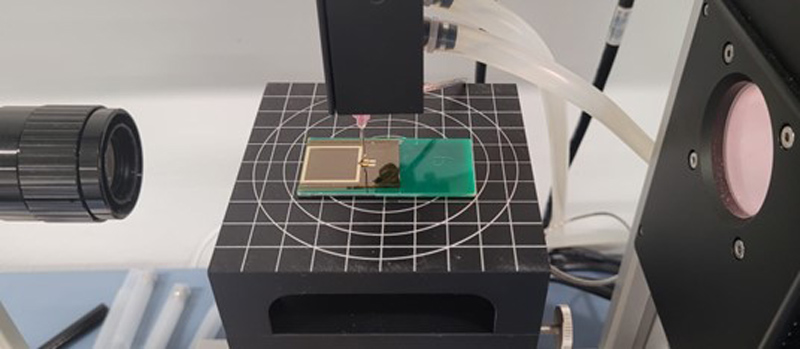
The MA23-funded research project "Digitalisation through printed electronics" is attempting to take advantage of these benefits and produce electrical components at FH Campus Wien using printing and sintering technologies. The project essentially pursues the following three project goals.

  • The first objective of the project is to set up and expand the existing research laboratory at FH Campus Wien. As part of the project, it is planned to equip the laboratory with state-of-the-art technical infrastructure in order to manufacture electrical components such as sensors, antennas and electrical circuits. In addition to suitable material printers (for inks and pastes), this also requires the necessary technical infrastructure to be able to sinter the components thermally and photonically. In addition, the project will acquire measuring instruments to be able to measure the printed components. In particular, the layer thickness, the roughness parameters, the edge steepness, the surface and volume resistance as well as the surface topographies (using AFM measurements) of the printed electrical components must be determined or measured. The contact angles and contact areas (which include the printed inks and materials with the substrate surface) must also be measured using the acquired laboratory infrastructure. As part of the project, the research laboratory at FH Campus Wien will also serve as a "knowledge hub" for application-oriented research in the field of printed electronics and will be used intensively by the employees. In addition to highly qualified specialists, researchers and project staff, students will also have the opportunity to use the research laboratory.
  • The second goal of the project is to establish and conduct research in the field of printed electronics. Printed electronics offers enormous opportunities for the development of flexible, cost-effective and customisable electronic systems. In particular, the project focuses on the realisation of printed sensors, antennas and compact electrical circuits. In addition, the "photonic sintering process" is to be intensively investigated. The optimum settings (with regard to the photonic sintering process) are to be determined for various nanoparticle-based inks, such as Au, Ag and Cu inks. This includes, for example, determining the energy input which is transferred and absorbed in the printed structures and leads to a fusion of the nanoparticles and to the formation of a sintering network. This can be analysed using an atomic force microscope, which is also being purchased as part of the project. The pulse durations of the generated light pulses emitted by the Xe flash lamp (which only last a few milliseconds) must also be taken into account and analysed during the sintering process.
  • Simulations and measurements of electromagnetic waves in the microwave range, which for example propagate in the microstrip lines printed with Cu inks and photonically sintered, and can couple or cross-talk in resonators, are also being considered. It is also planned to realise a functional biosensor based on printed split-ring resonators. As part of the project, the necessary biofunctionalisation of the sensor surfaces will be carried out by colleagues from the specialist area of bioengineering. In addition, encrypted and wireless data transmission of the sensor data will be realised by experts from the IT Security specialist area. Students will be involved in these activities in the form of theses. It is also planned to publish the research results in the form of scientific publications in specialist journals and to present the results at specialist conferences.
  • The third objective of the research project is to train students in the field of printed electronics using the latest technical infrastructure in order to provide qualified labour for industry in the future. By setting up the research laboratory at FH Campus Wien, we are creating a first-class learning and research environment for students. They will have access to modern printing and manufacturing technologies and the opportunity to gain practical experience in the development and production of printed electronics. Our highly qualified project staff will support them in expanding their knowledge and skills in this field. Students will be involved in the MA23-funded project "Digitisation through Printed Electronics", particularly in the form of theses and internships.

Funding Partners

Project Team

FH-Prof. DI Christian Halter

Deputy Head of Degree Programs Applied Electronics and Technical Informatics, Clinical Engineering; Chairperson of Works Council