Academic Expert Program

Sonography

part-time


Sonography

Technological leaps forward, innovative technologies, scarcer resources in the health care industry, the increasing work in interdisciplinary teams and the ongoing academization of health professions are changing the occupational field. The academic expert program offers specialization and a technical update in the field of sonography and has been recognized as advanced education in accordance with: Berufsgesetz (MTD-Gesetz) §31 i.d.g.F. You work with high-end devices and innovative technologies on the increasingly targeted imaging diagnostics and thus shape your professional profile. Your professional profile is sharpened with cross-sectional competencies in interprofessional collaboration when assessing examination results.

Continuing Higher Education Programmes according to § 9 FHG

Department
Health Sciences
Topics
Quality of life
Technologies

Highlights

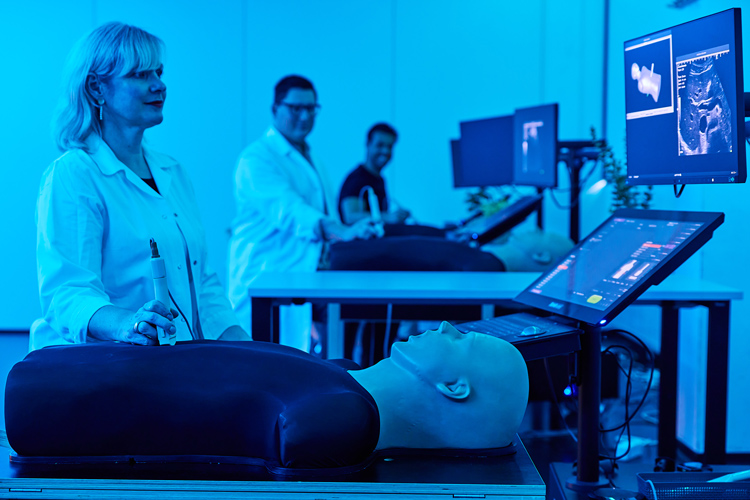
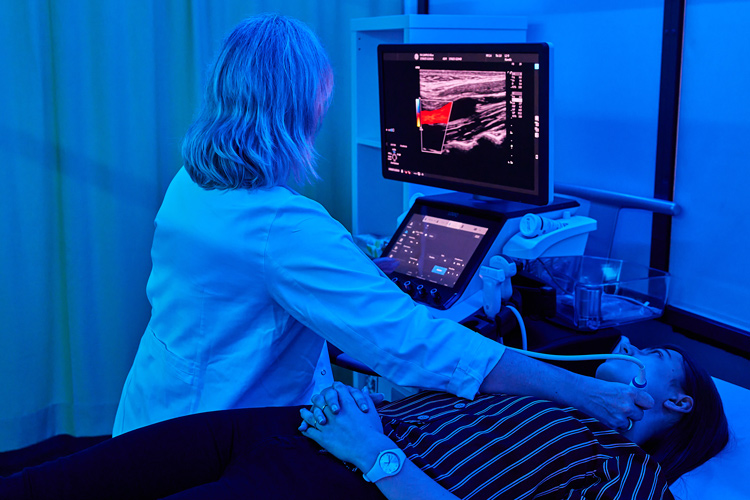
  • Hands-on training in a modern ultrasound skills lab

  • Seamless progression to the MSc (CE) in Health Studies

  • Active participation in shaping and advancing the professional field

  • Interprofessional collaboration with physicians in interpreting findings

  • A flexible program format with national and international experts in sonography as lecturers


    Facts

    Final degree

    Academic Expert in Sonography

    Duration of course
    2 semesters
    Organisational form
    part-time

    Tuition fee

    once payment € 7.350,-1

    + ÖH contribution + costs for optional additional services, if applicable2

    ECTS
    60 ECTS
    Language of instruction
    German, partially English

    Application winter semester 2026/27

    01. October 2025 - 15. June 2026

    Study places

    20

    1 Exclusive €  7.080,- for graduates of Unviserity of Applied Sciences Campus Vienna. 
    2 The costs depend on the additional services selected from the University of Applied Sciences Campus Vienna, such as work clothing, licenses, tutorials, or excursions.
    * Subject to approval by the relevant bodies or AQ Austria.

    Before the studies

    You are a radiographer or medical doctor and want to continue your academic education. Specializing in sonography is your next professional goal. You are fascinated by the idea of using the physical effects of sonography in such a way that the sectional image information can make a valuable contribution to the diagnosis or the exclusion of diseases. As a future expert, you would like to gain insight into the diverse world of sonography and learn about the various application areas that the variety of different uses make possible. These include examinations of various anatomical regions such as the abdomen, neck, vascular diagnostics, clarification of echocardiological issues, prenatal diagnostics as well as muscle and nerve sonography with real-time representation of movement sequences. You like to communicate with patients and take care of their needs. As part of the interdisciplinary team, you work at the interface between patient and experts from different disciplines. Your motivation for choosing the course is the prospect of making a valuable contribution in the health sector with this high-quality specialization.

    Why you should study with us

    Practical training on campus

    Thanks to the state-of-the-art infrastructure, you will gain valuable practical experience during your classes.

    Let's go international!

    A practical learning phase abroad offers the opportunity to broaden your horizons and gain new impressions.

    Active exchange

    Numerous disciplines at one location: participate in research projects and learn from others.

    Relevant admission requirement

    For admission you need

    • a completed relevant bachelor's degree or
    • an equivalent degree at a recognized domestic or foreign post-secondary educational institution

    and professional authorization in one of the following healthcare professions, including entry in the corresponding list (including general higher education entrance qualification and proof of special achievements/further trainings/special training after individual examination and, if applicable, imposition of conditions):

    • doctors of medicine
    • radiographers

    Language requirements for admission

    The required language level according to the Common European Framework of Reference for Languages (CEFR) is at least

    • German - level B2.

    Legalization of foreign documents

    Applicants may require legalization of documents from countries other than Austria in order for them to have the evidential value of domestic public documents. Information on the required legalizations can be found here in PDF format.

    Translation of your documents

    For documents that are neither in German nor English, a translation by a sworn and court-certified interpreter is required. Your original documents should have all the necessary legalization stamps before translation so that the stamps are also translated. The translation must be firmly attached to the original document or a legalized copy.

    Online application - uploading documents

    As part of your online application, upload scans of your original documents including all required legalization stamps. For documents not issued in German or English, scans of the corresponding translations must also be uploaded. The head of the study program decides on the equivalence of international (higher) education qualifications. Therefore, your documents can only be checked as part of the ongoing application process.

    Your path to studying at Hochschule Campus Wien (HCW) begins with your registration on our application platform. In your online account, you can start your application directly or activate a reminder if the application phase has not yet started.

    Documents for your online application

    1. Proof of identity
      • passport or
      • identity card or
      • Austrian driving license (proof of citizenship required) or
      • residence permit (proof of citizenship required)
    2. Proof of change of name, if applicable (e.g. marriage certificate)
    3. Proof of fulfillment of the relevant admission requirement
      • diploma / bachelor certificate or
      • equivalent foreign certificate
    4. Proof of German level B2 according to the Common European Framework of Reference for Languages (CEFR). The following apply as proof:
      • secondary school leaving certificate from a German-language school
      • completion of at least three years of studies in German
      • supplementary examination pre-study course - German B2
      • German certificate (not older than 3 years), e.g.:
        • Austrian German Language Diploma: ÖSD Certificate B2
        • Goethe Institute: Goethe Certificate B2
        • telc: German B2
        • German language test for university admission for foreign applicants: DSH-2
        • German Language Diploma of the Standing Conference of the Ministers of Education and Cultural Affairs of the Länder in the Federal Republic of Germany: DSD II
        • Test of German as a foreign language (Test DaF): Level TDN 4 in all parts
        • Language Center of the University of Vienna: Course and successfully passed exam at level B2
        • Proof of a higher language level is also valid.
    5. Curriculum vitae in tabular form in German
    6. Letter of motivation in German
    7. Proof of registration in the register for professionals, if available
    8. Letter on the coverage of costs from nursing management
    9. Legalizations and translations, if applicable (see tab “Foreign documents and degrees”)

    Your application is valid once you have completely uploaded the required documents. If you do not have all the documents at the time of your online application, please submit them to the secretary's office by email as soon as you receive them. Submitting your complete online application is considered as permission to take the written test.

    After completing your online application, you will receive an email confirmation with information on the next steps.

    The admission procedure includes a personal interview with the course director (approximately 30 minutes). The admission procedure takes place annually in May and June. You will receive an appointment for a personal interview after consultation with the administration office. We can only provide alternative individual dates for the admission procedure by email.

    The admission procedure consists of an admission interview, in which we would like to learn more about your motives, skills and knowledge. Professional experience in the field of sonography is desirable, but not a requirement. The course director will decide this individually and the admission requirements must be fulfilled. The entire admission procedure is clearly documented and archived.

    Learn about the course content and structure of the program; questions regarding prerequisites and the application process will also be answered.

    Dates

    • Thursday, April 23, 2026, 6:00 p.m.
    • Wednesday, May 20, 2026, 6:00 p.m.
    • Friday, June 12, 2026, 5:00 p.m.
    • Tuesday, June 30, 2026, 5:00 p.m.

    To participate, join via the Zoom Link; the same link applies to all sessions. (Link: https://hcw-ac-at.zoom.us/j/99069263976)

    The cost of the academic university course is € 7.350.

    For graduates of Unviserity of Applied Sciences Campus Vienna the course fee is € 7.080.

    In addition to the tuition fee, you will also have to pay the ÖH student union fee each semester.

    Can I afford the degree program?

    Financial aid is available for academic courses, master courses and for courses and seminars.

    You can find information about funding agencies under grants and scholarships.

    Do you still have questions about the course?

    Schedule an appointment with our administration office sonography@hcw.ac.at and you will receive a personal consultation appointment with the head of the academic course via Zoom.


    During the studies

    At Hochschule Campus Wien, we use the knowledge of our wide range of degree programs and create innovative courses at the interfaces of the disciplines. We draw upon the professional expertise of full-time lecturers and external specialists from various disciplines in Austria and abroad and provide you with the opportunity to implement the theory you have learned on high-end devices in our skills lab. Your learning process is supported and accompanied by experienced tutors. The sonographic know-how of Hochschule Campus Wien is already in demand internationally. Interdisciplinary projects are part of our research strategy.

    You can use the scientifically proven knowledge and skills you have gained from the course in your responsible role for the benefit of the patient. As a recognized further education, successfully completing the academic expert program for sonography you graduate with the academic title Academic Expert in Sonography.

    The training and further education programs currently on the market lag far behind the actual need for experts of sonography. At Hochschule Campus Wien, we took this as an opportunity to dedicate our technical expertise to developing an academic expert program together with researchers, teachers and practitioners from the intra- and extramural field of sonography. This collaboration provided valuable input in order to develop a curriculum that meets current requirements.

    International trends and visions in healthcare are current topics in the course. You provide impulses for future developments and areas of work and can complete the clinical routine as part of the course both at home and abroad.

    Work-life balance is important to us, which is why the course is organized in modules. Unlike individual advanced professional training courses, in the program at Hochschule Campus Wien you will benefit from a comprehensive further education with an internationally accredited academic qualification. Furthermore, you will strengthen your expertise in your professional field. As part of the course, you can gain an additional competitive advantage by specializing in the field of sonography.

    The interdisciplinary curriculum offers you the opportunity to deepen and strengthen your expertise in sonography with well-known national and international experts.

    You will perfect your English as an international technical language during the course, which is held in English, and an optional stay abroad as part of practice-related courses.

    You will receive a technical update in the field of sonography and can expand your professional expertise in different medical disciplines according to the current requirements in the professional field. The course thus offers you the opportunity to deepen your knowledge acquired in basic training and to expand it with current examination procedures and innovative technologies. The high amount of hands-on training under the guidance of experienced tutors lets you put the knowledge you have acquired into practice immediately.

    Technical quality management in sonography is becoming increasingly important. In the course, you will receive comprehensive knowledge in quality management in order to be able to professionally work on future agendas of technical quality assurance at the sonographic workplace.

    Another focus of the course is interprofessional collaboration with medical staff when assessing examination results.
    Insights into the study

    <
    >
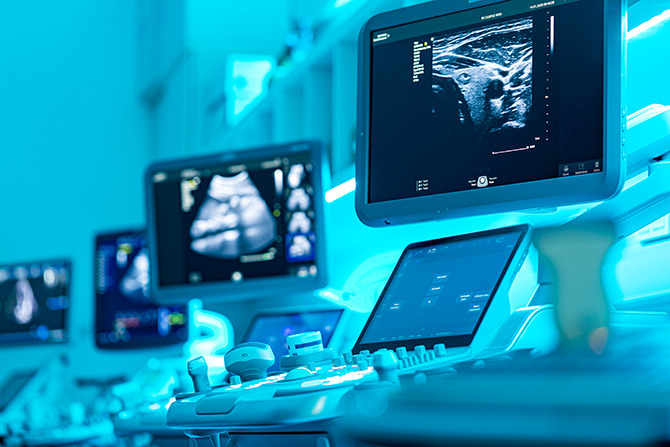
    A blue illuminated room with monitors on which ultrasound images can be seen.

    Latest Technology in the Skills Lab

    In addition to two new Siemens Juniper ultrasound machines, the skills lab also has a GE Vivid S7 ultrasound machine that is specialized for cardiac and vascular diagnostics.

    The skills lab also has a GE Logic9 and a Philips CX30 series ultrasound machine at it’s disposal.

    The devices are user friendly and produce high quality images. With the new EchoPac software, it is possible to edit the resulting images on the PC.

    Curriculum*

    Module Review courses in anatomy, physiology, pathology and sonomorphology

    Review courses in anatomy, physiology, pathology and sonomorphology

    2 SWS   5 ECTS

    Examination

    : The final module examination consists of theoretical and practical elements.

    2 SWS
    5 ECTS
    Start your studies | SE

    Start your studies | SE

    1 SWS   1 ECTS

    Content

    • Introduction to the degree program and the learning environment
    • Overview of the curriculum and study program
    • ECTS system and workload planning
    • Milestone planning and semester structure
    • Risk management and buffer times in the curriculum
    • Team building and communication rules in the year group
    • Setting up learning networks and collaboration platforms
    • Portfolio work to document subject specialization

    Teaching method

    • Interactive introductory session
    • Group work / team building
    • Peer learning
    • Workshop on study planning
    • Portfolio work
    • Reflection sessions
    • Blended learning (optional for materials)

    Examination

    Continuous assessment

    Literature

    Die Fachliteratur wird in Abstimmung mit der jeweiligen Lehrperson ergänzt.

    Teaching language

    Deutsch

    1 SWS
    1 ECTS
    anatomy | VO

    anatomy | VO

    0 SWS   1 ECTS

    Content

    • Organization and structure of the human organism
    • Repetition of basic anatomical knowledge
    • Structure-function relationships and their interpretation
    • Anatomical variants vs. standard findings
    • Networking of anatomical knowledge with medical-therapeutic specialties
    • Clinical relevance of anatomical structures

    Teaching method

    • Blended learning (digital modules, self-study)
    • Interactive learning platforms
    • Case-based exercises (structure-function relationships)
    • Peer learning / group work

    Examination

    Final exam

    Literature

    • Aumüller, G., et al.: Anatomie, Duale Reihe, 2. Auflage (Thieme, Stuttgart, 2010)
    • Platzer, W., et al.: Taschenatlas Anatomie  12. Auflage (Thieme, Stuttgart, 2018)

    Teaching language

    Deutsch

    1 ECTS
    Physiologie  | VO

    Physiologie  | VO

    0 SWS   1 ECTS

    Content

    • Repetition of the physiological basics
    • Structure-function relationships and their interpretation
    • Physiological processes and circuits of action
    • Norm variants and their significance
    • Networking of anatomical knowledge with medical-therapeutic specialties
    • Clinical/sonographic relevance of physiological processes and circuits of action

    Teaching method

    Blended learning (digital content, self-study)

    Interactive learning platform

    peer learning/group work

    Examination

    Module exam

    Literature

    • GOLENHOFEN K.: Basislehrbuch Physiologie, Kompendium, Fragen und Antworten, Urban&Fischer bei Elsevier i.d.akt.Aufl.
    • VAUPEL P., SCHAIBLE H.-G., MUTSCHLER E.: Anatomie, Physiologie, Pathophysiologie des Menschen, Wissenschaftliche Verlagsgesellschaft Stuttgard, i.d.akt.Aufl.
    • SILBERNAGL S., et al.: Physiologie, Thieme Stuttgart, i.d.akt.Aufl.
    • SILBERNAGL S., DESPOPOLOULOS A.: Taschenatlas Physiologie, Thieme Stuttgart, i.d.akt.Aufl.
    • Sonographie-Atlas online Ressource: sonographiebilder.de/sonographie-atlas

    Teaching language

    Deutsch

    1 ECTS
    Sonomorphology | VO

    Sonomorphology | VO

    0.5 SWS   1 ECTS

    Content


    • Repetition of basic sonomorphological knowledge
    • Structure-function relationships and their interpretation
    • Anatomical variants vs. standard findings
    • Networking of anatomical knowledge with medical-therapeutic specialties
    • Clinical/sonographic relevance of anatomical structures

    Teaching method

    Blended learning (digital content, self-study)

    Interactive learning platform

    Peer learning/group work

    Examination

    Module exam

    Literature

    • Waschke J. Hrsg.; Jensen P. Hrsg.: Sobotta - Atlas der Anatomie - alle Bände; Urban & Fischer-Verlag i.d.akt.Aufl.
    • Aumüller, G., et al.: Anatomie, Duale Reihe, i.d.akt.Auflaga
    • Platzer, W., et al.: Taschenatlas Anatomie,  i.d.akt.Auflaga 
    • Bloch, B.: Der Sono-Trainer; Thieme, i.d.akt.Auflage
    • Hofer, M. (Hrsg.): Sono Grundkurs, , Thieme, i.d.akt.Auflage
    • HOFER, M. (Hrsg.): FKDS-Trainer, DIDAMED Verlag GmbH, i.d.akt.Auflage
    • Gross, M. (Hrsg.): Sonographie, Schritt für Schritt zur Diagnose, Elsevier GmbH, Urban & Fischer Verlag, i.d.akt.Auflage
    • Schmid, G. et al.: Kursbuch Ultraschall: Nach den Richtlinien der DEGUM und der KBV; Thieme, Stuttgart, i.d.akt.Auflage
    • Dietrich, C.F.: Ultraschall-Kurs: Organbezogene Darstellung von Grund-, Aufbau- und Abschlusskurs. Nach den Richtlinien von KBV, DEGUM, ÖGUM und SGUM; Deutscher Arzte- Verlag: i.d.akt.Auflage
    • Amann-Vesti, B.; Thalhammer, C.; Huck, K. (Hrsg): Kursbuch Doppler – und Duplexsonographie, Thieme, Stuttgart, i.d.akt.Auflage
    • Ultraschall in der Medizin - European Journal of Ultrasound
    • VAUPEL P., SCHAIBLE H.-G., MUTSCHLER E.: Anatomie, Physiologie, Pathophysiologie des Menschen, Wissenschaftliche Verlagsgesellschaft Stuttgard, i.d.akt.Aufl.
    • Sonographie-Atlas online Ressource: sonographiebilder.de/sonographie-atlas

    Teaching language

    Deutsch

    0.5 SWS
    1 ECTS
    Sonopathology | VO

    Sonopathology | VO

    0.5 SWS   1 ECTS

    Content

    • Causes of disease and underlying mechanisms (etiology, pathogenesis)
    • Analysis of etiology-pathways
    • Sonomorphologic tissue changes of important diseases
    • Interpretation of histological and resulting typical sonographic patterns
    • Classification of pathological patterns (e.g. forms of necrosis, degrees of dysplasia)
    • Linking pathological changes with diagnostic results
    • Significance of various diseases for patients
    • Selection of diagnostic and therapeutic options from guidelines

    Teaching method

    • Lecture
    • Case discussions and interactive discussions
    • Problem-Based Learning (PBL)
    • blended learning
    • Peer learning / group work
    • Digital image analysis

    Examination

    Module exam

    Literature

    • VAUPEL P., SCHAIBLE H.-G., MUTSCHLER E.: Anatomie, Physiologie, Pathophysiologie des Menschen, Wissenschaftliche Verlagsgesellschaft Stuttgard, i.d.akt.Aufl.
    • Sonographie-Atlas online Ressource: sonographiebilder.de/sonographie-atlas
    • Böcker, W. et al: Lehrbuch Pathologie, 6. Auflage (Elsevier, München, 2019);
    • Riede, U.-K. et al: Allgemeine und spezielle Pathologie, 2. Auflage (Springer, Berlin, 2017)

    Teaching language

    Deutsch-Englisch

    0.5 SWS
    1 ECTS
    Module Medical-physical principles/AI & Technical QM & Innovations in Sonography

    Medical-physical principles/AI & Technical QM & Innovations in Sonography

    2 SWS   5 ECTS

    Examination

    : The final module examination consists of theoretical and practical elements.

    2 SWS
    5 ECTS
    Medical-physical principles/AI & Technical QM | VO

    Medical-physical principles/AI & Technical QM | VO

    1 SWS   3 ECTS

    Content

    • Based on the knowledge of the Bachelor's degree program in Radiology Technology/Study of Human Medicine, in-depth study of the physical state-of-the-art fundamentals of medical ultrasound diagnostics and the interaction with human tissue
    • Correct handling of transducers, basic transducer technology, new developments
    • Patient safety, safe handling of contrast media for contrast-enhanced ultrasound (CEUS),
    • State-of-the-art examination techniques and equipment
    • Technical quality management

    Teaching method

    Presenting and activating form (VO 40%, UE 60%)

    Presenter: Lecture, demonstration, video, simulation

    Activating: methods of development, guided exercises, problem-based learning, guided self-study (peer-to-peer), group work

    Blended learning: integration of face-to-face and online learning

    Examination

    Module exam

    Literature

    • Bloch, B.: Der Sono-Trainer; Thieme, i.d.akt.Auflage - Hofer, M. (Hrsg.): Sono Grundkurs, , Thieme, i.d.akt.Auflage
    • HOFER, M. (Hrsg.): FKDS-Trainer, DIDAMED Verlag GmbH, i.d.akt.Auflage - Gross, M. (Hrsg.): Sonographie, Schritt für Schritt zur Diagnose, Elsevier GmbH, Urban & Fischer Verlag, i.d.akt.Auflage
    • Schmid, G. et al.: Kursbuch Ultraschall: Nach den Richtlinien der DEGUM und der KBV; Thieme, Stuttgart, i.d.akt.Auflage
    • Dietrich, C.F.: Ultraschall-Kurs: Organbezogene Darstellung von Grund-, Aufbau- und Abschlusskurs. Nach den Richtlinien von KBV, DEGUM, ÖGUM und SGUM; Deutscher Arzte- Verlag: i.d.akt.Auflage
    • Amann-Vesti, B.; Thalhammer, C.; Huck, K. (Hrsg): Kursbuch Doppler – und Duplexsonographie, Thieme, Stuttgart, i.d.akt.Auflage
    • Flachskampf A.F.: Kursbuch Echokardiografie, Thieme Stuttgart, i.d.akt.Auflage
    • Wilkenshoff U., Kruck I.: Handbuch der Echokardiografie, Thieme, Stuttgart, i.d.akt.Auflage
    • Ultraschall in der Medizin - European Journal of Ultrasound

    Teaching language

    Deutsch

    1 SWS
    3 ECTS
    State-of-the-Art und Innovationen in Sonography - Excursion | UE

    State-of-the-Art und Innovationen in Sonography - Excursion | UE

    1 SWS   2 ECTS

    Content

    State-of-the-art examination techniques and equipment

    Innovative examination techniques and equipment/features of ultrasound devices

    Differences are identified

    Apply innovative techniques, reflect critically

    Apply AI techniques, reflect critically

    Use of new technical developments in the skills lab/excursion hands-on

    Teaching method

    Excursion

    State-of-the-art and innovations in sonography at the General Electrics Healthcare plant - Zipf ultrasound site

    In addition to an ultrasound museum, students gain an insight into the development and production of an ultrasound device and can assess the latest developments of devices on the market in a hands-on setting using tasks set by the lecturer responsible for the module. This includes, in particular, the use of AI techniques and automated functions in the respective systems.

    Examination

    Module exam

    Literature

    - Bloch, B.: Der Sono-Trainer; Thieme, i.d.akt.Auflage
    - Hofer, M. (Hrsg.): Sono Grundkurs, , Thieme, i.d.akt.Auflage
    - Hofer, M. (Hrsg.): FKDS-Trainer, DIDAMED Verlag GmbH, i.d.akt.Auflage
    - Gross, M. (Hrsg.): Sonographie, Schritt für Schritt zur Diagnose, Elsevier GmbH, Urban & Fischer Verlag, i.d.akt.Auflage
    - Schmid, G. et al.: Kursbuch Ultraschall: Nach den Richtlinien der DEGUM und der KBV; Thieme, Stuttgart, i.d.akt.Auflage - Dietrich, C.F.: Ultraschall-Kurs: Organbezogene Darstellung von Grund-, Aufbau- und Abschlusskurs. Nach den Richtlinien von KBV, DEGUM, ÖGUM und SGUM; Deutscher Arzte- Verlag: i.d.akt.Auflage
    - Amann-Vesti, B.; Thalhammer, C.; Huck, K. (Hrsg): Kursbuch Doppler – und Duplexsonographie, Thieme, Stuttgart, i.d.akt.Auflage
    - Flachskampf A.F.: Kursbuch Echokardiografie, Thieme Stuttgart, i.d.akt.Auflage
    - Wilkenshoff U., Kruck I.: Handbuch der Echokardiografie, Thieme, Stuttgart, i.d.akt.Auflage
    - Hoskins P., Martin K., Thrush A.; Diagnostic Ultrasound – Physics and Equipment, Cambridge University Press, i.d.akt.Auflage

    Teaching language

    Deutsch

    1 SWS
    2 ECTS
    Module Module Neck organs, thyroid gland and carotid arteries

    Module Neck organs, thyroid gland and carotid arteries

    4 SWS   10 ECTS

    Examination

    : The module examination in the modules on the organ areas consists of


    a) 30 performed sonographic examinations (case studies) from the respective organ areas

    b) On the basis of a case study: processing of a sonographic question with subsequent technical discussion and analysis

    4 SWS
    10 ECTS
    Carotids | ILV

    Carotids | ILV

    2 SWS   5 ECTS

    Content

    • Practical exercises for carrying out hemodynamic (Doppler) examinations of the carotid/vertebral vessels in accordance with national and international guidelines and standards
    • Effects and interpretation of image artifacts
    • Physiology/pathology in the hemodynamic (Doppler) examination, including knowledge of etiology, incidence, laboratory tests, sonographic appearance and differential diagnosis
    • Analysis of the ultrasound examination (images) including Doppler techniques/specialist discussion
    • Preparation of radiological findings/wording/specialist terminology
    • Systematic analysis for reporting in the interprofessional team

    Teaching method

    Presenting and activating form (VO 40%, UE 60%)

    Presenter: Lecture, demonstration, video, simulation

    Activating: methods of development, guided exercises, problem-based learning, guided self-study (peer-to-peer), group work

    Blended learning: integration of face-to-face and online learning

    Examination

    Module exam

    Literature

    • Bloch, B.: Der Sono-Trainer; Thieme, i.d.akt.Auflage
    • Hofer, M. (Hrsg.): Sono Grundkurs, , Thieme, i.d.akt.Auflage
    • Hofer, M. (Hrsg.): FKDS-Trainer, DIDAMED Verlag GmbH, i.d.akt.Auflage
    • Gross, M. (Hrsg.): Sonographie, Schritt für Schritt zur Diagnose, Elsevier GmbH, Urban & Fischer Verlag, i.d.akt.Auflage
    • Schmid, G. et al.: Kursbuch Ultraschall: Nach den Richtlinien der DEGUM und der KBV; Thieme, Stuttgart, i.d.akt.Auflage
    • Dietrich, C.F.: Ultraschall-Kurs: Organbezogene Darstellung von Grund-, Aufbau- und Abschlusskurs. Nach den Richtlinien von KBV, DEGUM, ÖGUM und SGUM; Deutscher Arzte- Verlag: i.d.akt.Auflage
    • Amann-Vesti, B.; Thalhammer, C.; Huck, K. (Hrsg): Kursbuch Doppler – und Duplexsonographie, Thieme, Stuttgart, i.d.akt.Auflage
    • Ultraschall in der Medizin - European Journal of Ultrasound


    Teaching language

    Deutsch

    2 SWS
    5 ECTS
    Neck organs & thyroid gland | ILV

    Neck organs & thyroid gland | ILV

    2 SWS   5 ECTS

    Content

    • Practical exercises for performing (Doppler) examinations of the entire neck organ/organ region in accordance with national and international guidelines and standards
    • Effects and interpretation of image artifacts
    • Physiology/pathology in the (Doppler) examination, including knowledge of aetiology, incidence, laboratory tests, sonographic appearance and differential diagnosis
    • Analysis of the ultrasound examination (images) including Doppler techniques/specialist discussion
    • Preparation of radiological findings/wording/specialist terminology
    • Systematic analysis for reporting in the interprofessional team

    Teaching method

    Presenting and activating form (VO 40%, UE 60%)

    Presenter: Lecture, demonstration, video, simulation

    Activating: methods of development, guided exercises, problem-based learning, guided self-study (peer-to-peer), group work

    Blended learning: integration of face-to-face and online learning

    Examination

    Module exam

    Literature

    • Bloch, B.: Der Sono-Trainer; Thieme, i.d.akt.Auflage
    • Hofer, M. (Hrsg.): Sono Grundkurs, , Thieme, i.d.akt.Auflage
    • Hofer, M. (Hrsg.): FKDS-Trainer, DIDAMED Verlag GmbH, i.d.akt.Auflage
    • Gross, M. (Hrsg.): Sonographie, Schritt für Schritt zur Diagnose, Elsevier GmbH, Urban & Fischer Verlag, i.d.akt.Auflage
    • Schmid, G. et al.: Kursbuch Ultraschall: Nach den Richtlinien der DEGUM und der KBV; Thieme, Stuttgart, i.d.akt.Auflage
    • Dietrich, C.F.: Ultraschall-Kurs: Organbezogene Darstellung von Grund-, Aufbau- und Abschlusskurs. Nach den Richtlinien von KBV, DEGUM, ÖGUM und SGUM; Deutscher Arzte- Verlag: i.d.akt.Auflage
    • Amann-Vesti, B.; Thalhammer, C.; Huck, K. (Hrsg): Kursbuch Doppler – und Duplexsonographie, Thieme, Stuttgart, i.d.akt.Auflage
    • Ultraschall in der Medizin - European Journal of Ultrasound


    Teaching language

    Deutsch

    2 SWS
    5 ECTS
    Module Abdominal module ultrasound and emergeny

    Abdominal module ultrasound and emergeny

    2 SWS   5 ECTS

    Examination

    : The module examination in the modules on the organ areas consists of


    a) 30 performed sonographic examinations (case studies) from the respective organ areas

    b) On the basis of a case study: processing of a sonographic question with subsequent technical discussion and analysis

    2 SWS
    5 ECTS
    Abdominal and emergency ultrasound | ILV

    Abdominal and emergency ultrasound | ILV

    2 SWS   5 ECTS

    Content

    • Practical exercises for carrying out hemodynamic (Doppler) examinations of the entire abdomen/abdominal organ systems in accordance with international guidelines and standards
    • Effects and interpretation of image artifacts
    • Physiology/pathology in the (Doppler) examination, including knowledge of aetiology, incidence, laboratory tests, sonographic appearance and differential diagnosis
    • Analysis of the ultrasound examination (images) including Doppler techniques/specialist discussion
    • Preparation of radiological findings/wording/specialist terminology
    • Systematic analysis for reporting in the interprofessional team

    Teaching method

    • Presenting and activating form (VO 40%, UE 60%)
    • Presenter: Lecture, demonstration, video, simulation
    • Activating: methods of development, guided exercises, problem-based learning, guided self-study (peer-to-peer), group work
    • Blended learning: integration of face-to-face and online learning

    Examination

    Module exam

    Literature

    • Bloch, B.: Der Sono-Trainer; Thieme, i.d.akt.Auflage
    • Hofer, M. (Hrsg.): Sono Grundkurs, , Thieme, i.d.akt.Auflage
    • Hofer, M. (Hrsg.): FKDS-Trainer, DIDAMED Verlag GmbH, i.d.akt.Auflage
    • Gross, M. (Hrsg.): Sonographie, Schritt für Schritt zur Diagnose, Elsevier GmbH, Urban & Fischer Verlag, i.d.akt.Auflage
    • Schmid, G. et al.: Kursbuch Ultraschall: Nach den Richtlinien der DEGUM und der KBV; Thieme, Stuttgart, i.d.akt.Auflage
    • Dietrich, C.F.: Ultraschall-Kurs: Organbezogene Darstellung von Grund-, Aufbau- und Abschlusskurs. Nach den Richtlinien von KBV, DEGUM, ÖGUM und SGUM; Deutscher Arzte- Verlag: i.d.akt.Auflage
    • Amann-Vesti, B.; Thalhammer, C.; Huck, K. (Hrsg): Kursbuch Doppler – und Duplexsonographie, Thieme, Stuttgart, i.d.akt.Auflage
    • Ultraschall in der Medizin - European Journal of Ultrasound


    Teaching language

    Deutsch

    2 SWS
    5 ECTS
    Module Evidence-based patient management & quality management in sonography

    Evidence-based patient management & quality management in sonography

    2 SWS   5 ECTS

    Examination

    : The final module examination consists of theoretical and practical elements.

    2 SWS
    5 ECTS
    Evidence-based patient management & quality management in sonography | ILV

    Evidence-based patient management & quality management in sonography | ILV

    2 SWS   5 ECTS

    Content

    • Analyzing case histories and planning case/care management with handovers, documentation, audit trails
    • Applying quality indicators
    • Checking legal and ethical requirements, risk assessment with ALARA
    • Comparing international benchmarks and creating a recommendation for standardizing a team process
    • Demonstrate ergonomic working and reflect on stress/prevention in the team

    Teaching method

    • Activating: elaborative methods, guided exercises, problem-based learning, guided self-study (peer-to-peer), group work
    • Blended learning: integration of face-to-face and online learning

    Examination

    Module exam

    Literature

    • Borgetto, B., Tomlin, G.S., Max, S., Brinkmann, M., Spitzer, L., Pfingsten, A. (2022). Evidenz in der Gesundheitsversorgung: Theorie, Methoden und praktische Umsetzung. In: Haring, R. (eds) Gesundheitswissenschaften. Springer Reference Pflege – Therapie – Gesundheit . Springer, Berlin, Heidelberg. doi.org/10.1007/978-3-662-54179-1_58-2
    • Evidenzbasiertes Arbeiten | Gesundheitsqualitätsportal (gv.at)SoR and BMUS Guidelines for Professional Ultrasound Practice (2025): The Society of Radiographers (SoR) have worked with the British Medical Ultrasound Society (BMUS) to update our joint Guidelines for Professional Ultrasound Practice (2025)
    • EFRS Guidelines and Statements

    • Beardmore C., et at.: Patient Advisory Group (PAG) of the European Society of Radiologie (ESR) & European Federation of Radiographers Societies (EFRS): How can effective communication help radiographers meet the expectations of patients-COMMUNICATION-a joint statement by the ESR & EFRS;

    • ÖGUM, DEGUM, SGUM

    Teaching language

    Deutsch

    2 SWS
    5 ECTS

    Module Scientific work literature research in Sonography

    Scientific work literature research in Sonography

    2 SWS   5 ECTS

    Examination

    : in-class assessment based on a learning journal

    2 SWS
    5 ECTS
    Scientific work in sonography | SE

    Scientific work in sonography | SE

    2 SWS   5 ECTS

    Content

    - Derivation and justification of scientific questions

    - Structuring research questions (e.g. PICO)

    - Systematic literature research in subject-specific databases

    - Critical selection and documentation of relevant literature

    - Reflection on the opportunities and limitations of Kl-supported research

    Teaching method

    - Problem-based learning
    - Research-based and self-directed learning
    - Guided literature research exercises
    - Moderated peer learning
    - Reflection tasks / learning journal

    Examination

    Module exam

    Literature

    ALLEA – All European Academies. (2023). Europäischer Verhaltenskodex für wissenschaftliche Integrität: Überarbeitete Fassung 2023 (Dt. Übers. Mai 2024). ALLEA. doi.org/10.26356/ECOC-German 

    European Commission (2025) Living guidelines on the responsible use of generative AI in research (second edition). research-and-innovation.ec.europa.eu/document/2b6cf7e5-36ac-41cb-aab5-0d32050143dc_en 

    BENESCH Michael/RAAB-STEINER Elisabeth (2013): Klinische Studien lesen und verstehen. Facultas WUV-UTB

    ÖAWI GWP-Richtlinien der OeAWI.- online: www.oeawi.at (Zugriff: 02.05.2026)

    RITSCHL V, WEIGL R, STAMM T, (Hrsg) (2023): Wissenschaftliches Arbeiten und Schreiben, Verstehen, Anwenden, Nutzen für die Praxis. 2nd ed. Berlin: Springer Berlin; Springer; 2023(Studium Pflege, Therapie, Gesundheit). ISBN: 978-3-662-66501-5

    KORNMEIER Martin (2012): Wissenschaftlich schreiben leicht gemacht, 5. Aufl. Haupt UTB

    WEIß Christel (Hg.): Basiswissen Medizinische Statistik. Springer; i.d.akt.Auflage

    Die Fachliteratur wird in Abstimmung mit der jeweiligen Lehrperson ergänzt.

    Teaching language

    Deutsch

    2 SWS
    5 ECTS
    Module Radiologic technology findings case collection

    Radiologic technology findings case collection

    2 SWS   5 ECTS

    Examination

    : Collection of case studies

    50 peer-reviewed sonographic case studies in each of four different organ regions

    2 SWS
    5 ECTS
    case collection | AP

    case collection | AP

    0.5 SWS   2 ECTS

    Content

    Structured collection of sonographic cases

    Analysis, documentation and reflection of case histories based on national and international guidelines (ÖGUM, DEGUM, SGUM, SoR)


    Teaching method

    • Activating: elaborative methods, guided exercises, problem-based learning, guided self-study (peer-to-peer),

    Examination

    Module exam

    Literature

    • VAUPEL P., SCHAIBLE H.-G., MUTSCHLER E.: Anatomie, Physiologie, Pathophysiologie des Menschen, Wissenschaftliche Verlagsgesellschaft Stuttgard, i.d.akt.Aufl.
    • Sonographie-Atlas online Ressource: sonographiebilder.de/sonographie-atlas
    • SoR and BMUS Guidelines for Professional Ultrasound Practice (2025): The Society of Radiographers (SoR) have worked with the British Medical Ultrasound Society (BMUS) to update our joint Guidelines for Professional Ultrasound Practice (2025)

    • EFRS Guidelines and Statements

    • ÖGUM, DEGUM, SGUM

    • Sonographie-Atlas online Ressource: sonographiebilder.de/sonographie-atlas

    Teaching language

    Deutsch

    0.5 SWS
    2 ECTS
    Radiographer advanced reporting | SE

    Radiographer advanced reporting | SE

    1.5 SWS   3 ECTS

    Content

    Legal framework conditions of the radiological findings

    Words/technical terms and their use

    Organization and structure of a radiology report

    Training: checklist, oral/dictated findings, sentence modules, etc.

    Teaching method

    Problem based learning

    Research-based and self-directed learning

    Guided research of recent literature (national/international)

    Peer-to-peer learning under moderation

    Briefing-Debriefing

    Examination

    Module exam

    Literature

    • VAUPEL P., SCHAIBLE H.-G., MUTSCHLER E.: Anatomie, Physiologie, Pathophysiologie des Menschen, Wissenschaftliche Verlagsgesellschaft Stuttgard, i.d.akt.Aufl.
    • Sonographie-Atlas online Ressource: sonographiebilder.de/sonographie-atlas
    • SoR and BMUS Guidelines for Professional Ultrasound Practice (2025): The Society of Radiographers (SoR) have worked with the British Medical Ultrasound Society (BMUS) to update our joint Guidelines for Professional Ultrasound Practice (2025)

    • EFRS Guidelines and Statements

    • ÖGUM, DEGUM, SGUM

    • Sonographie-Atlas online Ressource: sonographiebilder.de/sonographie-atlas

    Teaching language

    Deutsch

    1.5 SWS
    3 ECTS
    Module Echocardiography Ultrasound Module

    Echocardiography Ultrasound Module

    2 SWS   5 ECTS

    Examination

    : The module examination in the modules on the organ areas consists of


    a) 30 performed sonographic examinations (case studies) from the respective organ areas

    b) On the basis of a case study: processing of a sonographic question with subsequent technical discussion and analysis

    2 SWS
    5 ECTS
    Echocardiography | ILV

    Echocardiography | ILV

    2 SWS   5 ECTS

    Content

    • Practical exercises for performing echocardiographic examinations in accordance with national and international guidelines and standards
    • Effects and interpretation of image artifacts
    • Physiology/pathology in the echocardiographic examination, including knowledge of aetiology, incidence, laboratory tests, sonographic appearance and differential diagnosis
    • Analysis of the ultrasound examination (images/loops) including Doppler techniques/specialist discussion
    • Preparation of radiological findings/wording/specialist terminology
    • Systematic analysis for reporting in the interprofessional team

    Teaching method

    • Presenting and activating form (VO 40%, UE 60%)
    • Presenter: Lecture, demonstration, video, simulation
    • Activating: methods of development, guided exercises, problem-based learning, guided self-study (peer-to-peer), group work
    • Blended learning: integration of face-to-face and online learning

    Examination

    Module exam

    Literature

    • Hoskins P., Martin K., Thrush A.; Diagnostic Ultrasound - Physics and Equipment, Cambridge University Press, i.d.akt.Auflage
    • Lancellotti P., Cosyns B.; The EACVI Echo Handbook (The European Society of Cardiology Series), OUP Oxford; i.d.akt.Auflage
    • Kaddoura S.; Echo made easy, Churchhill Livingston Elsevier, i.d.akt.Auflage
    • Wilkenshoff V., Kruck I.; Handbuch der Echokardiograpie, Georg Thieme Verlag, i.d.akt.Auflage
    • Lange V.; Basics Kardiologie, Elsevier Urban und Fischer, i.d.akt.Auflage
    • thestrainbook.com

    Teaching language

    Deutsch

    2 SWS
    5 ECTS
    Module Module Gynecology and Fetal Medicine

    Module Gynecology and Fetal Medicine

    2 SWS   5 ECTS

    Examination

    : The module examination in the modules on the organ areas consists of

    a) 30 performed sonographic examinations (case studies) from the respective organ areas, including the corresponding validated checklists per sonographic examination. The "Fetal Medicine Education": The theoretical course for the certificate "The 11-13 weeks scan" must be presented. Depending on availability, 20 or a combination of both can be performed on volunteers or on a simulator. The assessment is carried out by the lecturer/tutor.

    b) On the basis of a case study: processing of a sonographic question with subsequent technical discussion and analysis

    2 SWS
    5 ECTS
    Gynecology and fetal medicine | ILV

    Gynecology and fetal medicine | ILV

    2 SWS   5 ECTS

    Content

    • Practical exercises for performing gynecological/fetal examinations in accordance with national and international guidelines and standards
    • Effects and interpretation of image artifacts
    • Physiology/pathology in the gynecological/fetal examination, including knowledge of etiology, incidence, laboratory tests, sonographic appearance and differential diagnosis
    • Analysis of the ultrasound examination (images/loops) including Doppler techniques/specialist discussion
    • Preparation of radiological findings/wording/specialist terminology
    • Systematic analysis for reporting in the interprofessional team

    Teaching method

    Presenting and activating form (VO 40%, UE 60%)

    Presenter: Lecture, demonstration, video, simulation

    Activating: methods of development, guided exercises, problem-based learning, guided self-study (peer-to-peer), group work

    Blended learning: integration of face-to-face and online learning

    Examination

    Module exam

    Literature

    • Chudleigh T., Smith A., Cumming S.; Obstetric and Gynaecological Ultrasound - How, Why and When, Elsevier, i.d.akt.Auflage
    • Merz E.; Ultrasound in Obstetrics and Gynecology, Georg Thieme Verlag,  i.d.akt.Auflage
    • Copel J., et al.; Obstetric Imaging: Fetal Diagnosis and Care, Elsevier,  i.d.akt.Auflage
    • VAUPEL P., SCHAIBLE H.-G., MUTSCHLER E.: Anatomie, Physiologie, Pathophysiologie des Menschen, Wissenschaftliche Verlagsgesellschaft Stuttgard, i.d.akt.Aufl.

    Teaching language

    Deutsch-Englisch

    2 SWS
    5 ECTS
    Module Module vaskular advanced and emergency ultrasound

    Module vaskular advanced and emergency ultrasound

    2 SWS   5 ECTS

    Examination

    : The module examination in the modules on the organ areas consists of


    a) 30 performed sonographic examinations (case studies) from the respective organ areas

    b) On the basis of a case study: processing of a sonographic question with subsequent technical discussion and analysis

    2 SWS
    5 ECTS
    Carotid arteries, upper and lower extremities, abdomen | ILV

    Carotid arteries, upper and lower extremities, abdomen | ILV

    2 SWS   5 ECTS

    Content

    • Practical exercises for performing vascular examinations in accordance with national and international guidelines and standards
    • Effects and interpretation of image artifacts
    • Physiology/pathology in the respective vascular examination region, including knowledge of aetiology, incidence, laboratory tests, sonographic appearance and differential diagnosis
    • Analysis of the ultrasound examination (images) including Doppler techniques/specialist discussion
    • Preparation of radiological findings/wording/specialist terminology
    • Systematic analysis for reporting in the interprofessional team

    Teaching method

    • Presenting and activating form (VO 40%, UE 60%)
    • Presenter: Lecture, demonstration, video, simulation
    • Activating: methods of development, guided exercises, problem-based learning, guided self-study (peer-to-peer), group work
    • Blended learning: integration of face-to-face and online learning

    Examination

    Module exam

    Literature

    • Bloch, B.: Der Sono-Trainer; Thieme, i.d.akt.Auflage
    • Hofer, M. (Hrsg.): Sono Grundkurs, , Thieme, i.d.akt.Auflage
    • Hofer, M. (Hrsg.): FKDS-Trainer, DIDAMED Verlag GmbH, i.d.akt.Auflage
    • Gross, M. (Hrsg.): Sonographie, Schritt für Schritt zur Diagnose, Elsevier GmbH, Urban & Fischer Verlag, i.d.akt.Auflage
    • - Schmid, G. et al.: Kursbuch Ultraschall: Nach den Richtlinien der DEGUM und der KBV; Thieme, Stuttgart, i.d.akt.Auflage
    • Dietrich, C.F.: Ultraschall-Kurs: Organbezogene Darstellung von Grund-, Aufbau- und Abschlusskurs. Nach den Richtlinien von KBV, DEGUM, ÖGUM und SGUM; Deutscher Arzte- Verlag: i.d.akt.Auflage
    • Amann-Vesti, B.; Thalhammer, C.; Huck, K. (Hrsg): Kursbuch Doppler – und Duplexsonographie, Thieme, Stuttgart, i.d.akt.Auflage
    • Flachskampf A.F.: Kursbuch Echokardiografie, Thieme Stuttgart, i.d.akt.Auflage
    • Wilkenshoff U., Kruck I.: Handbuch der Echokardiografie, Thieme, Stuttgart, i.d.akt.Auflage
    • Ultraschall in der Medizin - European Journal of Ultrasound


    Teaching language

    Deutsch

    2 SWS
    5 ECTS
    Module Musculoskeletal and Nerve Ultrasound

    Musculoskeletal and Nerve Ultrasound

    2 SWS   5 ECTS

    Examination

    : The module examination in the modules on the organ areas consists of


    a) 30 performed sonographic examinations (case studies) from the respective organ areas

    b) On the basis of a case study: processing of a sonographic question with subsequent technical discussion and analysis

    2 SWS
    5 ECTS
    Musculoskeletal and Nerve Ultrasound | ILV

    Musculoskeletal and Nerve Ultrasound | ILV

    2 SWS   5 ECTS

    Content

    * Skills lab training in performing musculoskeletal and nerves ultrasound examinations according to national and international guidelines and benchmarks

    * Influence/Usage of imaging artefacts

    * Usage/Interpretation of dopplertechniques

    * The relevance of various laboratory test results in connection with ultrasound examinations of the musculoskeletal system and the nerves

    * Patient-care and reflection of patient interaction

    * Case review and discussion

    Teaching method

    Presenting and activating form (VO 40%, UE 60%)

    Presenter: Lecture, demonstration, video, simulation

    Activating: methods of development, guided exercises, problem-based learning, guided self-study (peer-to-peer), group work

    Blended learning: integration of face-to-face and online learning

    Examination

    Module exam

    Literature

    - Waschke J. Hrsg.; Jensen P. Hrsg.: Sobotta - Atlas der Anatomie - alle Bände; Urban & Fischer-Verlag i.d.akt.Aufl.

    - Griffith JF.; Diagnostic Ultrasound: Musculoskeletal, Elsevier LTD, Oxford, i.d.akt.Auflage

    -  Gaulrapp H, Binder C.; Grundkurs Sonografie der Bewegungsorgane, Aktualisierte Standardschnitte und Richtlinien entsprechend der DEGUM, Elsevier Urban und Fischer, München, i.d.akt.Auflage

    - European Society of Musculosekeletal Radiolgogy, Musculoskeletal Ultrasound Technical Guidelines Ankle, online Recourse www.essr.org/subcommittees/ultrasound/

    - European Society of Musculosekeletal Radiolgogy, Musculoskeletal Ultrasound Technical Guidelines Elbow, online Recourse www.essr.org/subcommittees/ultrasound/

    - European Society of Musculosekeletal Radiolgogy, Musculoskeletal Ultrasound Technical Guidelines Hip, online Recourse www.essr.org/subcommittees/ultrasound/

    - European Society of Musculosekeletal Radiolgogy, Musculoskeletal Ultrasound Technical Guidelines Knee, online Recourse www.essr.org/subcommittees/ultrasound/

    - European Society of Musculosekeletal Radiolgogy, Musculoskeletal Ultrasound Technical Guidelines Shoulder, online Recourse www.essr.org/subcommittees/ultrasound/

    - European Society of Musculosekeletal Radiolgogy, Musculoskeletal Ultrasound Technical Guidelines Wrist, online Recourse www.essr.org/subcommittees/ultrasound/

     - MSK Room; Iriarte I.: Ultrasound of the Musculoskeletal System:Anatomical exploration and pathology; ISBN: 978-84-09-29944-7 i.d.akt.Aufl.

    Teaching language

    Deutsch-Englisch

    2 SWS
    5 ECTS

    Language of teaching
    German (at least one third of lectures are in English)

    *The academic expert program in sonography is currently being revised. At the same time, a master's program in health studies is being developed, which can be completed on top of the academic expert program in sonography.
    Subject to approval by the relevant committees.


    After graduation

    As a graduate of this program, a wide range of occupational fields and career opportunities are open to you. Find out here where your path can take you.

    In a rapidly changing professional field and with the constantly growing challenges in the health sector, it is becoming increasingly important to optimize the processes during examination and treatment procedures. The academic expert program ensures that you can perform state-of-the-art sonographic examinations and use the latest innovative technologies in diagnostics. You benefit from your know-how in the essential areas of sonography and technical quality management. In interdisciplinary collaboration with doctors, physicists and medical technicians and other health professions, you optimize examination and treatment procedures for the benefit of the patient and can make evidence-based decisions.

    • Public and private institutions of the health and social sectors

    • Education

      • Industry

      • Self-employed profession

        Can I get credit for the Academic expert program?

        After completing the academic expert program, you have the possibility to have the subject-specific modules credited for various master's programs such as the master course Diagnostic Ultrasound - Sonography at the FH Wiener Neustadt.


        Networking with graduates and organizations

        We work closely with the Vienna Healthcare Group, universities like the Medical University of Vienna, the professional association rt austria and other health care facilities. This guarantees you strong contacts for your professional career or participation in research and development activities. You can find information about our cooperation activities and much more at Campusnetzwerk. It's well worth visiting the site as it may direct you to a new job or interesting event held by our cooperation partners! 


        Contact

        Head of Program


        Downloads

        Folder Department Health Sciences
        pdf, 1,024 KB
         

        You want to know more? We will help you.


        Have you found all the information you are looking for?

        • Yes
        • No