
Thin-Film Technologies in Interdisciplinary Fields of Application (DIA)

This page contains automated translations.

Project duration: 1.4.2022 to 31.3.2027

Thin-film technology is a promising industry that is now gaining importance in many areas and disciplines. In particular, manufacturing processes based on sputtering technologies enable precise control in the production of thin films in the nanometre range. Controlling the layer thickness is crucial in many applications in order to achieve certain properties and functionalities. The surface properties of materials can be specifically modified by applying thin layers that are produced using sputtering technology. The following applications can be mentioned, for example.

  • The production of thin layers is of great importance in the field of sensor development. In general, thin layers can be applied to sensors to increase their sensitivity and improve their response times. Coatings can also enable efficient heat dissipation and protect sensor surfaces from corrosion or oxidation.
  • In the manufacture of medical implants, such as pacemakers or stents, thin layers are applied to the surfaces to improve the properties of the implant. For example, antimicrobial coatings can also be produced.
  • In the packaging industry, thin layers are used to improve the barrier properties of packaging materials. By applying a layer of sputtering to plastic films, oxygen and moisture penetration can be reduced, thereby extending the shelf life of food.
  • Thin coatings are used in optics, for example to control or influence the reflection or transmission of light. Optical coatings are used in the manufacture of solar cells, mirrors, filters, anti-reflective coatings, sunglasses, displays and many other optical devices.
  • Thin films are used in batteries and fuel cells to improve performance, efficiency and durability.
  • In the semiconductor industry, thin films are used to produce conductor layers, insulator layers or doping layers.

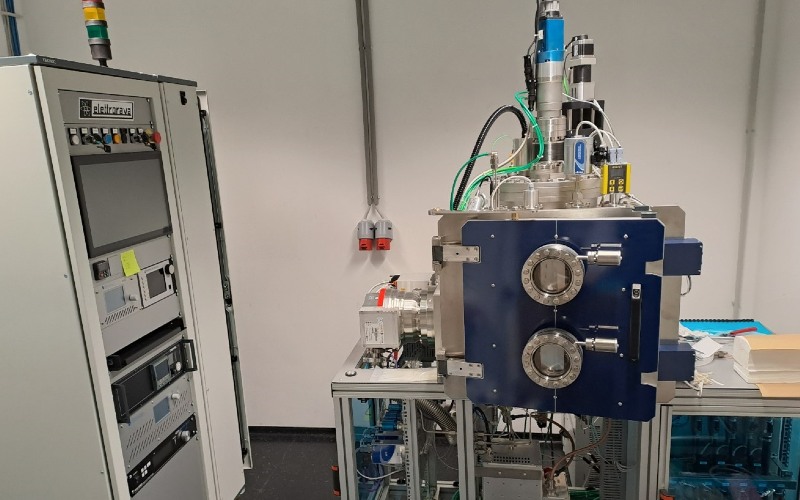
As part of the MA23-funded infrastructure project "Thin-film technologies in interdisciplinary fields of application (DIA)", the acquisition of a sputtering system is planned in order to produce thin coatings for various applications in the research areas at FH Campus Wien. A cooperation of experts from the study programs Applied Electronics and Technical Informatics, High Tech Manufacturing, Biomedical Analytics and Packaging Technology is planned for the implementation of the project

Research Goals

The project essentially pursues the following three project goals:

  • The first objective of the project is to set up as well as expand the existing research laboratories at FH Campus Wien. As part of the project, a sputtering system and an oxygen transmission rate measuring system (OTR measuring system) as well as a deep freezer (for temperatures down to -80°C) will be purchased. A Europe-wide tender is required for the purchase of the sputtering system and this will be carried out in the first phase of the project.
  • The second goal of the project is to establish and conduct research in interdisciplinary fields of application at FH Campus Wien. In addition to the possible applications of thin-film technology for the development of sensors and electrical components already described, the infrastructure will also be used in many other areas of application and disciplines at FH Campus Wien. In future, the research infrastructure will be used across disciplines and specialist areas in research at FH Campus Wien. It is planned to produce thin layers for packaging materials and to determine the permeability of oxygen. The oxygen barrier in food packaging is one of the most important properties, as many foods are extremely sensitive to oxidation and OTR as a characteristic value is of great practical relevance when selecting materials. The application of the OTR measuring device is not just limited to analysing packaging; printed electrical components and layers deposited by the sputtering system, which are required for sensors and antennas, for example (and are sometimes very sensitive to oxygen), can also be characterised in future. The acquired measuring system also enables simultaneous measurement in three cells and detects the passage of oxygen into inert carrier gas (nitrogen) using sensors.
    For applications in the specialist area of Biomedical Science, it is planned to produce coatings for implants as part of the project. Implants are products that can consist of different materials and are permanently inserted into the body in order to restore certain bodily functions. Common examples include dental implants, stents, heart valve implants and pacemakers. Implants play a particularly important role in orthopaedics, as bones cannot regenerate after injury or loss and must therefore be replaced to restore function. The demands placed on the materials used for implants are very high. Pathogens must not be allowed to adhere to the surface of the implants and multiply, as this could lead to chronic inflammation with serious consequences. The aim is to prevent the tissue around the implant from becoming inflamed, which in the worst case could lead to rejection of the implant. At the same time, the material should be robust and be able to retain its properties in the long term. Metals, ceramics and polymers are particularly suitable materials. In particular, it is planned to determine the influence of metal coatings on bacterial growth. In order to create the possible framework conditions for this project, a nitrogen tank is needed for the required cell cultures, which can guarantee the necessary storage temperature of the cells (storage at -80 °C is necessary for this).
  • The third aim of the research project is to involve students in the project and enable practical training. By setting up and expanding the research laboratories at FH Campus Wien, we are creating a first-class learning and research environment for students. The highly qualified project staff will support students in expanding their knowledge and skills. Students will be involved in the MA23-funded project "Thin-film technologies in interdisciplinary fields of application", particularly in the form of theses and internships.

Funding Partners

Project Team