


Bachelor's Degree Program

Bioengineering

part-time

This page contains automated translations.

The path from gene to product: biotechnology or bioengineering is the engineering discipline of biotechnology. It concerns optimizing and developing biotechnological methods for efficient production in the industry. The degree program is tailored specifically to the needs of industrial applications: pharmaceutical production, the chemical industry and brewing and fermentation technology. A bio-industrial pilot plant at the university provides unique opportunities for a practical and application oriented education.

Department
Applied Life Sciences
Topic
Technologies

Highlights

  • Applied research to optimize biotechnological methods for economical production in industry

  • Main areas of application: medical and industrial biotechnology as well as brewing and fermentation technology


    Facts

    Final degree

    Bachelor of Science in Engineering (BSc)

    Duration of course
    6 semesters
    Organisational form
    part-time

    Tuition fee per semester

    € 363,361

    + ÖH contribution + costs for optional additional services, if applicable2

    ECTS
    180 ECTS
    Language of instruction
    German

    Application Winter semester 2027/28

    15. December 2026 - 15. June 2027

    Study places

    40

    1 Tuition fees for students from third countries € 727 per semester. Details on tuition fees can be found in the general fee regulations.
    2 The costs depend on the additional services selected from the University of Applied Sciences Campus Vienna, such as work clothing, licenses, tutorials, or excursions.


    Before the studies

    You are interested in the practical application of biology and technology in the industry. Mathematics is one of your strengths. You also have good knowledge of natural sciences. You enjoy working in a team and on projects. You are a process-oriented and analytical thinker and are highly conscious of quality. You find a career in the industry attractive. Average English skills are expected. Language of instruction is German.

    Why you should study with us

    Study place = lab place

    Sharing is good, however, not your lab space, please. You are guaranteed your own.

    Highly sought-after knowledge

    What you learn here is crucial to solving global problems.

    International network

    Going abroad for an internship or a job: this is the next logical step when studying with us.

    Relevant admission requirement

    You need a general university entrance qualification, proven by

    • Austrian secondary school leaving certificate (AHS, BHS, vocational higher education entrance qualification) or
    • Austrian certificate of a limited higher education entrance qualification for the respective group of studies or
    • equivalent foreign certificate or
    • certificate of completion of at least three years of study with 180 ECTS credits at a recognized domestic or foreign post-secondary educational institution,

    or a relevant professional qualification with additional examinations.

    Further details

    Relevant professional qualification with additional examinations

    You have acquired your professional qualification, for example, by completing an apprenticeship in the field of

    • chemical laboratory technology or
    • chemical process engineering or
    • pharmaceutical technology. 

    Depending on the section, individual additional examinations must be taken as part of the limited higher education entrance qualification.

    Details on the limited higher education entrance qualification and the additional examinations can be obtained from the administration office.

    Language requirements for admission

    The required language level according to the Common European Framework of Reference for Languages (CEFR) is at least

    • German - level C1.

    Legalization of foreign documents

    Applicants may require legalization of documents from countries other than Austria in order for them to have the evidential value of domestic public documents. Information on the required legalizations can be found here in PDF format.

    Translation of your documents

    For documents that are neither in German nor English, a translation by a sworn and court-certified interpreter is required. Your original documents should have all the necessary legalization stamps before translation so that the stamps are also translated. The translation must be firmly attached to the original document or a legalized copy.

    Online application - uploading documents

    As part of your online application, upload scans of your original documents including all required legalization stamps. For documents not issued in German or English, scans of the corresponding translations must also be uploaded. The head of the study program decides on the equivalence of international (higher) education qualifications. Therefore, your documents can only be checked as part of the ongoing application process.

    Applicants with a German "Fachhochschulreife" (German advanced technical college entrance qualification)

    The German "Fachhochschulreife" (German advanced technical college entrance qualification) is not formally equivalent to the Austrian general university entrance qualification. Whether access to the Bachelor's degree program is possible via a relevant professional qualification and which additional examinations must be taken for this is decided by the head of the degree program or study program after reviewing the application documents in the course of the admission procedure. In your online application in the selection field "Relevant admission requirement", please select the item “Foreign limited higher education entrance qualification”.

    Your path to studying at Hochschule Campus Wien (HCW) begins with your registration on our application platform. In your online account, you can start your application directly or activate a reminder if the application phase has not yet started.

    There are 40 places available each year on the bachelor's degree program Bioengineering. The ratio of study places to applicants is currently approx. 1:3.

    Documents for your online application

    Proof of identity

    • passport or
    • identity card or
    • Austrian driving license (proof of citizenship required) or
    • residence permit (proof of citizenship required)

    Change of name - proof

    • e.g. marriage certificate - only required if your current name does not match the name on your proof of identity or on the documents required to prove the admission requirements

    Relevant admission requirement for the bachelor's degree program

    The relevant admission requirement is a general university entrance qualification or a relevant professional qualification.

    • Austrian secondary school leaving certificate (AHS, BHS, vocational higher education entrance qualification) or
    • Austrian certificate of a limited higher education entrance qualification for the respective group of studies or
    • equivalent foreign certificate or
    • certificate of completion of at least three years of study with 180 ECTS credits at a recognized domestic or foreign post-secondary educational institution or
    • proof of relevant professional qualification

    If you do not currently have a certificate, please upload your complete certificate (all pages) from the last completed school level.


    German level C1 - proof of language skills

    For admission, German language skills of at least level C1 of the Common European Framework of Reference for Languages (CEFR) must be provided.

    The following applies as proof:

    • secondary school leaving certificate from a German-speaking school
    • completion of at least three years of studies in German
    • supplementary examination pre-study course - German C1
    • German certificate (not older than 3 years), e.g.:
      • Austrian German Language Diploma: ÖSD Certificate C1
      • Goethe Institute: Goethe Certificate C1
      • telc: German C1 University
      • German language test for university admission for foreign applicants: DSH-2
      • German Language Diploma of the Standing Conference of the Ministers of Education and Cultural Affairs of the Länder in the Federal Republic of Germany: DSD II - C1
      • Test of German as a foreign language (Test DaF): Level TDN 4 in all parts
      • Language Center of the University of Vienna: Course and successfully passed exam at level C1/2

    Proof of a higher language level is also valid.


    Curriculum vitae in tabular form in German


    Letter of motivation in German


    Legalizations and translations, if applicable

    • see tab “Foreign documents and degrees” above

    Your application is valid once you have completely uploaded the required documents. If you do not have all the documents at the time of your online application, please submit them immediately upon receipt by email to the administration of your study program (see section “Contact”).

    After completing your online application, you will receive an email confirmation with information on the next steps.

    The admission procedure consists of a written test and an interview with the admission committee.

    • Aim
      The aim is to ensure places are offered to those persons who complete the multi-level admission procedure with the best results. The tests are designed to assess the skills needed for an applicant's chosen profession.
    • Procedure
      The written admission test includes questions from biology, physics, mathematics and chemistry. Applicants then undergo an admission interview on the same day to provide a first impression of their personal aptitude. The qualities interviewers are looking for include professional motivation, an understanding of the profession, performance, time management. Points are assigned to each section of the test.
    • Criteria
      The criteria for acceptance are based solely on performance. The geographical origin of the applicant has no influence on the admission decision. The admission requirements must be met in all cases. Applicants are evaluated according to the following weighting system:
      • Written admission test (60%)
      • Admission interview (40%)

      The study places are awarded at the latest in mid-July based on this ranking. The process as a whole and all test and assessment results from the admission procedure are documented in a transparent and verifiable manner.

    Written test and interview 
    We offer several dates in May and June. After reviewing your application, we will send you a list of dates to choose from.

    Planned start of the first semester
    End of August

    Do you still have questions about the study?

    Make an appointment with Elisabeth Holzmann (administration) elisabeth.holzmann@hcw.ac.at for a a personal consultation via Zoom.

    During the studies

    Your education and research benefit from our close partnerships with well-known biotech companies as well as the University of Natural Resources and Life Sciences, Vienna (BOKU) and the Vienna Institute of Biotechnology (VIBT), who share the campus with us. The partnership enables you to take advantage of the BOKU's excellent infrastructure. In addition to the laboratories, this includes an industrial pilot plant with which production processes can be developed on a laboratory scale and applied on a pilot scale. This provides you with a practice-oriented education, because in the industry the lab and pilot scale is only followed by the production scale in which the product is manufactured in commercially viable quantities. The simulation of the processes on a pilot scale helps determine deviations in each process step and develop process parameters for the commercial evaluation of the production processes. Numerous R&D projects in the degree program offer you the opportunity to work with cutting-edge applications and to make valuable contacts for your future career. Practical relevance is also guaranteed at our Campus Lecture evenings, which are open to all and feature contributions from prominent experts.

    The practically oriented degree program has established itself in applied research and development. It concerns optimizing bioengineering methods for industrial production. The degree program focuses on three industrial applications: red and white biotechnology as well as brewing and fermentation technology. The red biotechnology includes medical and pharmaceutical applications. The white biotechnology plays an increasingly important role in the chemical industry and other industries.

    The benefits of biotechnology are that fewer natural resources are used, energy efficiency is higher, CO ² emissions are lower and production costs are also lower. The fact that the degree program is particularly application oriented can also be seen within the context of R&D projects. For example, the section of Bioengineering together with the biotech company Vogelbusch developed a process improvement that helps to replace petroleum as the basis for chemicals with less expensive renewable raw materials.

    With Bioengineering you have chosen an intensive technical and scientific education. Technology, biology and chemistry are the foundation of the degree program.

    • You will acquire knowledge and skills in engineering, microbiology and molecular biology, chemical analysis and quality management.
    • The three main focuses of the degree program are the production of pharmaceuticals, which is called red biotechnology, the brewing and fermentation technology, which belongs to the yellow biotechnology, and the manufacture of chemicals, called white biotechnology.
    • Starting with the fifth semester you will specialize in either bioinformatics or bioprocess technology.
    • During your time in the degree program you will complete an internship in which you will apply your theoretical knowledge and acquire first-hand professional experience. For those working in a relevant profession it is possible to receive credit towards your coursework.
    • Your degree will provide you with the necessary tools for scientific work. You will train your ability to work well in a team during the course of your bachelor's thesis which you will write as part of a class project.

    Curriculum

    Module Analytical chemistry

    Analytical chemistry

    1 SWS   1 ECTS

    Learning results

    • Students acquire practical and manual skills and manual skills of simple chemical analysis, including data processing, presentation and evaluation.

    • The students master the practical implementation theoretical fundamentals of analytics, in particular dimensional dimensional analysis and stoichiometry.

    1 SWS
    1 ECTS
    General Chemistry I (Practical Course) | UE

    General Chemistry I (Practical Course) | UE

    1 SWS   1 ECTS

    Content

    Introduction to chemical laboratory techniques; qualitative determination of inorganic ions by wet chemical methods; titrations.

    Learning results

    • Students know the basics of general and analytical chemistry and have acquired knowledge of qualitative inorganic analysis and basic chemical operations.

    • Students will master practical and manual skills of simple chemical analysis, including data processing, presentation, and evaluation.

    • Students know the safety equipment in a lab.

    Teaching method

    Practices; on-the-job training

    Examination

    Final exam: Written work and the assessment of practical work

    Teaching language

    Deutsch

    1 SWS
    1 ECTS
    Module Inorganic and organic chemistry

    Inorganic and organic chemistry

    3.5 SWS   7 ECTS

    Learning results

    • Students have the ability to evaluate chemical auxiliaries, recognize chemical reactions on materials and as part of processes, to evaluate chemical evaluate chemical formulations, whether for nutrient media and as part of drug manufacturing.

    • Students have acquired theoretical knowledge of the elements and their compounds and are familiar with the periodic table and important principles of inorganic chemistry.

    • Students have acquired the fundamentals for their further education in analytical chemistry.

    3.5 SWS
    7 ECTS
    General and Inorganic Chemistry | VO

    General and Inorganic Chemistry | VO

    2.5 SWS   5 ECTS

    Content

    1. element and compound
    2. atomic structure and periodic table
    3. chemical bond
    4. molecular geometry
    5. gases, liquids and solids
    6. conservation of mass and energy
    7. chemical equilibrium I
    8. chemical equilibrium II
    9. oxidation and reduction
    10. coordination compounds
    11. basics of chemical thermodynamics
    12. main group chemistry I (hydrogen, alkali metals, alkaline earth metals, noble gases)
    13. main group chemistry II (boron group)
    14. main group chemistry III (carbon group)
    15. main group chemistry IV (nitrogen group)
    16. main group chemistry V (oxygen group)
    17. main group chemistry VI (halogens)
    18. transition metals
    19. environmental problems
    20. important aspects of general and inorganic chemistry in biological systems


    Learning results

    • Students know basics of general, inorganic and physical chemistry.

    • Students understand concepts of the anorganic chemistry.

    • Students have acquired knowledge about atomic structure, chemical bonds and the different chemical reactions.

    • Students know about environmental issues and the essential aspects of bioinorganic chemistry.

    • Students know about environmental issues and the essential aspects of bioinorganic chemistry.

    Teaching method

    Lecture with exercises

    Examination

    Final exam: written exam

    Teaching language

    Deutsch

    2.5 SWS
    5 ECTS
    Introduction to Organic Chemistry | VO

    Introduction to Organic Chemistry | VO

    1 SWS   2 ECTS

    Content

    - Organic Bonds
    - Basic concepts of organic chemistry
    - Introduction to organic compounds
    - Overview of functional groups, classes of substances and compounds
    - Basics of organic reactions

    Learning results

    • Students know the properties of organic bonds and basic concepts of organic chemistry.

    • Students have basic knowledge of organic compounds, functional groups, substance and compound classes.

    • Students know basics of organic reactions.

    Teaching method

    lecture

    Examination

    Final exam: written exam

    Teaching language

    Deutsch

    1 SWS
    2 ECTS
    Module Mathematics

    Mathematics

    3 SWS   4 ECTS

    Learning results

    • Students master numerical methods and derivatives, differential and integral calculus.

    3 SWS
    4 ECTS
    Mathematics  | ILV

    Mathematics  | ILV

    2 SWS   3 ECTS

    Content

    • Mathematical methoden in bioengineering (error analysis, dilution, flow rates, centrifugation, interpolation)
    • Matrices and linear maps
    • Differential calculus and integration, simple differential equations
    • Growth and decay
    • Linearisation and logarithmic scales


    Learning results

    • The students acquire a basic knowledge of mathematics and thus form the basis for the courses in technical and special mathematics, applied statistics, bioinformatics, process engineering and bioprocess engineering.

    • The students realise the significance of mathematics in Bioengineering by practically relevant examples.

    Teaching method

    Lecture with activating, problem-based learning elements.

    Examination

    Final exam: Immanent performance assessment and final written examination

    Teaching language

    Deutsch

    2 SWS
    3 ECTS
    Tutorial in Mathematics | UE

    Tutorial in Mathematics | UE

    1 SWS   1 ECTS

    Content

    Repetition and strengthening of fundamental mathematical concepts and methods.
    In particular, we will focus on the following items.

    1. Powers, quantities and units
    2. Terms, formulas, logarithm
    3. Linear and exponential functions
    4. Logarithmic scales
    5. Geometry, trigonometric functions, vectors

    Learning results

    • The students acquire the basic knowledge in the fields of mathematics and thus forms the basis for the course Technical and Special Mathematics, Applied Statistics, Bioinformatics, Chemical Engineering and Biochemical Engineering, using the same or similar computational examples whenever possible.

    • Students get experience and assurance in context with fundamental mathematical procedures

    Teaching method

    Exercise

    Examination

    Continuous assessment: written assignments

    Teaching language

    Deutsch

    1 SWS
    1 ECTS
    Module Microbiology

    Microbiology

    2.5 SWS   5 ECTS

    Learning results

    • Students have acquired a subject-oriented competence in microbiology, of the different groups of organisms and the related analysis methods.

    • Students have acquired knowledge of the microbial metabolism, cycles and phenotypes and can connect them with industrial biotechnological processes.

    2.5 SWS
    5 ECTS
    General Microbiology | VO

    General Microbiology | VO

    2 SWS   4 ECTS

    Content

    Introduction into microbiology, microbial diversity, microbial growth und cultivation, phenotype and genotype, as well as microbial taxonomy. Selected groups and species with importance to biotechnological production will be discussed in detail. 

    Learning results

    • Students understand basic general features of different microorganisms and their phenotype.

    • After finishing the lecture students understand microbiological growth processes and their biotechnological use.

    • At the end of the lecture, students can connect material cycles and microbial processes like fermentation.

    Teaching method

    Lecture

    Examination

    Final exam: Final exam, written

    Teaching language

    Deutsch

    2 SWS
    4 ECTS
    Microbiological Microscopy (Practical Course) | UE

    Microbiological Microscopy (Practical Course) | UE

    0.5 SWS   1 ECTS

    Content

    Introduction into light microscopy.

    Organization, content and function of simple cellular systems. Cellular organization of microorganisms (yeast, bacteria), and plants. Cell wall and organells for higher eukaryotic organisms. Function of plasmatic and non-plasmatic components.


    Learning results

    • After completion of the lecture the students are able to work with a light microscope.

    • At the end of the lecture, students are able to analyse the functionality of cells, cell components and organs and can interpret this information. Students can communicate their observations and put them in theoretical context.

    • Students are able to apply their knowledge to plan simple microbiological experiments.

    Teaching method

    Lecture and practical exercises

    Examination

    Continuous assessment: Exam, written

    Laboratory protocol

    Teaching language

    Deutsch

    0.5 SWS
    1 ECTS
    Module Physics

    Physics

    1.5 SWS   3 ECTS

    Learning results

    • Students will have a basic overview and understanding of electrical engineering as it relates to bioengineering applications.

    • Students are familiar with measurements and measuring systems, the basics of mechanics, electrical engineering, thermodynamics and hydraulics.

    1.5 SWS
    3 ECTS
    Physics | VO

    Physics | VO

    1.5 SWS   3 ECTS

    Content

    Measures and measurement systems, measurement errors, forms and mass of energy and power, the basics of mechanics (force, power, momentum, power transmission, measurement of work, electrical engineering (electric voltage and current, conduction, electric power), heat (basic thermodynamic concepts, measurement of thermal power, main theorems) and optics (geometrical optics, photometry, optics of microscopy).


    Learning results

    • Students have basic knowledge of physics and apply it confidently.

    • Students master the systematic thinking and approaches of physics and can develop and apply solutions in relevant subfields of physics.

    Teaching method

    Lecture

    Examination

    Final exam: Written Exam

    Teaching language

    Deutsch

    1.5 SWS
    3 ECTS
    Module Stoichiometry and titrimetry

    Stoichiometry and titrimetry

    3.5 SWS   7 ECTS

    Learning results

    • The students have theoretical and practical knowledge of volumetric analysis and stoichiometry.

    • The students have acquired competences which are the basis of the chemical-analytical practice of bioengineering.

    • Students are proficient in computational fundamentals. The- are used in part in the chemical exercises (chemical laboratory laboratory practical course).

    3.5 SWS
    7 ECTS
    Analytical and Physical Chemistry | VO

    Analytical and Physical Chemistry | VO

    2 SWS   4 ECTS

    Content

    Introduction to Analytical Chemistry - Fundamentals and Methods; Validation.
    Classical quantitative analysis: gravimetry, dimensional analysis (acid-base titrations, precipitation titrations, complexometric titrations, redox titrations).Spectroscopic methods: AAS, AES, RFA, REM; UV/VIS, IR, MS, XPS, NMR.
    Electrochemical methods: electrogravimetry, coulometry, conductometry, potentiometry, polarography.
    Introduction to separation techniques (chromatography, electrophoresis).


    Learning results

    • After successful completion of the course, students have acquired the basics of classical qualitative and quantitative chemical analysis and are thus prepared for the subsequent chemical exercises.

    • They have basic knowledge of spectroscopic, electrochemical and chromatographic methods.

    Teaching method

    This course goes beyond the concept of pure instructional learning (frontal lecture) and expects active listening, i.e. interaction between teacher and student is highly encouraged as time permits.
    face-to-face teaching as well as distance learning by means of "zoom
    small work assignments between the individual units
    presentations by students in small groups

    Examination

    Final exam: written exam

    Teaching language

    Deutsch

    2 SWS
    4 ECTS
    Stoichiometry and Quantitative Chemical Analysis | VO

    Stoichiometry and Quantitative Chemical Analysis | VO

    1.5 SWS   3 ECTS

    Content

    Molar mass / amount of substance, basic laws of stoichiometry, chemical reaction equations, redox reactions, solutions / concentration data / standard solutions, chemical equilibrium / ionic equilibria, gas laws / pH value calculations (acids, alkalis, buffers) / solubilities - solubility product
    Volumetry/ Calibration procedures and validation of analytical methods/ Dilutions (ratios)/ Buffers/ Calculations for nutrient media preparation/ Photometric determinations and exercise examples with calibration curves

    Learning results

    • After positive completion of the course, students will be able to perform typical tasks related to everyday laboratory work, such as preparing solutions of different concentrations as well as buffers with specific concentrations or pH values on their own.

    • They are able to perform the necessary preliminary calculations for the preparation of solutions and the same.

    • Students are be able to handle and solve calculation problems as well as laboratory practical problems.

    Teaching method

    lecture

    Lecture on the blackboard and with slides with active involvement of the students, exercises in the lecture, homework, practice examples for independent perfecting.

    Examination

    Final exam: Three written intermediate tests

    Teaching language

    Deutsch

    1.5 SWS
    3 ECTS
    Module Technical mathematics

    Technical mathematics

    1.5 SWS   3 ECTS

    Learning results

    • Students are able to apply theoretical concepts in the field of process engineering and are able to solve complex problems of planning and process execution.

    1.5 SWS
    3 ECTS
    Statistics for Chemical Analysis | ILV

    Statistics for Chemical Analysis | ILV

    1.5 SWS   3 ECTS

    Content

    Data description for a characteristic:
    Population and sample, measures, boxplot, frequency distributions, empirical density curves.

    Random variable:
    Probability theory (probability axioms, addition rule, conditional probability, multiplication rule); discrete random variable (binomial distribution, hypergeometric distribution); continuous random variable (normal distribution).

    Parameter estimation:
    Estimators, confidence intervals (mean, standard deviation, probability).

    Hypothesis testing:
    Introduction (alternative, null hypothesis, 1- and 2-sided hypotheses, error, test goodness); 1-sample comparisons ( t-test, binomial test); testing normal distribution assumption (QQ plot, Shapiro-Wilk test); 2-sample comparisons (t-test, F-test); sample size planning (t-test).

    Linear regression:
    2-dimensional normal distribution, product moment correlation; simple linear regression (least squares estimation, dependence test, coefficient of determination, regression through zero, scale transformations); linear calibration functions.

    Learning results

    • Students will be able to solve the following standard statistical tasks: a) are able to describe 1- and 2-dimensional samples with measures and graphs; b) are able to apply the most important rules for calculating probabilities; c) know selected probability distributions to capture the variation of random variables;

    • d) are able to estimate distribution parameters based on univariate samples; e) are able to compare means and probabilities within the framework of one-sample comparisons with a given nominal value; f) are able to detect differences between means and proportions in the context of parallel experiments and pairwise comparisons;

    • g) Be able to plan minimum sample sizes to detect relevant variances for simple alternative tests; h) be able to perform dependence analyses in the context of simple linear regression models and apply scale transformations to linearize nonlinear dependencies.

    Teaching method

    lecture and exercise

    Examination

    Final exam: written exam

    Teaching language

    Deutsch

    1.5 SWS
    3 ECTS

    Module Analytical chemistry

    Analytical chemistry

    5 SWS   9 ECTS

    Learning results

    • Students acquire practical and manual skills and manual skills of simple chemical analysis, including data processing, presentation and evaluation.

    • The students master the practical implementation theoretical fundamentals of analytics, in particular dimensional dimensional analysis and stoichiometry.

    5 SWS
    9 ECTS
    General Chemistry II (Practical Course) | UE

    General Chemistry II (Practical Course) | UE

    2 SWS   4 ECTS

    Content

    Within the framework of the chemical-analytical laboratory practical course II, you will carry out quantitative determinations. You will acquire important fundamentals of general and analytical chemistry and basic practical knowledge.

    Introduction part (+5 samples)
    1st sample: titration and measurement uncertainty
    2nd sample: weak acid, alkalimetric
    3rd sample: Gravimetric determination of iron
    4th sample: Water analysis - determination of water hardness
    5th sample: Nitrogen determination according to Parnas-Wagner

    Learning results

    • Students will have acquired practical and manual skills of simple chemical analysis, including data processing, presentation and evaluation.

    • Students master the practical implementation of the theoretical principles of analytics, especially dimensional analysis and stoichiometry.

    Teaching method

    practical course

    The tasks set are to be processed independently. The "analyses" are to be carried out according to the work instructions. The keeping of laboratory journals and the preparation of reports is practiced. In addition to the work instructions, a script is available in which the theory is also covered.

    Examination

    Final exam: Final testing and assessment of performance in the laboratory

    Teaching language

    Deutsch

    2 SWS
    4 ECTS
    General Chemistry III (Practical Course) | UE

    General Chemistry III (Practical Course) | UE

    3 SWS   5 ECTS

    Content

    1st sample: Conductometric determination of a salt solution
    2nd sample: Potentiometric determination of the equivalent weight of an amino acid (2 students together)
    3rd sample: Determination by means of ion-selective electrodes (Cl- next to I-) (2 students together)
    4th sample: Photometric determination of iron
    5th sample: Photometric determination of the pK value of an indicator (2 students together)
    6th sample: Redox titration - vitamin C iodometric
    7th sample: Ion chromatographic determination of chloride, nitrate and sulfate (group work)

    Learning results

    • Students will have acquired practical and manual skills of simple chemical analysis, including data processing, presentation and evaluation.

    • Students are able to practically implement the theoretical principles of analytics, especially dimensional analysis and stoichiometry.

    Teaching method

    practical course

    Examination

    Final exam: Final written examination and assessment of practical work

    Teaching language

    Deutsch

    3 SWS
    5 ECTS
    Module Inorganic and organic chemistry

    Inorganic and organic chemistry

    2 SWS   4 ECTS

    Learning results

    • Students have the ability to evaluate chemical auxiliaries, recognize chemical reactions on materials and as part of processes, to evaluate chemical evaluate chemical formulations, whether for nutrient media and as part of drug manufacturing.

    • Students have acquired theoretical knowledge of the elements and their compounds and are familiar with the periodic table and important principles of inorganic chemistry.

    • Students have acquired the fundamentals for their further education in analytical chemistry.

    2 SWS
    4 ECTS
    Organic Chemistry | VO

    Organic Chemistry | VO

    2 SWS   4 ECTS

    Content

    1. structural elements of organic compounds (hybrid orbitals, molecular orbitals)
    2. reaction mechanisms
    3. alkanes (properties, introduction to nomenclature, reactions, preparation, occurrence, representatives)
    4. alkenes (isomerism, reactions, representatives)
    5. alkynes (representatives, properties, occurrences, reactions)
    6. halogen compounds (properties, preparation, reactions)
    7. alcohols (properties, preparation, reactions, representatives of monohydric and polyhydric alcohols)
    8. ethers (properties, preparation, reactions)
    9. sulfur compounds
    10. amines (properties, preparation, reactions, representatives), other N- and P-compounds
    11. aldehydes and ketones (properties, preparation, reactions, representatives)
    12. carboxylic acids (properties, preparation, reactions, representatives)
    13. carboxylic acid derivatives (acid halides, esters, amides, anhydrides)
    14. amino acids and peptides
    15. aromatic compounds (aromaticity, properties, reactions, representatives)
    16. dicarboxylic acids
    17. hydroxycarboxylic acids
    18. organometallic compounds
    19. natural products (carbohydrates, fats, oils, waxes, terpenes, nucleic acids)

    Learning results

    • Students master the basics of organic chemistry.

    • Students will recognize important structures and reactivities as the basis for biochemical processes.

    Teaching method

    lecture

    Examination

    Final exam: written test at the end

    Teaching language

    Deutsch

    2 SWS
    4 ECTS
    Module Machine science

    Machine science

    2.5 SWS   5 ECTS

    Learning results

    • Students know different manufacturing techniques and their use.

    • Students can plan the use of different materials.

    • Students will be able to identify, evaluate, and plan the use of basic operations, machines, and machine parts used in bioengineering.

    • Students are able to combine process units into a process network and evaluate the mutual influence in the overall context.

    2.5 SWS
    5 ECTS
    Technical Drawing, Mechanical Engineering | ILV

    Technical Drawing, Mechanical Engineering | ILV

    0.5 SWS   1 ECTS

    Content

    As a basic course of Mechanical Engineering, the following content has to be conveyed:

    1) instrcution to technical drawing
    2) descriptive geometry (2D, 3D, sectional views, dimensioning)
    3) details for manufacturing (tolerances, fits, connections, surface processing, welding symbols)
    4) process flowcharts (basic flow chart, process flow diagram, P&ID)

    Learning results

    • Studierende können technische Zeichnungen lesen und erstellen.

    • Students can create necessary technical specifications for the construction of a machine part or a plant part.

    Teaching method

    lecture and practise

    Examination

    Continuous assessment: written exam

    Teaching language

    Deutsch

    0.5 SWS
    1 ECTS
    Materials science and manufacturing engineering | VO

    Materials science and manufacturing engineering | VO

    2 SWS   4 ECTS

    Content

    The course content covers the materials science of the most important metallic (ferrous materials, non-ferrous metals) and non-metallic materials such as ceramic materials, glass, plastics, composites. This area is supplemented by the explanation of corrosion and corrosion protection.
    Furthermore, manufacturing processes are taught such as casting and sintering, forging, rolling, pressing, turning, milling, drilling, sawing and grinding, as well as welding, soldering and bonding.
    The most important machine elements are taught to complement the material.


    Learning results

    • Students have knowledge of the fundamentals and properties of the materials and machine elements used today and can consider their advantages and disadvantages in practical applications. of their advantages and disadvantages in practical use.

    • Students are able to make a specific material selection or combination of different materials for plant components and have an overview of the protection of materials.

    Teaching method

    Lecture

    Examination

    Final exam: written exam

    Teaching language

    Deutsch

    2 SWS
    4 ECTS
    Module Microbiology

    Microbiology

    2.5 SWS   3 ECTS

    Learning results

    • Students have acquired a subject-oriented competence in microbiology, of the different groups of organisms and the related analysis methods.

    • Students have acquired knowledge of the microbial metabolism, cycles and phenotypes and can connect them with industrial biotechnological processes.

    2.5 SWS
    3 ECTS
    Microbiologic Methods | ILV

    Microbiologic Methods | ILV

    0.5 SWS   1 ECTS

    Content

    Overview on methods in microbiology as a detailed preparation for the practical courses ('Laborpraktikum')

    The methods discussed are: Aseptic techniques, Cultivation of MO, Identification of MO, Determination of growth kinetics, Antibiotics

    Learning results

    • Students understand the application of general microbiological knowledge within an industrial setting

    • After finishing the lecture, students can translate literature protocols into practical laboratory methods.

    • At the end of the lecture, students are able to work safely with biological agents.

    Teaching method

    Lecture with activating methods

    Examination

    Final exam: Final exam, written

    Teaching language

    Deutsch

    0.5 SWS
    1 ECTS
    Specific Microbiology | VO

    Specific Microbiology | VO

    2 SWS   2 ECTS

    Content

    Features of selected production strains (e.g. yeast: Pichia/Saccharomyces; mold: Penicillium/Aspergillus; and bacteria: Bacillus/Lactobacillus) and of important contanminants will be discussed.

    This course will present the following aspects of applied microbiology based on selected examples: Microoorganisms in association with Foods; microorganisms in the environment; pharmaceutical indicator organisms; production strains for biopharmaceuticals

    Learning results

    • At the end of the lecture, students are able to connect microbial features to industrial applications and products.

    • Students can evaluate the utilisation of microorganisms in different biotechnological fields.

    • After completion of the lecture, students are able to critically evaluate scientific literature in the field of special microbiology.

    Teaching method

    Lecture

    Distance learning tasks with feedback

    Examination

    Final exam: Final exam, written

    Teaching language

    Deutsch

    2 SWS
    2 ECTS
    Module Physics

    Physics

    2.5 SWS   5 ECTS

    Learning results

    • Students will have a basic overview and understanding of electrical engineering as it relates to bioengineering applications.

    • Students are familiar with measurements and measuring systems, the basics of mechanics, electrical engineering, thermodynamics and hydraulics.

    2.5 SWS
    5 ECTS
    Electrical Engineering | VO

    Electrical Engineering | VO

    1.5 SWS   3 ECTS

    Content

    Basic concepts of electrical engineering, basic electrical quantities, Ohm's law, electrical switching of loads.
    Types of current, line network and electrical connection, electrical installation and connections, protective measures for electrical equipment.
    Pictograms on electrical equipment and machines
    Electrical drive machines in chemical plants:
    Electric motors
    Three-phase squirrel-cage motors
    Direct current motors
    Motor protection types


    Learning results

    • Students will have a basic overview and understanding of electrical engineering as it relates to applications in biotechnology.

    • Students can read, sketch and calculate electrical diagrams.

    Teaching method

    Lecture

    Examination

    Final exam: Written Exam

    Teaching language

    Deutsch

    1.5 SWS
    3 ECTS
    Hydraulics and Fluid Mechanics | VO

    Hydraulics and Fluid Mechanics | VO

    1 SWS   2 ECTS

    Content

    Properties and behavior of fluids, especially aqueous fluids (especially viscosity and surface tension), fundamentals of hydrostatics and hydrodynamics (conservation equations and pipe hydraulics), rheology (sinking velocity of particles, stirrer design) and pump design.

    Learning results

    • Students know the basics of hydrostatics and hydrodynamics.

    • Students will be able to design piping, agitators, and pumps.

    Teaching method

    Lecture and exercises

    Examination

    Final exam: Written exam

    Teaching language

    Deutsch

    1 SWS
    2 ECTS
    Module Technical mathematics

    Technical mathematics

    2 SWS   4 ECTS

    Learning results

    • Students are able to apply theoretical concepts in the field of process engineering and are able to solve complex problems of planning and process execution.

    2 SWS
    4 ECTS
    Technical Mathematics | ILV

    Technical Mathematics | ILV

    2 SWS   4 ECTS

    Content

    Mathematical methods play an important role in the applied
    Sciences, in particular the following...
    - Solving systems of linear equations
    - error estimations
    - Numerical solution of (nonlinear) equations, zero search
    - Interpolation, numerical differentiation
    - Integral calculus and numerical integration
    The techniques learned are applied manually, but also mechanically (in Python), to solve numerically more complex problems.
    In particular, theory from fluid mechanics and hydraulics is used to address applied problems.

    Learning results

    • Students possess target-oriented competencies in technical mathematics in direct connection with process engineering. They are thus able to carry out complex problems of technical analysis and process control.

    • Students can solve linear and non-linear equations.

    • Students master the computer-aided machine solution of numerical problems.

    Teaching method

    Lecture and exercises

    Examination

    Final exam: immanent performance assessment and final written examination

    Teaching language

    Deutsch

    2 SWS
    4 ECTS

    Module Applied Microbiology

    Applied Microbiology

    3 SWS   5 ECTS

    Learning results

    • Students know the industrial use of prokaryotic and eukaryotic cell systems which are used in biotechnological applications.

    • Students are able to use microbiological methods, like the identification of microorganisms, their cultivation, dilutions experiments and the production of substrates.

    3 SWS
    5 ECTS
    General Microbiology (practical course) | UE

    General Microbiology (practical course) | UE

    3 SWS   5 ECTS

    Content

    Introduction into microbiological techniques:
    Working under sterile conditions
    Different cultivation techniques (surface cultures, liquid cultures)
    Cell number determination (according to Koch, Thoma chamber)

    Preparation of microbial media

    Morphology:
    Microscopic imaging of bacteria, yeast and filamentous fungi
    Staining techniques. Gram, capsule and spore staining

    Physiology:
    Growth of yeast on different carbon sources (C-auxanogram)
    Antibiotics testing (diffusion test, commercial test stripes, dilution method)
    Api test (physiological identification of bacteria with different biochemical tests)

    Growth kinetics:
    Growth characteristics of E. coli

    Learning results

    • Students are able to identify microorganisms

    • Students know how to cultivate microorganisms, log and analyse growth curves.

    • Students are able to select growth media, generate and sterilise them.

    Teaching method

    Practical course

    Examination

    Continuous assessment: immanent performance review

    Teaching language

    Deutsch

    3 SWS
    5 ECTS
    Module Biochemistry and Bioanalytics

    Biochemistry and Bioanalytics

    2.5 SWS   5 ECTS

    Learning results

    • Students know theoretical elements and functional relationships of the chemistry of the cell.

    • Students have the ability to intervene in the metabolism of the production strains in order to increase product formation and/or change product change the product composition.

    • Students will acquire core skills in the field of biopharmaceutical development (e.g.: The analytical assessment of a chromatographic process for the purification of a recombinant protein).

    • The students are able to perform bioanalytical and bioanalytical tests on production strains and their products and to evaluate the results.

    • Students will be able to compose scientific texts, search for scientific literature, and evaluate the quality of scientific information.

    2.5 SWS
    5 ECTS
    Biochemistry | VO

    Biochemistry | VO

    2 SWS   4 ECTS

    Content

    1. Material bases of biochemistry: carbohydrates, amino acids, lipids, nucleotides; isomerism, electrolytes.
    2. Peptides and Proteins: Structure, function
    3. Protein methods at a glance
    4. Hemoglobin
    5. Enzymes: basics, catalysis, mechanisms, kinetics, inhibition, regulation
    6. Intermediary metabolism: basics, energetic considerations
    7. Major metabolic pathways:
    8. Carbohydrate metabolism: glycolysis, fermentations, citrate cycle, Calvin cycle, pentose phosphate pathway, glycogen
    9. Lipid metabolism: fatty acids, cholesterol
    10. Biological membranes
    11. Respiratory chain and oxidative phosphorylation
    12. Amino acid and nucleotide metabolism in overview; cata- and anaplerotic reactions
    13. Nitrogen metabolism, urea cycle
    14. Photosynthesis
    15. DNA and RNA: structure and function
    16. Replication, transcription
    17. Translation, posttranslational modifications
    18. Regulation of gene expression
    19. Optional: molecular machines, intracellular sorting of proteins, signal transduction, immune system

    Learning results

    • The students know the most essential basics and contents of biochemistry

    • Starting from material fundamentals, students master functional aspects of biochemistry and are able to make cross connections to related disciplines (molecular biology, genetics, cell biology, physiology).

    • Students will master the major biochemical metabolic pathways such as glycolysis or the citrate cycle.

    Teaching method

    lecture

    Examination

    Final exam: Intermediate written test and final written exam

    Teaching language

    Deutsch

    2 SWS
    4 ECTS
    Introduction to the Biochemical Exercises | ILV

    Introduction to the Biochemical Exercises | ILV

    0.5 SWS   1 ECTS

    Content

    Superordinate topics
    - Introduction of the UAS laboratory and the equipment in it (precautions and behavior in this regard)
    - Structure of scientific texts
    - Evaluation of the quality of scientific content
    - Scientific literature search
    Laboratory methods
    - total protein determinations
    - Electrophoresis (SDSPAGE)
    - Western blot
    - ELISA
    - Michaelis Menten

    Learning results

    • Students will become familiar with the equipment in a laboratory and how to behave properly in a laboratory environment.

    • The students will know how scientific texts are structured and how to find scientific literature, and then they will be able to produce scientific texts.

    • Students will be able to evaluate the quality of authors of scientific articles, the scientific articles themselves, and the journals in which they are published.

    • The students know the laboratory methods they are confronted with in the exercises and can name things like advantages and disadvantages of these methods.

    • Students will be able to evaluate data from bioanalytical analyses and assess biopharmaceutical development processes.

    Teaching method

    lecture; The evaluation of various bioanalytical analyses will be practiced, as well as the assessment of biopharmaceutical development processes.

    Examination

    Final exam: written exam

    Teaching language

    Deutsch

    0.5 SWS
    1 ECTS
    Module Machine science

    Machine science

    2 SWS   4 ECTS

    Learning results

    • Students know different manufacturing techniques and their use.

    • Students can plan the use of different materials.

    • Students will be able to identify, evaluate, and plan the use of basic operations, machines, and machine parts used in bioengineering.

    • Students are able to combine process units into a process network and evaluate the mutual influence in the overall context.

    2 SWS
    4 ECTS
    Mechanical Engineering | VO

    Mechanical Engineering | VO

    2 SWS   4 ECTS

    Content

    Overview of basic operations, machines and machine parts used in food and biotechnology, in particular:

        Piping and fittings,
        pipe connections;
        Elements of rotary motion (bearings, seals, joining parts, lid closures, welded and brazed joints),
        Materials: steel, plastics, glass, lubricants; machine science.
        Machines
        - pumps
        - Stirrers, mixers
        - homogenizers
        - centrifuges
        - Machine safety
        Apparatus
        - pressure vessels
        - filter housings
        - heat exchangers
        Water treatment
        - pretreatment
        - filtration process
        - Distillation


    Translated with www.DeepL.com/Translator (free version)

    Learning results

    • Students apply process engineering principles in practice to combine process units and evaluate them in the process network.

    • Students will be competent in the selection, design, specification, and documentation of typical materials, machinery, and equipment used in biotechnology with an emphasis on hygiene and sterile processing.

    Teaching method

    Lecture

    Examination

    Final exam: written exam

    Teaching language

    Deutsch

    2 SWS
    4 ECTS
    Module Molecular biology

    Molecular biology

    2 SWS   4 ECTS

    Learning results

    • Students possess the theoretical competence of molecular competence in molecular genetics as far as it is necessary for the re-combined development of microbiological strains. is necessary.

    • Specifically, they are able to transform bacteria and express the desired foreign proteins, e.g. enzymes.

    • Students can write scientific texts.

    2 SWS
    4 ECTS
    Cell Biology | VO

    Cell Biology | VO

    2 SWS   4 ECTS

    Content

    The aim of this course is to provide basic knowledge of cell biology in terms of cellular composition and function. The production (starting from the genetic code) and function of proteins that are essential for proper function of cells and tissue will be discussed in detail. In this respect, an overview of cellular metabolism and energy production as well as storage will be given.
    Overall, students that pass this course will have a good understanding of cell biology and molecular biology to succeed in further cell biology and molecular biology classes during their studies.

    Learning results

    • Students can name and describe the most important cell organelles and summarize the most important properties of the organelles.

    • They know cell therapies based on the T-cell response and can explain complex cellular processes such as the cell cycle.

    • They can explain tissue types and know how cells function in a tissue environment.

    Teaching method

    Lecture

    Examination

    Final exam: written exam

    Teaching language

    Deutsch

    2 SWS
    4 ECTS
    Module Process engineering

    Process engineering

    6 SWS   12 ECTS

    Learning results

    • Students understand the basic operations of mechanical-thermal process engineering and can balance processes in terms of energy and materials.

    • Students will also be able to dimension processes thermodynamically.

    • Students have knowledge of the fundamentals of measurement, control and regulation technology, especially with regard to biotechnological processes.

    6 SWS
    12 ECTS
    Thermo-mechanical Process Engineering | VO

    Thermo-mechanical Process Engineering | VO

    2 SWS   4 ECTS

    Content

    Fundamental operations of mechanical-thermal Process Engineering are discussed in ths lecture. Energy Management and technical Thermodynamics, applied Thermodynamics, mixing & stirring, oxigen transfer, mechanical separating processes, thermal separating processes, physico-chemical separating processes.

    Learning results

    • Students know the basic operations of mechanical-thermal process engineering.

    • Students will be able to balance processes.

    Teaching method

    Lecture

    Examination

    Final exam: Written exam

    Teaching language

    Deutsch

    2 SWS
    4 ECTS
    Measurement, Control and Sensor Technology | ILV

    Measurement, Control and Sensor Technology | ILV

    1.5 SWS   3 ECTS

    Content

    Basic concepts of measurement, principles of electrical measurement of quantities with significance in biotechnological processes.
    Basics of sensor elements.
    Fundamentals of process automation, process control, in particular, programmable logic controllers (PLCs) and field bus systems.
    Introduction to the fundamentals of control theory, types of control systems, analysis, design and simulation of control loops.

    Learning results

    • Knowledge of the basics of measurement technology, control and regulation technology, particularly with respect to biotechnological processes.

    • Students will be able to select sensors to control biotechnological processes and know how to implement them in higher-level networks.

    Teaching method

    Lecture with activating elements

    Examination

    Final exam: wirtten exam

    Teaching language

    Deutsch

    1.5 SWS
    3 ECTS
    Tutorial for Calculations in Process Engineering | ILV

    Tutorial for Calculations in Process Engineering | ILV

    0.5 SWS   1 ECTS

    Content

    Autonomous solving of problems related to the lecture Mechanical-Thermal Process Engineering

    Learning results

    • Students are able to develop independent computational approaches to process engineering problems.

    Teaching method

    Practice

    Examination

    Continuous assessment: immanent performance assessment

    Teaching language

    Deutsch

    0.5 SWS
    1 ECTS
    Calculations in Process Engineering | ILV

    Calculations in Process Engineering | ILV

    2 SWS   4 ECTS

    Content

    Calculation operations of the mechanical-thermal process engineering:

    Basic operations of mechanical-thermal process engineering; applied thermodynamics, mass and heat balance, heat transfer, extraction and absorption.

    Learning results

    • Students can calculate material and heat balances.

    • Students can layout basic mechnical-thermal operation, such as adsoption, extraction, heat transfer, etc.

    Teaching method

    Pratice

    Examination

    Final exam: written exam

    Teaching language

    Deutsch

    2 SWS
    4 ECTS

    Module Applied Microbiology

    Applied Microbiology

    2 SWS   3 ECTS

    Learning results

    • Students know the industrial use of prokaryotic and eukaryotic cell systems which are used in biotechnological applications.

    • Students are able to use microbiological methods, like the identification of microorganisms, their cultivation, dilutions experiments and the production of substrates.

    2 SWS
    3 ECTS
    Technical Microbiology | VO

    Technical Microbiology | VO

    2 SWS   3 ECTS

    Content

    Industrial application of microorganisms and Industrial Bio-Products
    Primary and secondary metabolites
    Antibiotics
    Enzymes and other products

    Betalaktams
    Biosynthesis of Penicillin and Cephalosporin and strains
    Early development
    Mould-based Production Technology, productivity and economic constraints
    Selected process control parameters
    Aspects of Scale-Up
    Downstream Processing
    Regulatory framework and Summary

    Learning results

    • Students will be familiar with industrially relevant cell factories (cells) and different types of biotechnological products (primary, secondary metabolites and recombinant proteins).

    • Students understand the use of cells in a process engineering context.

    Teaching method

    Lecture

    Examination

    Final exam: written exam

    Teaching language

    Englisch

    2 SWS
    3 ECTS
    Module Applied Statistics and Bioinformatics

    Applied Statistics and Bioinformatics

    3 SWS   7 ECTS

    Learning results

    • Students have a basic understanding of statistics and can use R to write their own statistical analysis. They are aware of the most important bioinformatical applications and have basic knowledge in programming.

    3 SWS
    7 ECTS
    Applied Statistics | ILV

    Applied Statistics | ILV

    2 SWS   3.5 ECTS

    Content

    Review of elementary concepts and methods (confidence intervals and tests, acceptance sampling, control charts, simulation experiments, design of experiments, regression, calibration experiments, inter laboratory tests.

    Learning results

    • After completion of the lecture, students are able to analyse statistical problems within their field with appropriate statistical methods.

    • Students are able to select the appropriate statistical method for the task.

    • At the end of the lecture, students are able to practically perform the imparted statistical methods.

    Teaching method

    Lecture, problem based learning

    Examination

    Final exam: Final exam, written

    Teaching language

    Deutsch

    2 SWS
    3.5 ECTS
    Programming and Bioinformatics | ILV

    Programming and Bioinformatics | ILV

    1 SWS   3.5 ECTS

    Content

    Introduction to the field of Bioinformatics and its applications, specific topics will be discussed in detail, and with practical excercises. Basic concepts of programming will be discussed and illustrated with hands on exercises.

    Learning results

    • After completing the lecture students are able to understand basic concepts and algorithms in the field of Bioinformatics.

    • Die students can write simple programs.

    • After completion of the lecture, students know the most improtant bioinformatics online resources.

    Teaching method

    Lecutre, discussion and problem based learning

    Examination

    Continuous assessment: Case study and MC-test

    Teaching language

    Deutsch

    1 SWS
    3.5 ECTS
    Module Biochemistry and Bioanalytics

    Biochemistry and Bioanalytics

    4.5 SWS   6 ECTS

    Learning results

    • Students know theoretical elements and functional relationships of the chemistry of the cell.

    • Students have the ability to intervene in the metabolism of the production strains in order to increase product formation and/or change product change the product composition.

    • Students will acquire core skills in the field of biopharmaceutical development (e.g.: The analytical assessment of a chromatographic process for the purification of a recombinant protein).

    • The students are able to perform bioanalytical and bioanalytical tests on production strains and their products and to evaluate the results.

    • Students will be able to compose scientific texts, search for scientific literature, and evaluate the quality of scientific information.

    4.5 SWS
    6 ECTS
    Bioanalytics | VO

    Bioanalytics | VO

    2 SWS   3 ECTS

    Content

    Total protein determination, immunological detection methods (ELISA, bead based array, protein arrays, Western blot, ...) interaction analyses (SPR, BLI, ...) proteomics (mass spectrometry, 2 D gel electrophoresis) electrophoresis (SDS PAGE, Blue Native, ...), chromatography, enzymatic analyses, ...

    In-depth knowledge of physico-chemical, methodological and instrumental basics of bioanalysis; limits of analytics; data evaluation;


    Learning results

    • Students will be able to design bioanalytical studies on production strains and their products and evaluate the results.

    • The students master the basic protein analyses such as electrophoresis, chromatography and immunological methods and can name advantages and disadvantages and compare the methods with each other.

    • Students are familiar with various interaction analyses and total protein determinations and are also familiar with complex methods such as 2D electrophoresis and mass spectrometry as well as HPLC and other methods.

    • Students are able to compare, contrast and differentiate between methods. They can judge when it makes sense to use which method and justify the decision. Ultimately, the students can solve analytical problems by choosing the appropriate methods.

    • The students master scientific literature search, and they can present scientific content.

    Teaching method

    Flipped classroom and problem-based learning in face-to-face unit

    Examination

    Final exam: written exam; presentation with oral exam

    Teaching language

    Deutsch

    2 SWS
    3 ECTS
    Biochemistry (Practical Course) | UE

    Biochemistry (Practical Course) | UE

    2.5 SWS   3 ECTS

    Content

    Includes as needed and practical: biochemical separation methods, immunochemical and enzymatic methods (e.g. ELISA, Western blot, enzyme analysis), protein analysis, carbohydrate analysis.

    Learning results

    • The students can apply the techniques learned in the module Bioanalytics and train the handling of laboratory equipment.

    • The students have gained first experience with bioanalytical methods and can evaluate, assess and compare them with each other.

    • The students know and master methods that are necessary to follow and evaluate a production process (e.g.: of a monoclonal antibody).

    • Students will be able to write scientific texts.

    Teaching method

    practical exercise

    Examination

    Final exam: Submission of a scientific protocol

    Teaching language

    Deutsch

    2.5 SWS
    3 ECTS
    Module Bioprocess engineering

    Bioprocess engineering

    5 SWS   10 ECTS

    Learning results

    • Students possess the knowledge of biotechnical process engineering and are therefore able to to conceptualize and calculate fermentation processes.

    • Students will be able to design and operate automated bioreactors for various biological systems.

    • The students possess the basic skills of brewing and fermentation technology, from the selection of raw materials, process control and quality control. quality control. These form the basis for independent activities in the tivity in the field of brewing and fermentation. In addition the didactic form of direct experience, they have an increased experience, they have an increased understanding of complex industrial biotechnical processes.

    5 SWS
    10 ECTS
    Calculations in Bioprocess Engineering | ILV

    Calculations in Bioprocess Engineering | ILV

    1 SWS   2 ECTS

    Content

    Examples from bioprocess engineering are calculated:
    - Growth rates
    - Substrate consumption/product formation kinetics
    - Mass balances for the description of processes
    - Evaluation of raw data from the process types batch, fedbatch and chemostat

    Learning results

    • Students can calculate problems (calculations) from biotechnical process engineering and are able to conceptualize and calculate plants.

    • Students can calculate enzyme and growth kinetics and use them to evaluate biotechnological processes.

    Teaching method

    Practise

    Examination

    Final exam: immanent performance assessment and final written examination

    Teaching language

    Deutsch

    1 SWS
    2 ECTS
    Brewing and Fermentation Technology | VO

    Brewing and Fermentation Technology | VO

    2 SWS   4 ECTS

    Content

    Brewing Technology:
    Raw materials in brewing. Enzymatic processes during malting, mashing, boiling and fermentation&storage of beer. Filling technology in beverage industry.
    Analyses and assessment of quality control in breweries. beer design.
    beer tasting.

    Learning results

    • Students possess the basic skills of brewing and fermentation technology, from the selection of raw materials to process management and quality control. These form the basis of independent activities in the field of brewing and fermentation. Furthermore, through the didactic form of direct experience, they possess an increased understanding of complex industrial biotechnical processes.

    • Students will be able to create a beer recipe and can design the brewing process.

    Teaching method

    Lecture series by several experts, excursion

    Examination

    Final exam: Written exam

    Teaching language

    Deutsch

    2 SWS
    4 ECTS
    Biochemical engineering | VO

    Biochemical engineering | VO

    2 SWS   4 ECTS

    Content

    Bioprocess engineering includes production systems (cells) and their preservation, support processes such as CIP, sterilization of equipment and media preparation, process types (batch to perfusion), bioreactors and their automation, material and energy transfer (mass and energy transfer).

    Learning results

    • Students possess the knowledge of biotechnical process engineering and are thus able to conceptualize and calculate fermentation processes.

    • Students will be able to design and operate automated bioreactors for various biological systems.

    Teaching method

    Blended Learing


    Examination

    Final exam: witten exam

    Teaching language

    Deutsch

    2 SWS
    4 ECTS
    Module Molecular biology

    Molecular biology

    2 SWS   4 ECTS

    Learning results

    • Students possess the theoretical competence of molecular competence in molecular genetics as far as it is necessary for the re-combined development of microbiological strains. is necessary.

    • Specifically, they are able to transform bacteria and express the desired foreign proteins, e.g. enzymes.

    • Students can write scientific texts.

    2 SWS
    4 ECTS
    Molecular Biology | VO

    Molecular Biology | VO

    2 SWS   4 ECTS

    Content

    Historical context
    Genome, transcriptome and proteome
    Differences between eukaryotes, prokaryotes, archaea and viruses.
    Replication - Transcription - Translation
    Mutations and recombination
    structure of DNA; DNA bases; DNA base changes; DNA damage and repair
    other methods of DNA analysis

            Sequencing technology
            Agarose gel electrophoresis
            DNA extractions
            Nucleic acid quantification
            PCR / qPCR
            micro arrays
            FISH
            Blotting Techniques
        Transfection, transduction (methods)
        Genome Editing (CRISPR, Zn Finger, ...)
        Plasmid component assembly...
        Expression Hosts
        Cell lineage development

    Practical examples

    Primer design, mass calculations analytical restriction digestion

    Learning results

    • Students possess the theoretical competence of molecular genetics as far as it is necessary for the recombinant development of microbiological strains.

    • Specifically, you will be able to transform bacteria and express the desired foreign proteins, e.g. enzymes. This module is directly related to the Molecular Biology Exercises module.

    • Students can design primers and can analyze scientific data (e.g.: qPCR) and present this in a text.

    Teaching method

    lecture

    Examination

    Final exam: Tests at the end

    Teaching language

    Deutsch

    2 SWS
    4 ECTS

    Module Professional internship and final examination

    Professional internship and final examination

    1 SWS   2 ECTS

    Learning results

    • Students acquire knowledge about the structures in a relevant company and gain experience in working gain experience in working in an operational environment. In Addition to aspects, they also learn about methods of protocol and documentation in practice.

    • Students prove the competencies they have learned in an overall examination and obtain the degree Bachelor of Science.

    1 SWS
    2 ECTS
    Ethics in Biotechnology | ILV

    Ethics in Biotechnology | ILV

    1 SWS   2 ECTS

    Content

    Basic concepts of ethics

    • Ethical theories
    • Ethics in decision-making and reflection models
    • Ethics in everyday life - personal and professional responsibility
    • Insights into the ethics committee at Hochschule Campus Wien
    • New development trends and their ethical relevance (e.g. AI)
    • Ethical issues in relation to the professional field
    • current topics in (bio)ethics

    Learning results

    • Students are able to understand and explain the central terms and concepts of ethics.

    • Students are able to apply ethics to personal and professional responsibility and make ethically sound decisions in everyday life.

    • Students are able to critically evaluate, discuss and reflect on important current topics in (bio)ethics, including new technological and social developments such as artificial intelligence, from an ethical perspective.

    • Students are able to understand the functioning and purpose of an ethics committee, in particular by gaining insights into the ethics committee of Hochschule Campus Wien.

    Teaching method

    Lecture with activating methods, group work, discussion, work assignments with (peer) feedback, presentation, reflection, blended learning

    Examination

    Continuous assessment: Immanent performance review

    Teaching language

    Englisch

    1 SWS
    2 ECTS
    Module Molecular biology exercises

    Molecular biology exercises

    3 SWS   6 ECTS

    Learning results

    • Students possess detailed skills in molecular genetics. molecular genetics.

    • Students will master the appropriate working techniques to produce and analyze recombinant biomolecules.

    • Students can write scientific texts.

    3 SWS
    6 ECTS
    Introduction to Scientific Work | ILV

    Introduction to Scientific Work | ILV

    1 SWS   2 ECTS

    Content

    Task:
    Insertion of a yeGFP gene into a yeast using CRISPR/CAS9

    Creation of a corresponding concept and presentation of this concept with all relevant key data.

    Learning results

    • Students have created a reasonable, understandable concept for inserting a gene into a bug.

    • Students will be able to communicate the results of their group work in a scientific presentation.

    Teaching method

    Practical course / seminar

    Examination

    Final exam: Presentation and submission of a concept

    Teaching language

    Englisch

    1 SWS
    2 ECTS
    Molecular Biology (Practical Course)  | UE

    Molecular Biology (Practical Course)  | UE

    2 SWS   4 ECTS

    Content

    Construction of an expression vector to produce l-lactic acid in Saccharomyces cerevisiae
    1.) Isolation of the l-lactat-dehydrogenase gen form Lactobacillus plantarum
    2.) Construction and amplification of the expression vector in E. coli
    3.) Transferring the expression vector in the target organism S. cerevisiae and measurement of the LDH activity

    Learning results

    • Students possess detailed skills in molecular genetics that provide them with the foundation to produce and analyze recombinant biomolecules along with the appropriate working techniques.

    • Students have learned the common methods and practices of molecular biology based on a defined task.

    • Students can write scientific texts.

    Teaching method

    practical course

    Examination

    Final exam: Submission of a scientific protocol

    Teaching language

    Deutsch

    2 SWS
    4 ECTS
    Module Quality Control

    Quality Control

    2.5 SWS   5 ECTS

    Learning results

    • Students understand the difference between analytics and quality control and are competent in laboratory organization, instrument management, method development, and failure analysis.

    • Students will be able to create a beer recipe, design a brewing process, and apply aspects of industrial hygiene and quality control.

    2.5 SWS
    5 ECTS
    Brewing laboratory with QC Focus | UE

    Brewing laboratory with QC Focus | UE

    1.5 SWS   3 ECTS

    Content

    Content is the brewing process including in-process controls and documentation:

    - Recipe design and layout of the brewing process.
    - raw material selection
    - Execution of the brewing process including documentation
    - fermentation monitoring
    - Filling, labeling
    - IPK (raw materials, chemical and microbial analyses)
    - Industrial hygiene and equipment cleaning

    Learning results

    • Studierende besitzen die Grundfertigkeiten der Brautechnik von Bierdesign, derAuswahl der Rohstoffe über die Prozessführung bis zur Qualitätskontrolle. Im Weiteren besitzen sie durch die didaktische Form der direkten Erfahrung ein erhöhtes Verständnis komplexer industrieller biotechnischer Prozesse und den Zusammenhang mit dem QM.

    • Students master analytical methods of in-process control and can use them correctly in the overall context.

    Teaching method

    Pratice

    Examination

    Final exam: Final written test and protocol

    Teaching language

    Deutsch

    1.5 SWS
    3 ECTS
    Quality Control  | ILV

    Quality Control  | ILV

    1 SWS   2 ECTS

    Content

    This course is aiming two major goals:
    First of all to develope a common understanding in quality-control-systems concerning the differences to general analytics. Secondly, to deepen the knowledge and background of quality relevant principles and requirements. Methods in breweries quality control, representative for food essentiell quality control will be addressed. Main topics are dealing with laboratory organization, equipment management, Method development and error analysis.

    Learning results

    • Students master the basic knowledge and rules of quality control.

    • The students have networked the knowledge of several competence areas (quality management, beer analytics, quality control and the fermentation technology laboratory) and understand differences and correlations.

    Teaching method

    Lecture and discussion

    Examination

    Final exam: immanent performance assessment and final written examination

    Teaching language

    Deutsch

    1 SWS
    2 ECTS
    Module Quality management

    Quality management

    3 SWS   6 ECTS

    Learning results

    • The students know the importance of the quality concept, especially in the context of the GMP essence and the associated standards. They are also able to work out the corresponding requirements from the Good Manufacturing Practice guidelines.

    • The students are prepared for the examination "Certificate Quality Representative" according to ISO9001. This is taken by an external provider (extracurricular).

    3 SWS
    6 ECTS
    Good Manufacturing Practice and Pharmaceutical Quality Management | VO

    Good Manufacturing Practice and Pharmaceutical Quality Management | VO

    1 SWS   2 ECTS

    Content

    • Terms, principles, concepts and practice of today's quality management and in particular good manufacturing practice;
    • Processes and their procedural instructions;
    • Models and standards;
    • the concept of "The Deviation" and its general meaning;
    • Good manufacturing practice: legal basis and meaning;
    • selected aspects of good manufacturing practice.

    Learning results

    • Students know the basic concepts of pharmaceutical quality management and understand their significance in the context of GMP. They are able to identify the associated standards and explain their application in practice.

    • After completing the course, students are able to critically evaluate the relevance and application of GMP concepts and pharmaceutical QM concepts in various industrial contexts. Students will be able to implement specific GMP requirements in different industrial contexts in order to initiate continuous improvement processes.

    Teaching method

    Lecture with discussion

    Examination

    Final exam: Written exam

    Teaching language

    Deutsch

    1 SWS
    2 ECTS
    QM for quality representatives | ILV

    QM for quality representatives | ILV

    2 SWS   4 ECTS

    Content

    Structure of the ISO 9000ff standards-family
    Aim and benefit of quality management systems
    Contents of ISO 9001 and the associated standard requirements in detail
    Terms related to ISO 9001
    Certification of quality management systems based on ISO 9001

    Learning results

    • At the end of this lecture, students will understand the requirements of ISO 9001.

    • The students know the requirements for a certification according to ISO 9001 and the importance of a certification.

    • Students will be able to participate the exam "Certified Quality Representative", which provides an internationally recognized proof of competence in the field of quality management. Note: This certification exam is not part of this lecture.

    Teaching method

    Lecture and group work, self-study

    Examination

    Continuous assessment: performance evaluation group work, individual oral exam

    Teaching language

    Deutsch

    2 SWS
    4 ECTS
    Module Cell Technology

    Cell Technology

    1 SWS   2 ECTS

    Learning results

    • Students possess advanced knowledge of applied fermentation and cell technology, especially animal cell technology.

    • Students will have mastered the fundamentals of vaccine production. Students have the ability to operate small-scale fermentors.

    • Students will have the ability to operate automated bioreactors, run aseptic processes, and analyze process data.

    1 SWS
    2 ECTS
    Animal Cell Technology | VO

    Animal Cell Technology | VO

    1 SWS   2 ECTS

    Content

    1. isolation of cells
    2. hayflicklimit, telomeres and telomerase
    3. specialized cells
    4. establishment of continuously growing cell lines (immortalization)
    5. tissue engineering, organ culture
    6. cell culture laboratory, sterile technique and cryopreservation
    7. cultivation methods, cell number, media and additives
    8. cell line characterization
    9. applications of animal cell lines and development of recombinant cell lines

    Learning results

    • Students will have advanced knowledge of applied fermentation and cell technology, especially animal cell technology.

    • The students know and understand the central processes in the life of a cell (apoptosis, differentiation, ..).

    • Students know how cell lines are produced and how they are characterized and cryopreserved in culture.

    Teaching method

    lecture

    Examination

    Final exam: written test at the end

    Teaching language

    Englisch

    1 SWS
    2 ECTS
    Specialization Bioinformatics
    Module Specialization Bioinformatics I

    Specialization Bioinformatics I

    3 SWS   9 ECTS

    Learning results

    • Students are able to apply programming skills, analyse and graphically represent data, and can critically evaluate data generation processes.

    3 SWS
    9 ECTS
    Bioinformatics and Bioinformatic Data Analysis | ILV

    Bioinformatics and Bioinformatic Data Analysis | ILV

    1.5 SWS   3 ECTS

    Content

    Introduction to data analysis with R. The lecture goes through data types and programming structures in R. The implementation of simple algorithms will be explained as well as the basic packages for data science with R.

    Learning results

    • At the end of the lecture, students are able to write small programs in R to analyse data.

    • After completing the lecture students are able to create simple plots and perform data interpretation.

    • Students are able to apply their knowledge to data analysis in a biotechnological context.

    Teaching method

    Lecture with activating methods, homework with feedback

    Examination

    Continuous assessment: Homework

    Teaching language

    Deutsch

    1.5 SWS
    3 ECTS
    Programming | ILV

    Programming | ILV

    1.5 SWS   6 ECTS

    Content

    This course is the first course for a student planning to study computer programming. The course content introduces the student mainly to both procedure-oriented and with basics on object-oriented programming languages. 
    Structured programs will be written with a computer programming language (Python) with an emphasis on procedure-oriented programming. Topics will include basic computer hardware architecture constructs, flowcharting, pseudocode, top down design, logic structures, data structures and types, decisions, subroutines, looping, sequential file processing, data collection types and building basic graphical user interfaces.

    Learning results

    • Students demonstrate problem solving skills by developing algorithms to solve problems incorporating diagram program logic flow and pseudocode.

    • After completing the lecture students are able to design and implement structured programs.

    • After completion of the lecture students are able to generate simple I/O interaction using graphical user interfaces.

    Teaching method

    Lecture, work assignments with feedback

    Examination

    Continuous assessment: MC-test, homework

    Teaching language

    Deutsch

    1.5 SWS
    6 ECTS
    Specialization Bioprocess Engineering
    Module Specialization Bioprocess Engineering I

    Specialization Bioprocess Engineering I

    3 SWS   9 ECTS

    Learning results

    • Students are able to implement the requirements of the EU Guide to Good Manufacturing Practice.

    • Students are able to design plants and their automation. They are able to cross-connections between process units and sections (upstream, downstream) and thus to prevent risks.

    3 SWS
    9 ECTS
    Biotechnological Plant Engineering and Automation | VO

    Biotechnological Plant Engineering and Automation | VO

    2 SWS   5 ECTS

    Content

    Biotechnological plants are planned, built and operated according to product, organism and manufacturing process in various sizes.
    Multidisciplinary thinking and the ability to network diverse technical knowledge are taught in the VO biotechnological plant engineering. For example, mechanical, process and thermodynamic conditions, as well as cell and product characteristics can be considered in the selection and design of process equipment. In addition, local, legal, quality-related and customer-specific conditions must be observed during design and planning.

    Essential aspects of the lecture are equipment specification, system components:

        General Piping and Connections (Piping, Fittings, Flexible Connections, Welded and Brazed Joints)
        Valves and Armatures
        Instrumentation (coordination with LV Instrumentation and Control);  

    Support Systems

        Pharmaceutical Water Systems
        Cleaning of Process Equipment
        Sterilization of Process Equipment
        Further Utilities for Biotechnology Production Plants     

    Planning processing of apparatus, piping, electrical engineering and MSR (drawing, specifications and data sheets, FAT, procurement)

    Plant construction

        Building construction and completion

    Assembly and validation

        Planning and execution
        Validation program and plant acceptance (brief explanation)

    Learning results

    • Students are able to design biotechnological plants and their automation. They are able to establish cross-links between the process units and sections (up-stream, down-stream) and prevent associated risks.

    Teaching method

    Lecture

    Examination

    Final exam: wirtten exam

    Teaching language

    Deutsch

    2 SWS
    5 ECTS
    GMP seminar | ILV

    GMP seminar | ILV

    1 SWS   4 ECTS

    Content

    In-depth introduction to GMP based on selected chapters of the EU GMP Guide and the AMBO. Supplementary lecture and exercises to the course Introduction to GMP and Quality Management, in particular on selected GMP topics such as documentation and validation.
    Exercise on the preparation of the process instruction, the specifications (URS, FS) and the master batch record.

    Learning results

    • Students will be able to understand the requirements of the EU Guide to Good Manufacturing Practice regarding premises and equipment, as well as documentation, and suggest approaches for implementation.

    • Students will be able to create a manufacturing specification, a process specification, and a requirements specification (URS).

    Teaching method

    Lecture with exercise and discussion

    Examination

    Continuous assessment: assignements (written work)

    Teaching language

    Englisch

    1 SWS
    4 ECTS

    Module Professional internship and final examination

    Professional internship and final examination

    1.5 SWS   9 ECTS

    Learning results

    • Students acquire knowledge about the structures in a relevant company and gain experience in working gain experience in working in an operational environment. In Addition to aspects, they also learn about methods of protocol and documentation in practice.

    • Students prove the competencies they have learned in an overall examination and obtain the degree Bachelor of Science.

    1.5 SWS
    9 ECTS
    Bachelor exam | AP

    Bachelor exam | AP

    1 SWS   1 ECTS

    Content

    Presentation of the final thesis

    Examination talk about the final thesis carried out, as well as its cross-references to relevant subjects of the curriculum or a practice-related question and its cross-references to the subjects of the curriculum in the bachelor's degree program.

    Learning results

    • Students will be able to present projects.

    • Students demonstrate their cross-linked knowledge in biotechnology in a final exam.

    Teaching method

    Self-study

    Examination

    Final exam: commission examination

    Teaching language

    Deutsch

    1 SWS
    1 ECTS
    Practical Training  | PR

    Practical Training  | PR

    0 SWS   7.5 ECTS

    Content

    The completion of an internship in a company is planned as part of the course of studies.

    Learning results

    • Students acquire knowledge of the structures in a specialized company and gain experience in working in an operational environment.

    • In addition to direct technical aspects, they learn methods of recording and documentation in practice.

    Teaching method

    practical application in a professional context

    Examination

    Final exam: written work (written report)

    Teaching language

    Deutsch

    7.5 ECTS
    Practical Training - Reflection | UE

    Practical Training - Reflection | UE

    0.5 SWS   0.5 ECTS

    Content

    Students describe their activities and experiences during the professional internship they completed.

    Learning results

    • Students can reflect on the experiences and knowledge gained during the internship in a structured manner.

    • Students may write an internship report.

    Teaching method

    Practical exercise

    Examination

    Final exam: written work (written report)

    Teaching language

    Deutsch

    0.5 SWS
    0.5 ECTS
    Module Downstream-Processing

    Downstream-Processing

    1.5 SWS   3 ECTS

    Learning results

    • Students understand the principles and methods of isolation and purification of both small organic molecules (metabolites) and polymer molecules (including polysaccharides, but especially proteins). These fundamentals include preparation as raw material for further processing, i.e. crystallization for small molecules and aseptic filling and lyophilization for proteins. The students are thus able to use these basics in the subsequent laboratory practical course, downstream processing practical course, to implement these basics on examples and gain experience.

    1.5 SWS
    3 ECTS
    Aseptic Filling | VO

    Aseptic Filling | VO

    0.5 SWS   1 ECTS

    Content

    The course addresses the technology of GMP-compliant manufacturing aseptically prepared sterile liquid pharmaceutical products and methods to assess the process performance.

    Learning results

    • With respect to GMP-compliant manufacturing of medicinal products the students are able to develop a general understanding of aseptic preparation of sterile liquid pharmaceutical products manufactured with different methods.

    Teaching method

    Lecture and "blended learning" tasks

    Examination

    Final exam: Final exam 100%, "blended learning" tasks are part of the exam material

    Teaching language

    Deutsch

    0.5 SWS
    1 ECTS
    Downstream-Processing, Proteins | VO

    Downstream-Processing, Proteins | VO

    1 SWS   2 ECTS

    Content

    Aligned to proteins:

    1.     Chromatography,
    2.     adsorption;
    3.     Formulation of proteins as active pharmaceutical ingredients;
    4.     Lyophilization;
    5.     Reconstitution

    Learning results

    • Students understand the principles and methods of isolation and purification of organic molecules, small molecules (metabolites) and polymer molecules (including polysaccharides, but especially proteins).

    • Students will know and understand the preparation of these molecules as raw materials for further processing, i.e. crystallization for small molecules and aseptic filling and lyophilization for proteins.

    • Students are thus able to use these fundamentals in the subsequent laboratory practical course.

    Teaching method

    lecture

    Examination

    Final exam: written test at the end

    Teaching language

    Deutsch

    1 SWS
    2 ECTS
    Module Quality management

    Quality management

    1 SWS   2 ECTS

    Learning results

    • The students know the importance of the quality concept, especially in the context of the GMP essence and the associated standards. They are also able to work out the corresponding requirements from the Good Manufacturing Practice guidelines.

    • The students are prepared for the examination "Certificate Quality Representative" according to ISO9001. This is taken by an external provider (extracurricular).

    1 SWS
    2 ECTS
    Plant Hygiene | VO

    Plant Hygiene | VO

    1 SWS   2 ECTS

    Content

    This lecture highlights the process elements of pharmaceutical manufacturing namely personnel, equipment, materials and premises of pharmaceutical manufacturing from the perspective of pharmaceutical process hygiene and contamination.

    Learning results

    • Students will recognize hazards posed by contamination and the potential sources of the hazard as it relates to personnel and production areas.

    • Students will be able to implement the rule of industrial hygiene.

    Teaching method

    Lecture and "blended learning" tasks

    Examination

    Final exam: Final Exam 100%, blended learning tasks can compensate up to 5%

    Teaching language

    Deutsch

    1 SWS
    2 ECTS
    Module Cell Technology

    Cell Technology

    2.5 SWS   4 ECTS

    Learning results

    • Students possess advanced knowledge of applied fermentation and cell technology, especially animal cell technology.

    • Students will have mastered the fundamentals of vaccine production. Students have the ability to operate small-scale fermentors.

    • Students will have the ability to operate automated bioreactors, run aseptic processes, and analyze process data.

    2.5 SWS
    4 ECTS
    Bioprocessing Laboratory | UE

    Bioprocessing Laboratory | UE

    1.5 SWS   2 ECTS

    Content

    Design of a fermentation process
    Operation of an automated fermentation plant under aseptic conditions
    Practical execution of a fedbatch with E.coli for the production of a recombinant protein
    Process evaluation / assessment
    Preparation of a protocol

    Learning results

    • Students will have the ability to operate automated bioreactors, run aseptic processes, and analyze process data.

    • Students master the practical principles of vaccine production.

    • Students are proficient in the use of small-scale fermentors and can operate complex computer-controlled technical equipment.

    Teaching method

    Groupwork

    Examination

    Final exam: Protocol and collaboration

    Teaching language

    Englisch

    1.5 SWS
    2 ECTS
    Digital transformation of processes | VO

    Digital transformation of processes | VO

    1 SWS   2 ECTS

    Content

    Digitalization is something we encounter more and more often in our daily lives, so the following content will be taught:

        Definition and nomenclature of digitization
        Tools in digitalization
        Project planning for digital processes

    The goal of the course is that students learn to know processes with potential for digitization, define the problem in the context of digitization and develop a project plan to convert the process into a digital solution.


    Learning results

    • Students can apply the potential of digitization to their field of work.

    Teaching method

    Lecture with activating methods

    Examination

    Final exam: Presentation, project delivery

    Teaching language

    Deutsch

    1 SWS
    2 ECTS
    Specialization Bioinformatics
    Module Specialization Bioinformatics II

    Specialization Bioinformatics II

    7 SWS   12 ECTS

    Learning results

    • Students are able to evaluate relevant software, install and use it. They are able to use relevant and specific vocabulary and can formulate their requirements concerning digitalisation of processes.

    7 SWS
    12 ECTS
    Bachelor'sThesis Seminar - Bioinformatics | SE

    Bachelor'sThesis Seminar - Bioinformatics | SE

    1 SWS   1 ECTS

    Content

    In the lecture students will be supported in the research into the biological topic of their bachelor thesis in bioinformatics. The written format of the bachelor's thesis will be explained and the scientific process of writing a thesis will be introduced.

    Learning results

    • Students are able to summarise and critically evaluate scientific literature.

    • After finishing the lecture students are able to effectively summarize their work and present it.

    • At the end of the lecture students are able to evaluate a scientific topic.

    Teaching method

    Lecture, peer-feedback

    Examination

    Final exam: Presentation

    Teaching language

    Deutsch

    1 SWS
    1 ECTS
    Linux-based Systems and Data Bases | ILV

    Linux-based Systems and Data Bases | ILV

    1 SWS   1 ECTS

    Content

    The operating system Linux is essential in bioinformatics. This lecture and exercise provides an introduction to Linux in general and the usage of the operating system in particular

    Data base systems:
    In this part students will learn the basics of relational data base systems and SQL. In a small MySQL use case with they will gain practical experience with databases.

    Learning results

    • After completion of the lecture students have a basic understanding of operating systems.

    • After completion of the lecture students know database applications and are able to solve simple tasks.

    • Students are able to use the Linux Shell and the most important commands.

    Teaching method

    Lecture with practical exercises

    Examination

    Final exam: Written final exam and homework

    Teaching language

    Englisch

    1 SWS
    1 ECTS
    Programme Design, Automation, Bachelor Thesis | SE

    Programme Design, Automation, Bachelor Thesis | SE

    5 SWS   10 ECTS

    Content

    The seminar is meant to support the students in their bachelor thesis, the content is dependent on the topic the student has selected.

    Learning results

    • Students are are able to write a scientific thesis in accordance with the quality criteria of a bachelor grade.

    • After completion of the lecture students are able to implement a given bioinformatical topic on their own.

    • After completing the lecture students are able to understand and apply all relevant mechanisms of the programming language or analysis method.

    Teaching method

    Lecture, tasks with feedback

    Examination

    Final exam: This seminar forms the basis for the bachelor thesis and will be appraised together with it.

    Teaching language

    Deutsch

    5 SWS
    10 ECTS
    Specialization Bioprocess Engineering
    Module Specialization Bioprocess Engineering II

    Specialization Bioprocess Engineering II

    7 SWS   12 ECTS

    Learning results

    • Students will be able to write a scientific thesis.

    • Students have experience working in teams.

    • Students will be able to design a biopharmaceutical process, describe the plant components in a specification sheet, and prepare GMP documents.

    • Students will be able to perform, evaluate and account for various DSP operations.

    7 SWS
    12 ECTS
    Facility Design, GMP-Project, Bachelor's Thesis | SE

    Facility Design, GMP-Project, Bachelor's Thesis | SE

    5 SWS   10 ECTS

    Content

    Plant design, process design, group work with an individual part. Starting from basic data for the production of biomass or a product, a process is to be designed, the equipment is to be specified.  Each student has to create a P&I scheme on site as a part coordinated with the overall plan.

    Project work on Good Manufacturing Practice in the context of bioprocess plant; In the project work plant design, a coordinated manufacturing specification, a site master file, separate process instructions, an overall resource planning and calculation are prepared by the individual participants. The manufacturing specification, as well as the Site Master File (SMF), are distributed among the group. The group has to create a unified concept for the manufacturing specification and the procedural instructions. Each student has to create a part of the entire manufacturing specification as well as at least one relevant process instruction, coordinated with the entire QM documentation concept and the uniform format. The respective parts of the manufacturing specifications and process instructions are assigned during the course. Furthermore, an entire SMF is created in the group.

    WORKING IN THE GROUP (Teamwork)

    Learning results

    • Students are able to design plants and their automation. They are able to prevent cross-connections between process units and sections (up-stream, down-stream) and thus risks.

    • Students will be able to produce a scientific paper.

    • Students will be able to work as a team to solve a complicated problem.

    Teaching method

    Problem-based learning, group work and individual work

    Examination

    Final exam: written work and presentation

    Teaching language

    Deutsch

    5 SWS
    10 ECTS
    Bachelor's Thesis Seminar - Bioprocess Technology | SE

    Bachelor's Thesis Seminar - Bioprocess Technology | SE

    1 SWS   1 ECTS

    Content

    Supervision of bachelor thesis in bioprocess engineering

    Learning results

    • Students are able to conceptualize plants and their automation. They are able to establish cross-links between process units and sections (up-stream, down-stream).

    Teaching method

    Prcatice, Individual work

    Examination

    Final exam: written composition

    Teaching language

    Deutsch

    1 SWS
    1 ECTS
    Downstream Processing Laboratory | UE

    Downstream Processing Laboratory | UE

    1 SWS   1 ECTS

    Content

    Purification of a recombinant protein produced with E.coli:

    1. Cell disruption by homogenization
    2. Biomass separation with centrifuge
    3. Affinity chromatography (IMAC - Immobilized Metal Affinity Chromatography)
    4. Packing and characterization of a column
    5. Size exclusion chromatography
    6. Protein analysis for balancing the purification steps

    Learning results

    • Students will be able to perform, balance and evaluate different DSP operations.

    • They are able to establish cross-links between process units and sections (up-stream, down-stream).

    Teaching method

    Practice

    Examination

    Final exam: Protocol and collaboration

    Teaching language

    Englisch

    1 SWS
    1 ECTS

    Semester dates
    Winter semester: Mid of August to end of January
    Summer semester: Beginning of February to mid of July

    Number of teaching weeks
    20 per Semester

    Times
    Mon - Fri 6.15pm until 9.30pm
    Saturday from 8.45am

    Electives
    Selection and participation according to available places. There may be separate admission procedures.
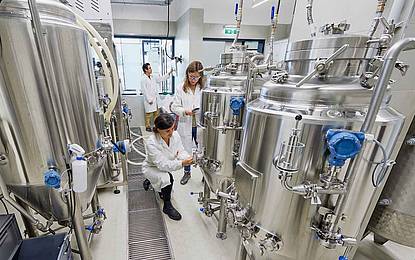
    Drei Personen in Laborkitteln arbeiten inmitten von Edelstahl-Gärtanks

    PLENTY OF SPACE FOR TEACHING AND RESEARCH

    Brewing beer, academically

    Beer has been brewed for thousands of years, and legend has it that the discovery of fermentation was purely coincidental. In our Scientific Brewhouse, we leave nothing to chance.

    Read more

    Networking with graduates and organizations

    We work closely with numerous industrial companies, universities such as the University of Natural Resources and Life Sciences, Vienna (BOKU), the Austrian Centre of Industrial Biotechnology (ACIB) and other research institutes. This guarantees you strong contacts for internships, employment or participation in research and development activities. You can find information about our cooperation activities and much more at Campusnetzwerk.It’s well worth visiting the site as it may direct you to a new job or interesting event held by our cooperation partners!

    Studying made easy

    People smiling at each oter
    Try out studying

    Try out your desired study program (content only in German)

    >
    Bücher mit Geld
    Funding & Scholarships

    More information here

    >
    Hände zeigen auf Weltkarte
    Time abroad

    Expertise, language skills, broadening horizons

    >
    Fish jumps out of fishbowl into another fishbowl
    Open Lectures

    Find out more

    >
    Center for academic writing
    >
    Intensive German course
    >
    EICC
    >
    Recognition of Qualifications
    >
    Accessibility
    >
    queer@HCW
    >

    After graduation

    As a graduate of this program, a wide range of occupational fields and career opportunities are open to you. Find out here where your path can take you.

    Your will receive an education for a growth market. Biotechnology is a key technology of the 21st century that is booming internationally as well as in Austria. Right here in Vienna, a dynamic life science cluster has developed that has also created many jobs in the industry. You will be qualified for a wide range of fields from traditional biotech companies that manufacture pharmaceuticals, to various industries in which bioengineering methods are used in the production of foods, industrial chemicals, other biotechnology products or in brewing and beverage production.

    With your expertise as a bioengineer you will work primarily on optimizing and further developing biotechnological production processes and methods that already work in the lab so that they are also suitable for the commercially viable production in the industry. Quality control and quality assurance play an important role in the production. In the medium term, you will be able to head the production, laboratory or project management.
    • Biopharmaceutical industry

    • Industrial biotechnology

    • Chemicals and plastics

    • Food industry

      • Environmental technology

      • Research institutions

      • Hospitals

      • Authorities


        Downloads

        Folder for Section Bioengineering and Bioinformatics (only in German)
        pdf, 605 KB

        Contact

        Head of Degree Program

        Administration

        Favoritenstraße 222
        E.3.22 (study organisation)
        E.3.25 (section organisation)
        1100 Wien
        +43 1 606 68 77-3600
        bioengineering@hcw.ac.at

        HCW at Google Maps (Google Maps)

        Office hours during semester
        Mo to Thur, 4.30 p.m. to 6.15 p.m.

        Availability by phone
        Mo to Thur, 10.00 a.m. to 6.15 p.m
        Fr, 10.00 a.m. to 2.00 p.m

        Consultation via Zoom

        Make an appointment
         

        You want to know more? We will help you.


        Have you found all the information you are looking for?

        • Yes
        • No
        <
        >
        Drei Personen in Laborkitteln arbeiten inmitten von Edelstahl-Gärtanks

        Plenty of room for teaching and research

        Beer brewing, academically

        Beer has been brewed for thousands of years, and legend has it that fermentation was discovered by chance. In our Scientific Brewhouse, however, nothing is left to chance.

        Mehr dazu