

Dr. techn. Bernhard Rainer, MSc
Head of Research Center Sustainability and Packaging

Project Duration: 01.01.2020 to 31.12.2022
From 2030 onwards, in accordance with the European Union's circular economy strategy, all plastic packaging must be recyclable or reusable. This fact is putting pressure on the plastics processing industry to develop appropriate packaging solutions for the food sector as well.
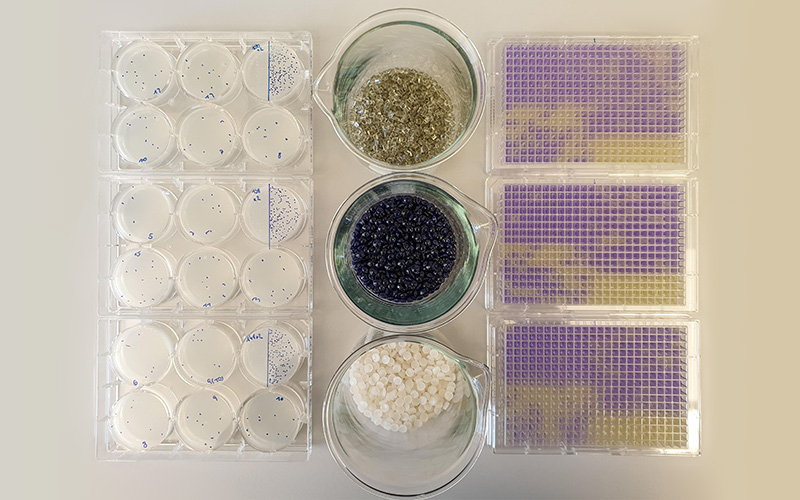
At the moment, the EFSA has hardly authorised any recycling processes, with the exception of PET. Potentially harmful substances could migrate from the polymers into the food they contain and thus pose a risk to consumers. At present, not all possible contaminants can be covered by chemical analysis. Unidentified substances are assumed to be worst-case: directly DNA-reactive genotoxins. Therefore, the use of post-consumer recyclates for the production of food contact materials is currently not yet possible for some very frequently used polymer groups, in particular polyolefins (polyethylene/polypropylene). The Cornet/FFG Polycycle project was launched to develop a test strategy and generate data to enable the authorisation of new recycling processes, including for the food sector.
To meet this challenge, Hochschule Campus Wien is currently working on a test battery focussing on the detection of DNA-reactive genotoxins. The strategy is based on ruling out the presence of these contaminants using in vitro bioassays, thereby supplementing existing analytical methods. The so-called Ames assay in particular has proven to be extremely promising for this application. The greatest challenge here is to improve the detection limits of this assay and to enable the detection of critical substances in very low concentration ranges. In addition to this, sample preparation methods are being developed that should enable greater concentration of the critical analytes. Another important aspect is the software-supported simulation of migration, which should enable a realistic estimation of target concentrations.
Head of Research Center Sustainability and Packaging
Project Staff
Head of Department; Head of Degree Programs Sustainable Packaging Technology, Sustainable Packaging Design and Technology
Company partners (Germany):
APK AG
share GmbH
VogtlandPET GmbH
BuergofolGmbH
HTPGmbH & Co. KG
akk-consulting
BARRIOPAC®
forschgruen Beratungsbüro
FOOD INNOVATIONS
GVMGesellschaft für Verpackungsmarktforschung mbH
JSBeratungJan Söllig
Onusseit Consulting
Pacoon GmbH
Peter Will Verpackungsentwicklung
Umweltkanzlei Dr. Rhein - Beratungs- und Prüfgesellschaft mbH
VerDeSoft GmbH
Unternehmensberatung Weihenstephan
Bund Deutscher Verpackungsingenieure e.V.
Industrieverband Papier- und Folienverpackung e.V. (IPV)
Zentrum für Lebensmittel- und Verpackungstechnologie e.V.
Company partners (Austria):
ALPLA Werke Alwin Lehner GmbH & Co KG
baMed Babyartikel GmbH
Bodo Möller Chemie Austria GmbH
G. Coreth Kunststoffverarbeitungs-GmbH
EREMA Engineering Recycling Maschinen und Anlagen GmbH
Fischer-Plastik GmbH
Fries Kunststofftechnik GmbH
Franz S. Huemer GmbH
Meier Verpackungen GmbH
Miraplast Plastics Processing GmbH
Pack Experts
Premiumpack GmbH
Reichherzer & CO Fleischwarenbedarf GmbH
Sky Plastic Recycling and Commerce GmbH
Starlinger & Co GmbH
Tetra Holdings GmbH
Thermoplastkreislauf GmbH
Volpini Verpackungen GmbH Austria
Wolf Plastics Verpackungen GmbH
Dannemann Global Extrusion GmbH Hildegard Wagner
Joma Plastics Engineering GmbH
World Packaging Organisation