

Mag. rer. nat. Dr. rer. nat. Harald Penasso
Senior Lecturer (Parental Leave)

Project Duration: 01.08.2024 to 30.06.2026
Degenerative musculoskeletal disorders, such as knee osteoarthritis, are on the rise worldwide. In 2020, the prevalence of knee osteoarthritis among adults over 40 ranged from 19.8% to 26.1%. In Austria, osteoarthritis is diagnosed in approximately 10.5% of men and 18.3% of women over the age of 45. Furthermore, 202 people per 100,000 inhabitants received a total knee replacement in 2019, making Austria one of the countries with the highest prevalence of this procedure. Risk factors for these conditions include a sedentary lifestyle, obesity, and poor motor control. Osteoarthritis significantly impairs activities of daily living such as walking, climbing stairs, and standing up, and often leads to a sedentary lifestyle.
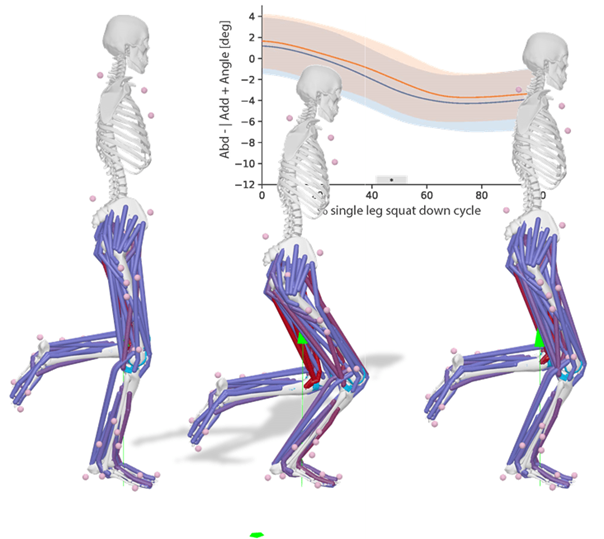
For this reason, in the SETT project we are creating a reference database on leg biomechanics for various everyday tasks and physical exercises. Knee biomechanics is of critical importance as it relates to patellofemoral and tibiofemoral joint loading, which is associated with patellofemoral pain and knee osteoarthritis. Research has identified several biomechanical factors that predispose people to patellofemoral and knee osteoarthritis, including valgus knee (knock knees), lower leg/thigh rotation, hip adduction and gluteus medius muscle activity. Understanding these factors is crucial for stabilizing the knee and reducing joint contact forces. KneeSim now aims to use musculoskeletal simulation in OpenSim to provide insight into the internal processes of the musculoskeletal system in order to identify movements with high loads.
Senior Lecturer (Parental Leave)
Head of Research Center Research Center Health Sciences; Research and Development
Senior Lecturer
Senior Lecturer
Senior Researcher