






Dr. techn. Bernhard Rainer, MSc
Head of Research Center Sustainability and Packaging

Project Duration: 01.01.2023 to 31.12.2024
With the European Circular Economy Action Plan (CEAP), the EU requires that by 2030, all packaging placed on the market must be recyclable, or made from recycled material. When evaluating recycling processes, the European Food Safety Authority (EFSA) assumes that contaminants are to be considered as direct DNA-reactive substances, so-called mutagens. These are toxicologically critical to consumer safety and their presence must be excluded to allow the use of recycled material for food contact (or other high-value applications, such as cosmetic packaging). This is particularly challenging for polyolefins, where very low migration limits apply. The evaluation of recyclates with regard to the presence of critical substances was already started in the predecessor project PolyCycle. There, indications of such pollutants were systematically found in some samples, which probably did not have a post-consumer origin.
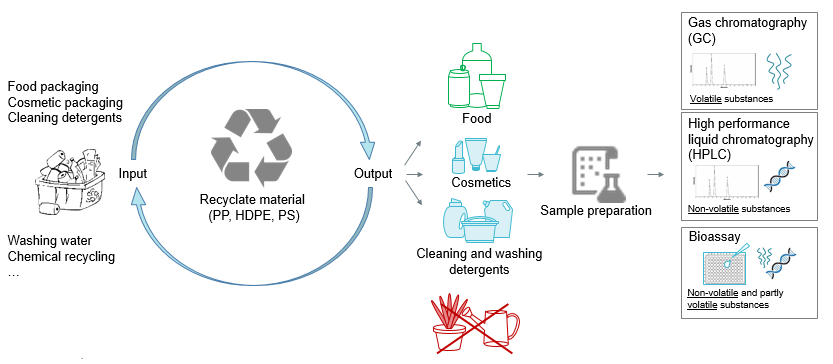
PET recycling is already well established compared with the recycling of polyolefins and polystyrene (PS). Above all, the lack of toxicological information on the substances contained in the recycled material is of crucial importance for safety assessment. This consequently complicates the use of polyolefins and PS in food contact applications. At present, any unknown substance must be classified as a DNA-reactive mutagen and/or carcinogen. The EFSA has classified these substances as being of very high concern and is monitoring the situation closely. The PolyCycle project has already shown that these concerns are not unfounded, as around 30 per cent of all polyolefin samples tested showed a positive reaction to DNA-reactive mutagenicity in the in vitro bioassays. These contaminations proved to be systematic, suggesting that the substances do not originate from the post-consumer sector, but from the recycling process itself. The relevant stage in the recycling process must be identified and adjusted accordingly. Furthermore, the results showed that non-volatile substances have a significant influence on mutagenicity. Instrumental-analytical identification of the substances could assist in the toxicological assessment.
Head of Research Center Sustainability and Packaging
Head of Department; Head of Degree Programs Sustainable Packaging Technology, Sustainable Packaging Design and Technology
Senior Researcher
Project Staff