
Interprofessional Master's Program (Continuing Education)

Simulation in Health Care*

Simulation in Health Care*

part-time


Simulation in Health Care*

Simulation is becoming increasingly important in training, further and continuing education in various disciplines of the healthcare sector. Real and potential situations are practiced in protected and safe learning environments. The interprofessional master's program Simulation in Health Care (I-SIM) teaches in-depth didactic, technological, and scientific skills for teaching, practice, research, and development in a simulation center. In cooperation with the InPASS Institute, graduates receive a certificate as a CRM simulation instructor in addition to their master's degree.

Department
Applied Nursing Science

Highlights

  • Interprofessional master's degree – different disciplines carry out simulations and develop them further.

  • Very high proportion of online teaching + practical units in the 3,000 m2 SimLab

  • Strong technical components, virtual simulations, and use of AI

  • CRM simulation instructor certificate from the InPASS Institute in addition to the master's degree.


    Facts

    Final degree

    Master of Science (Continuing Education) MSc (CE)

    Duration of course
    4 semesters
    Organisational form
    part-time

    Tuition fee

    Once-payment 14.000€1

    + ÖH Beitrag

    ECTS
    120 ECTS
    Language of instruction
    German and English

    Application winter semester 2026/27

    02. March 2026 - 30. June 2026

    Study places

    20

    Location

    Hochschule Campus Wien

    1 payment plan with installments per semester available, information below
    * Subject to approval by the relevant bodies or AQ Austria.


    Before the studies

    You want to rethink learning in the healthcare sector and actively shape the future of patient, client, and resident safety. You are enthusiastic about simulation as a structured learning activity that replicates real or potential situations from training and practice in the healthcare sector and helps to develop, deepen, and reflect on knowledge, skills, and perspectives in a realistic, safe learning environment. You bring an open mindset for collaboration with different professions, for innovative teaching and learning approaches, and for the technological aspects of simulation—from working in a simulation center to developing virtual simulations to the reflective use of AI in research, development, and implementation of simulation. The program is aimed at experts from various disciplines who would like to further develop, research, or implement simulation in the healthcare sector from their respective professional perspectives.

    Why you should study with us

    360° practise

    You learn in real-life situations right from the start: With our cooperation partners or in our well-equipped simulation rooms.

    Applied nursing research

    Gain experience and learn from others in interdisciplinary research projects.

    Study with a future

    Continue your basic training with unique further education programmes for promising professional fields.

    Relevant admission requirement

    The relevant admission requirement is, in accordance with §9 (7) FHG

    • a completed bachelor's degree in a relevant subject with at least 180 ECTS credits or
    • the completion of a degree of equal or higher value from a domestic or foreign post-secondary or tertiary educational institution in the field of health care and nursing, a profession covered by MTD-G (German Medical Professions Act) and midwifery, human/dental and veterinary medicine, as well as technical degree programs, or
    • the completion of a degree in another unrelated subject (e.g., bachelor's degree, diploma, master's degree) at a domestic or foreign post-secondary or tertiary educational institution (at least 180 ECTS) and proof of (planned) professional activity in the health care sector, (planned) work in a simulation center, or (planned) work in the context of research and development of simulation in the health care sector

    and, in addition

    • at least 2 years of relevant professional experience.

    Language requirements for admission

    The required language level according to the Common European Framework of Reference for Languages (CEFR) is at least

    • German - level B2 and
    • English - level B2.

    Depending on the module and course, classes are held in German or English.

    Legalization of foreign documents

    Applicants may require legalization of documents from countries other than Austria in order for them to have the evidential value of domestic public documents. Information on the required legalizations can be found here in PDF format.

    Translation of your documents

    For documents that are neither in German nor English, a translation by a sworn and court-certified interpreter is required. Your original documents should have all the necessary legalization stamps before translation so that the stamps are also translated. The translation must be firmly attached to the original document or a legalized copy.

    Online application - uploading documents

    As part of your online application, upload scans of your original documents including all required legalization stamps. For documents not issued in German or English, scans of the corresponding translations must also be uploaded. The head of the study program decides on the equivalence of international (higher) education qualifications. Therefore, your documents can only be checked as part of the ongoing application process.

    Your path to studying at Hochschule Campus Wien (HCW) begins with your registration on our application platform. In your online account, you can start your application directly or activate a reminder if the application phase has not yet started.

    Documents for your online application

    Proof of identity

    • passport or
    • identity card or
    • Austrian driving license (proof of citizenship required) or
    • residence permit (proof of citizenship required)

    Proof of citizenship

    Proof of citizenship is only required if you have uploaded an Austrian driving license or residence permit as proof of identity. For foreign documents, please upload them together in one file:

    • scan of the original document and
    • legalization (if necessary - find out here) and
    • German or English translation by a certified legal interpreter (if the original document was not issued in German or English)

    Change of name - proof

    • e.g. marriage certificate - only required if your current name does not match the name on your proof of identity or on the documents required to prove the admission requirements

    Proof of fulfillment of the relevant admission requirement

    • Bachelor's certificate or diploma supplement
    • transcript of records

    If you have not yet completed your studies, please upload proof of all courses completed to date as part of the relevant degree program, including ECTS credits.


    Englisch level B2 - proof of language skills

    For admission, English language skills of at least level B2 of the Common European Framework of Reference for Languages (CEFR) must be provided.

    The following applies as proof:

    • secondary school leaving certificate with successfully passed secondary school leaving examination in English (level B2 must be evident)
    • secondary school leaving certificate from an English-speaking school
    • university entrance qualification certificate from an Austrian university with a successfully passed examination in the subject English
    • Transcript of Records/Diploma Supplement from a recognized post-secondary educational institution with proof of successfully completed English-language courses amounting to at least 6 ECTS credits or 150 hours
    • IB Diploma according to the regulations of the International Baccalaureate Organization with English as a school subject
    • supplementary examination pre-study course - English B2
    • English certificate (not older than 3 years), e.g. obtained from:
      • Hochschule Campus Wien: Oxford Test of English Level B2 (score range = 111-140)
      • TOEFL: 72-94 points
      • IELTS Academic: Overall Band Score = 5,5-6,5
      • Cambridge: Ergebnis Level B2 (minimum scale score = 160 bei B2 First (FCE) or C1 Advanced (Certificate in Advanced English CAE))
      • proof of language competence from a university language center at level B2

    Proof of a higher language level is also valid.


    Proof of language skills German B2

    For admission, German language skills of at least level B2 of the Common European Framework of Reference for Languages (CEFR) must be provided.

    The following applies as proof:

    • secondary school leaving certificate from a German-language school
    • completion of at least three years of studies in German
    • supplementary examination pre-study course - German B2
    • German certificate (not older than 3 years), for example:
      • Austrian German Language Diploma: ÖSD Certificate B2
      • Goethe Institute: Goethe Certificate B2
      • telc: German B2
      • German language test for university admission for foreign applicants: DSH-2
      • German Language Diploma of the Standing Conference of the Ministers of Education and Cultural Affairs of the Länder in the Federal Republic of Germany: DSD II
      • Test of German as a foreign language (Test DaF): Level TDN 4 in all parts
      • Language Center of the University of Vienna: Course and successfully passed exam at level B2

    Proof of a higher language level is also valid.


    Letter of motivation in German


    Curriculum vitae in tabular form in German


    Relevant professional experience

    Proof of your relevant professional experience, provided as:

    • certificate of employment or
    • confirmation of the employer or
    • insurance data extract

    The admission procedure consists of two stages. The first stage is your online application. The documents you submit will be used to check that you meet the formal admission requirements. The second stage is a personal admission interview, during which we would like to find out more about your motives, skills, and knowledge.

    Do you still have questions about the program?

    Please contact the administration at  pflege@hcw.ac.at to arrange a personal consultation with the heas of program via Zoom.

    The heads of programs also provide information and advice during regular sessions:

    Online infosessions 

    • Wed, 25th March 2026, 9.00am
    • Wed, 8th April 2026, 4.00pm
    • Wed, 29th April 2026, 9.00am
    • Wed, 13th May 2026, 4.00pm
    • Wed, 27th May 2026, 9.00am
    • Wed, 10th June 2026, 4.00pm
    • Wed, 17th June 2026, 9.00am

    You can join the infosession via this Zoom-Link, wich is valid for all meetings. (Meetind ID: 918 888 9117)

    If you have any questions regarding your participation in the session, please contact pflege@hcw.ac.at 

    Costs1

    Variant A

    one-off payment of € 14.000,-

    Due approximately 4 weeks before the start of the first semester.

    Variant B

    Semesterrate € 3.605,- 

    Due approximately 4 weeks before the start of every semester.

    Total costs € 14.420,-

    Can I afford my studies?

    Financial assistance can be applied for academic expert programs, master's programs, and courses and seminars.

    Information on funding agencies can be found under Funding and Scholarships


    Insights into the program

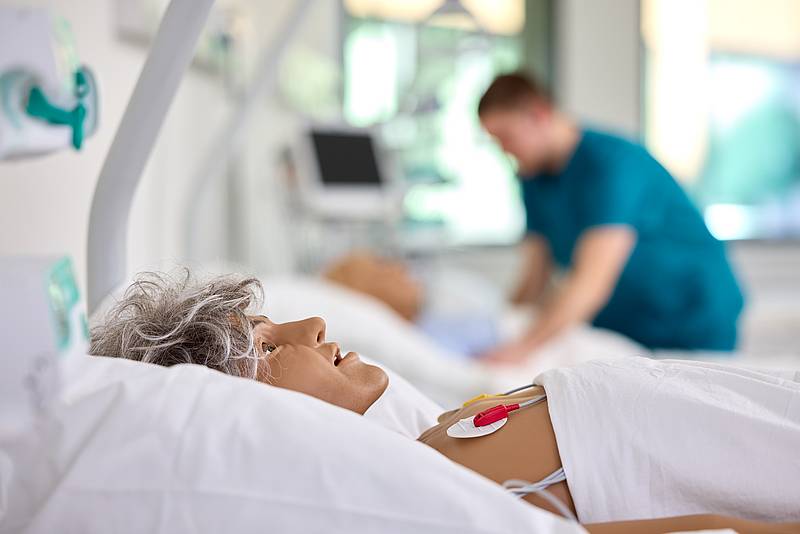
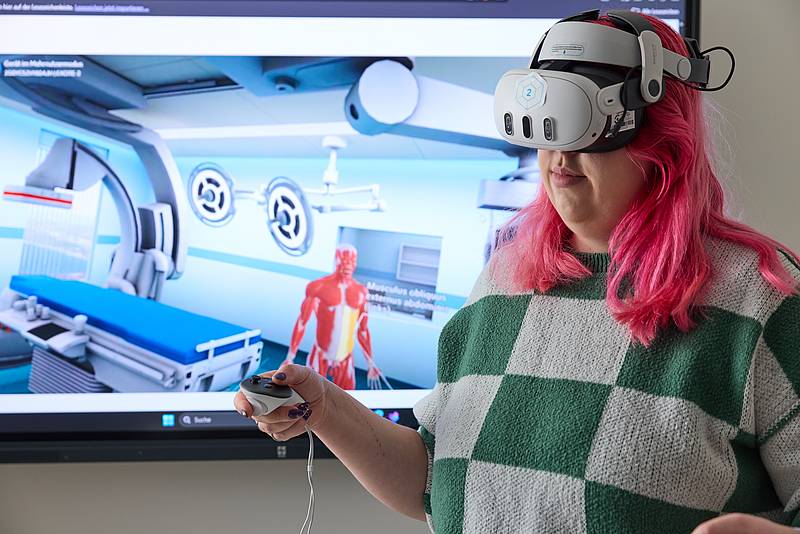
    Interprofessional, international, and innovative: The I-SIM master's program focuses on simulations in health care and also offers a strong engineering focus. Students complete the practical units in the state-of-the-art SimLab, which covers an entire floor of the university with an area of over 3,000 m2.
    <
    >
    Im Vordergrund eine Patientenpuppe in einem Krankenbett. Im Hintergrund eine Person im Kasak über ein zweites Krankenbett gebeugt.
    Eine Person mit VR-Brille und einer Kontrolleinheit in der Hand. Im Hintergrund ein Monitor, der eine Simulation in einem Patientenzimmer zeigt.
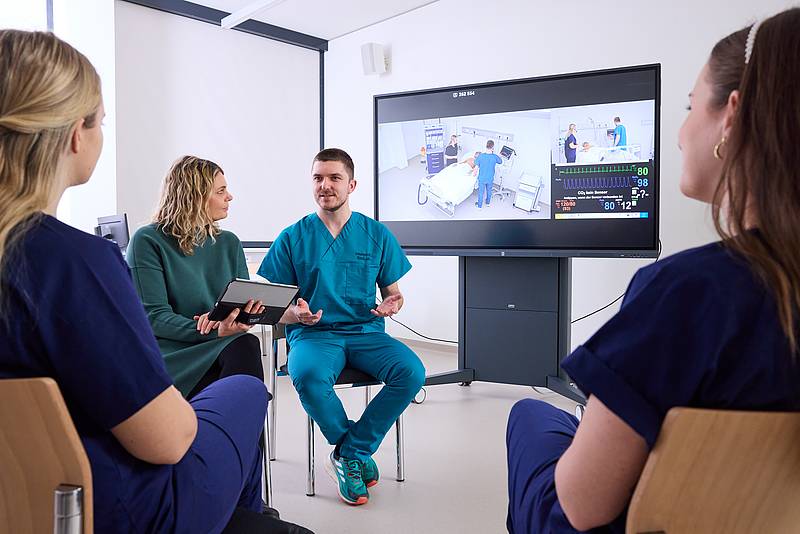
    Vier Personen in einem kleinen Stuhlkreis, die miteinander sprechen. Im Hintergrund ein großer Monitor, der Aufnahmen aus verschiedenen Patientenzimmern zeigt.
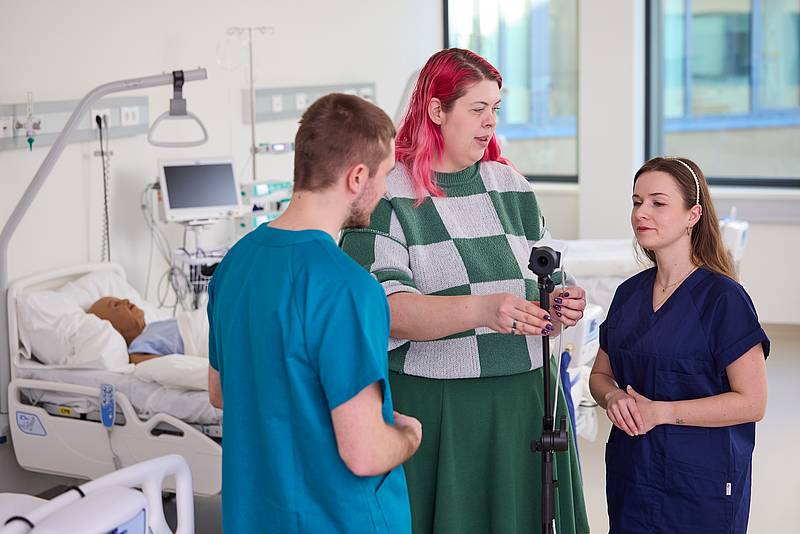
    Drei Personen in einem Patientenzimmer sprechen miteinander. Im Hintergrund eine Patientenpuppe in einem Bett.
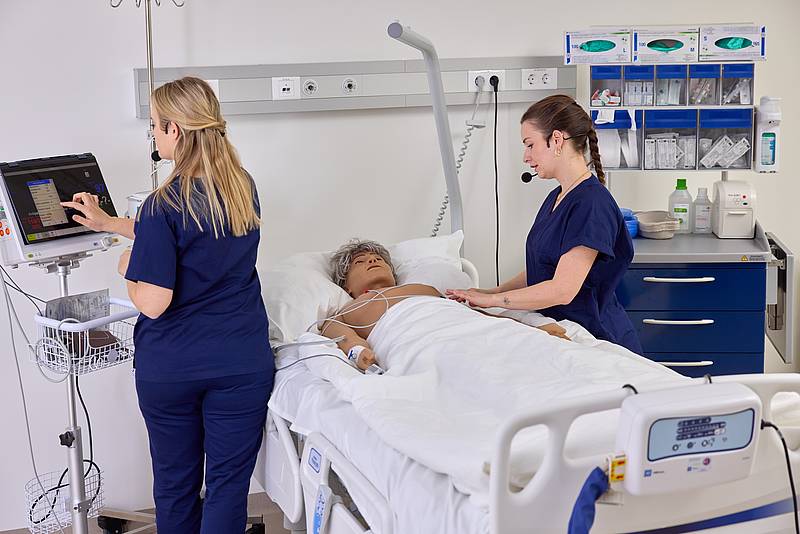
    Zwei Studierende an einem Krankenbett mit einer Patientenpuppe und einem Bildschirm, der die simulierten Vitalwerte zeigt.
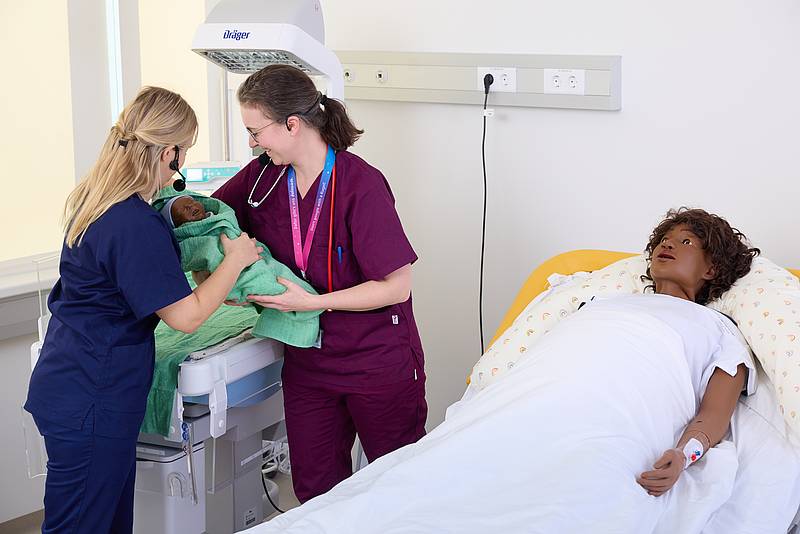
    Zwei Personen in Kasaks in einem Krankenzimmer halten ein Modell eines Säuglings. Daneben ein Krankenbett mit einer Puppe, die eine Patientin darstellt.

    During the studies

    Hochschule Campus Wien is currently the only university of applied sciences in the German-speaking world to offer a master's program in simulation in health care, thus enabling graduates from various disciplines to obtain higher qualifications. On-campus teaching takes place in the state-of-the-art simulation center at Hochschule Campus Wien and is supplemented by a high proportion of digital teaching formats (around 70%). This makes it possible to study from anywhere in the German-speaking world. It also gives students the opportunity to exchange ideas and network across disciplines and national borders on simulation in the health care sector here in Vienna.

    The program focuses on innovative teaching methods and best practice samples from teaching. In interprofessional R&D projects, you can learn about application-oriented research in practice and make valuable contacts for your professional future. Your feedback is important to us: we continue to develop training content based on continuous monitoring and targeted evaluation studies for new formats.

    Our large national and international network and the cooperation between our various departments in teaching and research offer great potential. With almost 70 study programs in seven departments, Hochschule Campus Wien is the largest and most diverse university of applied sciences in Austria. Having launched the bachelor's degree program in Health Care and Nursing in 2008 as the first university of applied sciences in Austria to do so, we now have extensive expertise and have built up a large network in the healthcare sector.

    The program comprises six key areas of focus:

    1. mindset and ethics in simulation
    2. didactics and communication in simulation
    3. implementing simulations
    4. interprofessional education (IPE) and collaboration (IPC) in simulation
    5. engineering and computer science in simulation
    6. research in simulation 
       

    Curriculum

    Module Foundational Mindset in Simulation
    4 SWS
    10 ECTS
    Impro Workshop - Embracing Challenges | UE

    Impro Workshop - Embracing Challenges | UE

    1 SWS   2 ECTS

    Content

    > Basic principles of improvisational theater: (Yes exactly And, enjoy failure, let your partner shine)

    > Techniques for transforming mistakes and failure into something positive/opportunities

    > games to get to know each other

    > Warm-up exercises from the field of improvisational theater

    > Exercises in self-perception and perception of others.

    > Scenic exercises in plenary

    Teaching method

    Lecture, small group exercises

    Examination

    Continuous assessment: Attendance and active participation

    Literature

    > Boal, A. (2019). THEATRE OF THE OPPRESSED. PLUTO Press.

    > Johnstone, K. (2006). Theaterspiele: Spontaneität, Improvisation und Theatersport (6. Aufl.). Alexander-Verl.

    > Dixon, R. (2000). Im Moment: Theaterkunst, Improtheater - Reflexionen und Perspektiven. Impuls-Theater-Verl. / Buschfunk.

    > Lösel, G. (2004). Theater ohne Absicht: Impulse zur Weiterentwicklung des Improvisationstheaters; [ein Herz-, Hand-und Hirnbuch für Improvisationstheater]. Impuls-Theater-Verlag.

    > Lösel, G. (2014). Das Spiel mit dem Chaos: Zur Performativität des Improvisationstheaters (Vol. 56). transcript Verlag.

    > Spolin, V. (1997). Improvisationstechniken für Pädagogik, Therapie und Theater (5. Aufl.). Junfermann.

    > Tavares, G. (2012). Improv for everyone. M & L Books.

    Teaching language

    Deutsch

    1 SWS
    2 ECTS
    Professional Integrity in Simulation | ILV

    Professional Integrity in Simulation | ILV

    1 SWS   3 ECTS

    Content

    < Foundations for simulation participation: mindset, norms, and patient-/client-centered orientation; integrity beyond compliance. 

    < Professional integrity as a core element of professional practice 

    < Introduction to the mindset needed for effective participation in simulation-based education: Integrity, dignity, psychological safety, clear boundaries; inclusive verbal and nonverbal communication. 

    < Reflection on ethical standards and their relevance in simulation: Ethical/professional frameworks: principles and discipline-specific codes; shared interprofessional standards. Core ethical standards: respect, trust, confidentiality, professional conduct 

    < Translating ethical principles into concrete behaviors during simulation 

    < Demonstrating understanding of integrity in interpersonal interactions within simulation settings

    Teaching method


    Impulse lectures and interactive short inputs


    Examination

    Continuous assessment

    Literature

    Brown, M. E. L., Coker, O., Heybourne, A., & Finn, G. M. (2020). Exploring the Hidden Curriculum’s Impact on Medical Students: Professionalism, Identity Formation and the Need for Transparency. Medical Science Educator, 30 (3), 1107–1121.

    Canadian Interprofessional Health Collaborative. (2024). CIHC Competency Framework for Advancing Collaboration 2024. www.cihc-cpis.com

    INACSL Standards Committee, Xavier, N., Quinn, J., Amidon, B., Barnes, R., Bronson, S., & Dunning, L. (2025a). The impact of professional integrity on simulation learning outcomes: A systematic review. Clinical Simulation In Nursing, 101.

    INACSL Standards Committee, Xavier, N., Quinn, J., Amidon, B., Barnes, R., Bronson, S., & Dunning, L. (2025b). Healthcare Simulation Standards of Best Practice® Facilitation. Clinical Simulation In Nursing, Volume 105, 101778

    Interprofessional Education Collaborative. (2023, November 20). IPEC Core Competencies for Interprofessional Collaborative Practice. Version 3. www. ipecollaborative.org/ipec-core-competencies

    Park, C. S, & Murphy, T. F. Code of Ethics Working Group, & Society for Simulation

    in Healthcare. (2018). Healthcare Simulationist: Code of Ethics (pp. 1–12). https:

    //www.ssih.org/SSH- Resources/Code- of- Ethics .

    Society for Simulation in Healthcare, & Code of Ethics Working Group. (n.d.).

    Healthcare Simulationist Code of Ethics . Society for Simulation in Healthcare Resources. Retrieved Nov 21, 2025, from www.ssih.org/SSH-Resources/ Code- of- Ethics

    World Health Organization. (n.d.). WHO Code of Ethics . Retrieved Nov. 21, 2025, from www.who.int/publications/m/item/who- code- of- ethics

    Teaching language

    Englisch

    1 SWS
    3 ECTS
    Introduction to Psychological Safety | ILV

    Introduction to Psychological Safety | ILV

    2 SWS   5 ECTS

    Content

    < Basics of psychological safety: definition of the term; historical development from organizational psychology; differences to comfort (growth mindset vs. feel-good atmosphere).

    < Models of psychological safety: Clark's four-level model (Inclusion, Learner, Contributor, Challenger Safety) and Team Psychological Safety Scale; Just Culture models in healthcare; comparison with TeamSTEPPS and Crew Resource Management.

    < Antecedents and barriers: Individual factors such as proactive personality, emotional stability, learning orientation; team factors such as inclusive leadership, role clarity, peer support; organizational influences (error culture, power structures, hierarchies, diversity).

    < Strategies for creating a "safe container": prebriefing techniques, learning contracts, building trust; positive appreciation, non-verbal communication, asking questions; dealing with emotions and reactance; restoring safety after disruptions.

    < Debriefing and psychological safety: importance of safety for effective reflection; balance between feedback and protection from loss of face; models such as Good Judgment, PEARLS; dealing with defensive behavior and hierarchies.

    < Sociological and cultural aspects: Power imbalances, role models, gender, intersectionality; influence of organizational culture on error reporting and "speak-up"; international comparison.

    < Andragogy and learning in safe environments: Andragogical principles (self-direction, experience, relevance, practice orientation, respectful attitude); importance of reflection, feedback and experience for sustainable learning.

    < Evaluation of psychological safety: application of instruments such as the Team Psychological Safety Questionnaire; observation criteria in simulations; quality assurance.


    Teaching method

    Impulse lectures and interactive short inputs

    Examination

    Continuous assessment: Practical examination, portfolio

    Literature

    Centres for Disease Control and Prevention. (2021). Principles of Adult Learning. CDC Learning Connection. www.cdc.gov/training/development/pdf/adultlearning-principles.pdf

    Clark, T. R. (2020). The 4 Stages of Psychological Safety: Defining the Path to Inclusion and Innovation. Oakland, CA: Berrett Koehler.

    Dong, C., Altshuler, L., & Colleagues. (2024). Psychological safety in health professions education: Insights and strategies from a global community of practice. Frontiers in Medicine, 11, Article 1508992. doi.org/10.3389/fmed.2024.1508992

    Edmondson, A. C. (2019). The Fearless Organization: Creating Psychological Safety in the Workplace for Learning, Innovation, and Growth. Hoboken, NJ: John Wiley & Sons.

    Kolbe, M., Eppich, W., Rudolph, J., Meguerdichian, M., Catena, H., Cripps, A., Grant, V., & Cheng, A. (2020). Managing psychological safety in debriefings: A dynamic balancing act. BMJ Simulation & Technology Enhanced Learning, 6(3), 164–171. doi.org/10.1136/bmjstel-2019-000470

    Lateef, F. (2020). Maximizing learning and creativity: Understanding psychological safety in simulation-based learning. Journal of Emergencies, Trauma, and Shock, 13(1), 5–14. doi.org/10.4103/JETS.JETS_96_19

    Rudolph, J. W., Raemer, D. B., & Simon, R. (2014). Establishing a safe container for learning in simulation: The importance of debriefing with good judgment. Simulation in Healthcare, 9(6), 339–349.

    Vu, V., Buléon, C., Le, T. A., Lua, C. C. P., Martin, F., Minehart, R., & Macaire, P. (2025). Changing minds, saving lives: How training psychological safety transforms healthcare. BMJ Open Quality, 14(2), e003186. doi.org/10.1136/bmjoq-2024-003186

    Teaching language

    Deutsch

    2 SWS
    5 ECTS
    Module Learning Theory Principles of Simulation-Based Learning
    4 SWS
    10 ECTS
    Learning Theory Foundations for Simulation-Based Learning | ILV

    Learning Theory Foundations for Simulation-Based Learning | ILV

    1 SWS   3 ECTS

    Content

    • Foundations of learning and teaching theories: Behaviorism (Skinner; learning through reinforcement), cognitivism (information processing, memory structures), constructivism (learning as an active, constructive process), social-cognitive theory (Bandura's self-efficacy and observational learning), humanistic theory (Rogers), connectivism and sociocultural approaches.


    • Adult education / andragogy: Andragogical principles such as self-direction, experience orientation, relevance, practical relevance and respect; role of reflection and lifelong learning.


    • Cognitive load theory: limited capacity of working memory, instructional design to reduce external load, segmentation and progression; model progression and active integration of representations.


    • Mastery learning and deliberate practice: learning to mastery (outcome-based rather than time-based); continuous feedback loops; progressive difficulty; importance for patient safety and skill development.


    • Instructional design and curriculum development: Using the ADDIE model (analysis, design, development, implementation, evaluation) to systematically develop simulation-based curricula. Consideration of fidelity, goal definition, feedback methods and assessment.


    • Feedback and debriefing: difference between feedback (information) and debriefing (reflection), forms and timing of feedback; role of psychological safety.


    • Sociological and psychological aspects: Group processes, team dynamics, social identity, power relations; influence of culture and diversity; self-efficacy and motivation. Reflection on implicit bias.


    • Evaluation of simulation and learning: use of taxonomic models (Bloom, Miller) to derive learning objectives and evaluation; formative vs. summative assessment; measurement of transfer performance and practical relevance.


    Teaching method

    Lecture with exercises, interactive elements and group discussions

    Examination

    Final exam: Oral examination

    Literature

    Bandura, A. (1977). Social learning theory. Prentice-Hall.

    Centers for Disease Control and Prevention. (2021). Principles of adult learning. CDC Learning Connection. www.cdc.gov/training/development/pdf/adultlearning-principles.pdf

    de Jong, T., & Sarti, L. (1994). Design and production of multimedia and simulation-based learning material. Kluwer Academic Publishers.

    Felix, H. M., & Schertzer, K. (2022). Mastery learning in medical simulation. In StatPearls. StatPearls Publishing.

    Felix, H. M., & Simon, L. V. (2022). Conceptual frameworks in medical simulation. In StatPearls. StatPearls Publishing.

    Kolb, D. A. (1984). Experiential learning: Experience as the source of learning and development. Prentice Hall.

    McGaghie, W. C., Issenberg, S. B., Cohen, E. R., Barsuk, J. H., & Wayne, D. B. (2011). Does simulation-based medical education with deliberate practice yield better results than traditional clinical education? Medical Education, 45(2), 171–183.

    Squires, K., Heaney, S., Macdonald Wicks, L., Johnston, C., & Brown, L. (2024). Use of learning theories to guide simulation-based learning in allied health student professional placements: A narrative review. International Journal of Work-Integrated Learning, 25(2), 289–304.

    Sweller, J., Ayres, P., & Kalyuga, S. (2011). Cognitive load theory. Springer.


    Teaching language

    Deutsch

    1 SWS
    3 ECTS
    Formulating Learning Outcomes  | UE

    Formulating Learning Outcomes  | UE

    1 SWS   2 ECTS

    Content

    • Meaning and functions of learning outcomes in simulation-based learning
    • Types and levels of learning outcomes (cognitive, psychomotor, affective)
    • Learning outcomes in constructive alignment (relation to teaching/learning activities and assessment)
    • Formulation of competence-oriented and verifiable learning outcomes (SMART, Bloom, Miller)
    • Ethical and context-sensitive aspects in the formulation (psychological safety, target group orientation)
    • Use and critical analysis of AI-supported tools in the development of learning outcomes
    • Analysis and theory-based revision of existing learning outcomes
    • Basics of evaluating learning outcomes in the context of simulations

    Teaching method

    Flipped classroom; peer review / peer feedback; case-based learning

    Examination

    Continuous assessment

    Literature

    Anderson, L. W., & Krathwohl, D. R. (Eds.). (2001). A taxonomy for learning, teaching, and assessing: A revision of Bloom’s taxonomy of educational objectives (Complete ed.). Longman.

    Bergstermann, A., Cendon, E., Flacke, L. B., Friedrich, A., Hiltergerke, C., Schäfer, M., Strazny, S., Theis, F., Wachendorf, N. M., & Wetzel, K. (2013). Handreichung Lernergebnisse. Teil 1: Theorie und Praxis einer outcomeorientierten Programmentwicklung“ doi.org/10.25656/01:12984

    Biggs, J. (1996). Enhancing teaching through constructive alignment. Higher Education, 32(3), 347–364. doi.org/10.1007/BF00138871

    Kauffeld, S., Grote, S., & Frieling, E. (Hrsg.). (2009). Handbuch Kompetenzentwicklung. Schäffer-Poeschel.

    Teaching language

    Deutsch

    1 SWS
    2 ECTS
    Health Care Standards - Best Practice  | ILV

    Health Care Standards - Best Practice  | ILV

    1 SWS   2 ECTS

    Content

    > Overview and comparative mapping of INACSL, SSH, and ASPE standards

    > Writing measurable outcomes for simulation based education by analyzing and integrating INACSL Outcomes & Objectives and Simulation Design criteria

    > How standards translate into audit tools for accreditation evidence; and/or a standards audit for a simulation centre or course

    > Framing focused questions about standards, accreditation, and outcomes (e.g., learner performance, patient safety, team functioning); basic searching and critical appraisal refresher

    > Argue a position, supported by literature, on how standards/accreditation influence the local or aspirational context.


    Teaching method

    Lecture with exercises and group discussions

    Examination

    Continuous assessment

    Literature

    INACSL Standards Committee. (2025). Preamble: Grounded in excellence: The Cornerstone Healthcare Simulation Standards of Best Practice®. Clinical Simulation in Nursing, 105, 101774. doi.org/10.1016/j.ecns.2025.101774

    INACSL Standards Committee. (2025). Healthcare Simulation Standards of Best Practice®: Prebriefing: Preparation and briefing. Clinical Simulation in Nursing, 105, 101777. doi.org/10.1016/j.ecns.2025.101777

    INACSL Standards Committee. (2025). Healthcare Simulation Standards of Best Practice®: Facilitation. Clinical Simulation in Nursing, 105, 101776. doi.org/10.1016/j.ecns.2025.101776

    INACSL Standards Committee. (2025). Healthcare Simulation Standards of Best Practice®: The debriefing process. Clinical Simulation in Nursing, 105, 101775. doi.org/10.1016/j.ecns.2025.101775

    INACSL Standards Committee. (2025). Healthcare Simulation Standards of Best Practice®: Professional integrity. Clinical Simulation in Nursing, 105, 101778. doi.org/10.1016/j.ecns.2025.101778

    INACSL Standards Committee. (2021). Healthcare Simulation Standards of Best Practice®: Professional development. Clinical Simulation in Nursing, 58, 5–8. doi.org/10.1016/j.ecns.2021.08.007

    INACSL Standards Committee. (2021). Healthcare Simulation Standards of Best Practice®: Simulation design. Clinical Simulation in Nursing, 58, 14–21. doi.org/10.1016/j.ecns.2021.08.009

    INACSL Standards Committee. (2021). Healthcare Simulation Standards of Best Practice®: Operations. Clinical Simulation in Nursing, 58, 33–39. doi.org/10.1016/j.ecns.2021.08.012

    INACSL Standards Committee. (2021). Healthcare Simulation Standards of Best Practice®: Outcomes and objectives. Clinical Simulation in Nursing, 58, 40–44. doi.org/10.1016/j.ecns.2021.08.013

    INACSL Standards Committee. (2021). Healthcare Simulation Standards of Best Practice®: Simulation-enhanced interprofessional education. Clinical Simulation in Nursing, 58, 49–53. doi.org/10.1016/j.ecns.2021.08.015

    INACSL Standards Committee. (2021). Healthcare Simulation Standards of Best Practice®: Evaluation of learning and performance. Clinical Simulation in Nursing, 58, 54–56. doi.org/10.1016/j.ecns.2021.08.016

    Lewis, K. L., Bohnert, C. A., Gammon, W. L., Hölzer, H., Lyman, L., Smith, C., Thompson, T. M., Wallace, A., & Gliva-McConvey, G. (2017). The Association of Standardized Patient Educators (ASPE) Standards of Best Practice (SOBP). Advances in Simulation, 2(10). doi.org/10.1186/s41077-017-0043-4 (BioMed Central)

    Barlow, M., Heaton, L., Ryan, C., Downer, T., Reid-Searl, K., Guinea, S., Dickie, R., Wordsworth, A., Hawes, P., Lamb, A., & Andersen, P. (2024). The application and integration of evidence-based best practice standards to healthcare simulation design: A scoping review. Clinical Simulation in Nursing, 87, Article 101495. doi.org/10.1016/j.ecns.2023.101495 (Western Sydney University Researchers)

    Crawford, S. B. (2018). Comment on ASPiH standards for simulation-based education. BMJ Simulation & Technology Enhanced Learning, 4(3), 103–104. doi.org/10.1136/bmjstel-2018-000323 (PMC)


    Teaching language

    Englisch

    1 SWS
    2 ECTS
    Academic Writing | ILV

    Academic Writing | ILV

    1 SWS   3 ECTS

    Content

    Scientific thinking and research in an interprofessional context:

    < Deepening scientific thinking, argumentation and working methods in interprofessional contexts of the health care sector

    < Translating complex practical and simulation problems into precise, scientifically based research questions

    < Reflection on responsibility and integrity in the scientific knowledge process

    Information literacy and literature evaluation:

    < Strategic and efficient literature research in subject-specific and interdisciplinary databases

    < Assessing scientific sources according to quality and relevance criteria (level of evidence, methodology, topicality, peer review)

    < Structured organization of literature with the help of literature management tools

    < In-depth understanding of scientific citation logic and its ethical, methodological and institutional significance

    Scientific text production and communication:

    <Planning, structuring and writing scientific text samples in compliance with international citation and formatting standards

    < Application of argumentation-logical and evidence-based writing techniques

    < Developing a coherent scientific line of argument in your own specialist context

    Digital and AI-supported tools in science:

    < Critical reflection on the use of AI-based and digital tools in the research process

    < Application of AI-supported systems for research, structural and text support, taking into account transparency, traceability and scientific ethical principles


    Teaching method

    Lecture with exercises and group discussions

    Examination

    Continuous assessment: Submission of a scientific problem (partial performance 1), submission of a sample exposé (partial performance 2)

    Literature

    ALLEA – All European Academies. (2023). Europäischer Verhaltenskodex für wissenschaftliche Integrität: Überarbeitete Fassung 2023 (Dt. Übers. Mai 2024). ALLEA. doi.org/10.26356/ECOC-German

    Buck, I. (2025). Wissenschaftliches Schreiben mit KI (1. Aufl.). UTB GmbH.

    Ertl-Schmuck, R., Unger, A., & Mibs, M. (2023). Wissenschaftliches Arbeiten in Gesundheit und Pflege (2., überarb. u. erw. Aufl.). UTB GmbH.

    Esselborn-Krumbiegel, H. (2022). Richtig wissenschaftlich schreiben: Wissenschaftssprache in Regeln und Übungen (Vol. 3429). UTB.

    Österreichische Agentur für wissenschaftliche Integrität. (2019). Richtlinien der Österreichischen Agentur für wissenschaftliche Integrität zur Guten Wissenschaftlichen Praxis (Neugestaltung 2019 [Erstauflage 2015]). Österreichische Agentur für wissenschaftliche Integrität.

    Ritschl, V., Weigl, R., & Stamm, T. (Hrsg.). (2023). Wissenschaftliches Arbeiten und Schreiben: Verstehen, anwenden, Nutzen für die Praxis (2. Aufl.). Springer.

    Schmohl, T., Watanabe, A., & Schelling, K. (Hrsg.). (2023). Künstliche Intelligenz in der Hochschulbildung: Chancen und Grenzen des KI-gestützten Lernens und Lehrens. transcript Verlag. doi.org/10.14361/9783839457696

    Theisen, M. R. (2024). Wissenschaftliches Arbeiten: Erfolgreich bei Bachelor- und Masterarbeit (19., neu bearb. Aufl.). Vahlen.

    Teaching language

    Deutsch

    1 SWS
    3 ECTS
    Module Use and Intent of Simulation
    7 SWS
    10 ECTS
    Introduction to Simulation Modalities and the Concept of Fidelity  | ILV

    Introduction to Simulation Modalities and the Concept of Fidelity  | ILV

    1 SWS   1 ECTS

    Content

    • Overview of different simulation modalities (low-, medium- and high-fidelity simulation, computer-based simulation, standardized patients, hybrid simulations)
      • Characteristics, strengths, limitations and resource requirements
      • Assessment and selection of suitable forms of simulation depending on learning objectives, target groups and skills to be developed
    • Concept of fidelity
      • Introduction to the concept and dimensions of fidelity
      • Discussion of the importance of fidelity for learning success, realism and transfer to everyday practice
      • Reflection on the balance between realism, costs, practicability and didactic added value
    • Practical moulage exercise:
      • Application of various materials and techniques to create realistic training scenarios
      • Testing and reflecting on the use of moulage in the context of different fidelity levels

    Teaching method

    Lecture with exercises and group discussions

    Examination

    Continuous assessment: Submission of a simulation scenario (partial achievement 1), independent production and presentation of a moulage (partial achievement 2), active participation in the implementation of a simulation scenario in a small group (partial achievement 3)

    Literature

    Duinmeijer, W. C., Fresiello, L., Swol, J., Torrella, P., Riera, J., Obreja, V., Puślecki, M., Dąbrowski, M., Arens, J., & Halfwerk, F. R. (2023). Simulators and Simulations for Extracorporeal Membrane Oxygenation: An ECMO Scoping Review. Journal of Clinical Medicine, 12(5). doi.org/10.3390/jcm12051765

    Hamstra, S. J., Brydges, R., Hatala, R., Zendejas, B., & Cook, D. A. (2014). Reconsidering fidelity in simulation-based training. Academic medicine, 89(3), 387-392.

    Lavoie, P., Deschênes, M.F., Nolin, R., Bélisle, M., Blanchet Garneau, A., Boyer, L., Lapierre, A., & Fernandez, N. (2020). Beyond Technology: A Scoping Review of Features that Promote Fidelity and Authenticity in Simulation-Based Health Professional Education. Clinical Simulation in Nursing, 42, 22–41. doi.org/10.1016/j.ecns.2020.02.001

    Roussin CJ, Weinstock P. SimZones: An Organizational Innovation for Simulation Programs and Centers. Acad Med. 2017 Aug;92(8):1114-1120. doi: 10.1097/ACM.0000000000001746. PMID: 28562455.

    Owen, H. (2012). Early use of simulation in medical education. Simulation in Healthcare, 7(2), 102-116.

    Teaching language

    Deutsch

    1 SWS
    1 ECTS
    Low Fidelity / Task-Based-Trainers (Skills-Training) | ILV

    Low Fidelity / Task-Based-Trainers (Skills-Training) | ILV

    1 SWS   1 ECTS

    Content

    > Definition of low fidelity simulation and skills training

    Differentiation between low, medium and high fidelity simulations

    Characteristics and objectives of low fidelity simulations

    Definition: What does "skills training" mean in a university context?

    Practical examples from the healthcare sector

    Didactic objectives of both forms of training


    < Strengths and weaknesses of the simulation types "low fidelity simulation" and "skills training"

    Comparison of degree of complexity, costs and learning transfer

    Analysis of effectiveness in relation to cognitive, psychomotor and social learning objectives

    Classification in the didactic setting (preparation, implementation, transfer)

    Limits of fidelity to reality and effects on learning effectiveness


    < Intended learning outcomes appropriate to the simulation types "low fidelity simulation" and "skills training"

    Assignment of learning outcomes to knowledge, skill and competence levels

    Examples of observable actions for checking the outcomes

    Reflection on learning outcomes with regard to job-related requirements


    < "Cognitive apprenticeship" model for skills training and the role of the skills trainer

    Basics and phases of the cognitive apprenticeship model (modeling, coaching, scaffolding, etc.)

    Transfer to the context of practical skills training

    Designing learning environments according to the model


    < Methodical possibilities of reflective learning in low fidelity simulation and skills training

    Different requirements for reflection processes depending on the form of simulation


    Teaching method

    Lecture with exercises and group discussions, low fidelity simulation training and skills training

    Examination

    Continuous assessment: Submission of teaching disposition (optionally for low fidelity simulation or skills training) (partial performance 1), submission of description of use of "Cognitive Apprenticeship" model (partial performance 2)

    Literature

    Biggs, J. B., & Tang, C. (2011). Teaching for Quality Learning at University. (4nd ed.). Society for Research into Higher Education & Open University Press.

    Collins, A., Brown, J. S. & Newman, S. E. (1989). Cognitive apprenticeship: Teaching the crafts of reading, writing, and mathematics. In L. B. Resnick (Hrsg.), Knowing, learning, and instruction: Essays in honor of Robert Glaser (pp. 453 – 494). Hillsdale: Lawrence.

    INACSL Standards Committee. (2021). Onward and Upward: Introducing the Healthcare Simulation Standards of Best Practice TM. Clinical Simulation in Nursing, 58, 1–4. doi.org/10.1016/j.ecns.2021.08.006

    Küng, R., Staudacher, D. & Panfil, E. (2018). Ein zentrales pädagogisches Modell für die Praxisausbildung: «Cognitive Apprenticeship». Das Potenzial des CAS-Modells im Kontext der Kriterien für «guten Unterricht». PADUA, 13(2), 115-123.

    Wooley, N. & Jarvis, Y. (2007). Situated Cognition and Cognitive Apprenticeship: A model for teaching and learning clinical skills in a technologically rich and authentic environment. Nurse Education Today, 27, 73 – 79.

    Teaching language

    Deutsch

    1 SWS
    1 ECTS
    High Fidelity Simulation | ILV

    High Fidelity Simulation | ILV

    2 SWS   2 ECTS

    Content

    > Introduction to the concept of fidelity

    > Introduction to Fictional Contract

    > Definition, areas of application and differentiation of high fidelity

    > Planning and implementation of high fidelity

    > Tips and tricks

    Teaching method

    Lecture with exercises and group discussions

    Examination

    Final exam: Written examination

    Literature

    Golicnik, A., Berden, J., Goslar, T., & Gorjup, V. (2023). High fidelity ECMO simulation: A reality check with reality-use of simulation in ECMO teaching program. Journal of Artificial Organs: The Official Journal of the Japanese Society for Artificial Organs, 26(1), 36–44. doi.org/10.1007/s10047-022-01336-1

    Kim, J., Park, J.-H., & Shin, S. (2016). Effectiveness of simulation-based nursing education depending on fidelity: A meta-analysis. BMC Medical Education, 16, 152. doi.org/10.1186/s12909-016-0672-7

    Koca, A., Schlatter, S., Delas, Q., Denoyel, L., Lehot, J.-J., Lilot, M., & Rimmelé, T. (2023). Influence of the embedded participant on learners’ performance during high-fidelity simulation sessions in healthcare. BMC Medical Education, 23(1), 751. doi.org/10.1186/s12909-023-04724-0

    Massoth, C., Röder, H., Ohlenburg, H., Hessler, M., Zarbock, A., Pöpping, D. M., & Wenk, M. (2019). High-fidelity is not superior to low-fidelity simulation but leads to overconfidence in medical students. BMC Medical Education, 19(1), 29. doi.org/10.1186/s12909-019-1464-7

    Scerbo, M. W., & Dawson, S. (2007). High fidelity, high performance? Simulation in Healthcare: Journal of the Society for Simulation in Healthcare, 2(4), 224–230. doi.org/10.1097/SIH.0b013e31815c25f1

    Vangone, I., Arrigoni, C., Magon, A., Conte, G., Russo, S., Belloni, S., Stievano, A., Alfes, C. M., & Caruso, R. (2024). The efficacy of high-fidelity simulation on knowledge and performance in undergraduate nursing students: An umbrella review of systematic reviews and meta-analysis. Nurse Education Today, 139, 106231. doi.org/10.1016/j.nedt.2024.106231


    Teaching language

    Deutsch

    2 SWS
    2 ECTS
    Computer-Based Simulation (e.g. VR-Simulation, Augmented Reality) | UE

    Computer-Based Simulation (e.g. VR-Simulation, Augmented Reality) | UE

    1 SWS   2 ECTS

    Content

    Overview of computer-based simulation options:

    < Branching Choice Games

    < Simulation video games

    < Mixed reality/extended reality (virtual reality/augmented reality)

    < Asset sourcing

    < Use of artificial intelligence

    Branching choice games:

    < Structure

    < Applications

    < Target group, examples, advantages/disadvantages

    Simulation video games:

    < Basic knowledge of software development in video games

    < Graphics, sound

    < Platforms: Smartphone, PC/game console

    < Target group, examples, advantages/disadvantages

    Mixed reality/extended reality (virtual reality/augmented reality):

    < Basic knowledge of software development for MR/XR and engines

    < Graphics, sound, haptics

    < Platforms: Manufacturers, variants

    < Areas of application, examples, advantages/disadvantages

    Practical exercises:

    < Carrying out simulation scenarios on different platforms and documenting the observations in a seminar paper

    < One example each for: Branching choice games, video games, MR/XR

    Evaluation and scientific analysis

    Teaching method

    Self-study on basic knowledge, performance assessment in the first course unit, theory unit on specific specialist knowledge in attendance, practical exercises with accompanying/concluding seminar paper

    Examination

    Continuous assessment: Initial test on self-study content, performance of practical small group exercises and documentation in a seminar paper, assessment after each partial submission and final submission.

    Literature

    Baniasadi, Tayebeh, Seyed Mohammad Ayyoubzadeh, und Niloofar Mohammadzadeh. „Challenges and Practical Considerations in Applying Virtual Reality in Medical Education and Treatment“. Oman Medical Journal 35, Nr. 3 (2020): e125. doi.org/10.5001/omj.2020.43.

    Barteit, Sandra, Lucia Lanfermann, Till Bärnighausen, Florian Neuhann, und Claudia Beiersmann. „Augmented, Mixed, and Virtual Reality-Based Head-Mounted Devices for Medical Education: Systematic Review“. JMIR Serious Games 9, Nr. 3 (2021): e29080. doi.org/10.2196/29080.

    Biese, Kevin J., Donna Moro-Sutherland, Robert D. Furberg, u. a. „Using Screen-Based Simulation to Improve Performance During Pediatric Resuscitation“. Academic Emergency Medicine 16, Nr. s2 (2009): S71–75. doi.org/10.1111/j.1553-2712.2009.00590.x.

    Boutin, Jonah, Jafer Kamoonpuri, Reza Faieghi, Joon Chung, Sandrine de Ribaupierre, und Roy Eagleson. „Smart haptic gloves for virtual reality surgery simulation: a pilot study on external ventricular drain training“. Frontiers in Robotics and AI 10 (Januar 2024): 1273631. doi.org/10.3389/frobt.2023.1273631. LV-Beschreibung Computer Based Simulation Seite 3 von 3


    Comprehensive Healthcare Simulation: Nursing. Comprehensive Healthcare Simulation. Springer, 2023. link-1springer-1com-10s3gwghw01b6.han.hcw.ac.at/book/10.1007/978-3-031-31090-4.

    Dörner, Ralf, Wolfgang Broll, Paul Grimm, und Bernhard Jung, Hrsg. Virtual und Augmented Reality (VR/AR): Grundlagen und Methoden der Virtuellen und Augmentierten Realität. Springer, 2019. doi.org/10.1007/978-3-662-58861-1.

    Kakazu, Judy. But Did You Die? Developing Critical Thinking in Paramedics Using Interactive Branching Scenarios. 2021. scholarspace.manoa.hawaii.edu/server/api/core/bitstreams/a05f7ff5-80b5-46bd-ade5-1482730c87ab/content.

    Watsjold, Bjorn K., Michael Cosimini, Paulius Mui, und Teresa M. Chan. „Much ado about gaming: An educator’s guide to serious games and gamification in medical education“. AEM Education and Training 6, Nr. 4 (2022): e10794. doi.org/10.1002/aet2.10794.

    Wiley.Com. „Healthcare Simulation Education: Evidence, Theory and Practice | Wiley“. Zugegriffen 3. November 2025. www.wiley.com/en-us/Healthcare+Simulation+Education%3A+Evidence%2C+Theory+and+Practice-p-9781119061595.

    Winkler-Schwartz, Alexander, Vincent Bissonnette, Nykan Mirchi, u. a. „Artificial Intelligence in Medical Education: Best Practices Using Machine Learning to Assess Surgical Expertise in Virtual Reality Simulation“. Journal of Surgical Education 76, Nr. 6 (2019): 1681–90. doi.org/10.1016/j.jsurg.2019.05.015.


    Teaching language

    Deutsch

    1 SWS
    2 ECTS
    Simulation with Standardized Patients  | UE

    Simulation with Standardized Patients  | UE

    1 SWS   2 ECTS

    Content

    > Introduction to working with SPs

    > Scenario planning with SPs

    > Moulage: active exercise with moulage material (burns, cuts, gunshot wounds, decubitus ulcers, hematomas, etc.)

    > Facilities and Staffing

    > Recruitment & Training

    > Debriefing with SPs

    > Feedback and evaluations when working with SPs

    Teaching method

    Lecture with exercises and group discussions

    Simulation training with standardized patients

    Examination

    Continuous assessment: Submission of an SP scenario (partial achievement 1), active participation in moulage exercise (partial achievement 2), implementation of an SP scenario in small groups (partial achievement 3)

    Literature


    Cleland JA, Abe K, Rethans JJ. The use of simulated patients in medical education: AMEE Guide No 42. Med Teach. 2009 Jun;31(6):477-86. doi: 10.1080/01421590903002821. PMID: 19811162.

    Sommer M, Fritz AH, Thrien C, Kursch A, Peters T. Simulated patients in medical education - a survey on the current status in Germany, Austria and Switzerland. GMS J Med Educ. 2019 May 16;36(3):Doc27. doi: 10.3205/zma001235. PMID: 31211222; PMCID: PMC6545614.

    Britz V, Koch Y, Schreckenbach T, Stefanescu MC, Zinßer U, Sterz J, Ruesseler M. Influence of using simulated or real patients on undergraduate medical students acquiring competencies in medical conversations in surgery: A prospective, controlled study. Front Surg. 2022 Sep 12;9:986826. doi: 10.3389/fsurg.2022.986826. PMID: 36171816; PMCID: PMC9510648.

    Cantillon, P., Stewart, B., Haeck, K., Bills, J., Ker, J., & Rethans, J. J. (2010). Simulated patient programmes in Europe: Collegiality or separate development? Medical Teacher, 32(3), e106–e110. doi.org/10.3109/01421590903389090

    Fritz AH, Thrien C, Strohmer R. Qualitätssicherung des Feedbacks von Simulationspatientinnen und Simulationspatienten. In: Peters T, Thrien C, eds. Simulationspatienten - Handbuch für die Aus-und Weiterbildung in der Medizin und anderen Gesundheitsberufen. Bern: Hogrefe Verlag; 2018.

    Schnabel, K. (2018). Simulation aus Fleisch und Blut: Schauspielpatienten. In: St.Pierre, M., Breuer, G. (eds) Simulation in der Medizin. Springer, Berlin, Heidelberg. doi.org/10.1007/978-3-662-54566-9_10

    Steinacker, A.C., Kreiss, V., Herchet, D. (2022). Tipps und Tricks für eine realitätsnahe Darstellung. In: Simulationsszenarien für Aus- und Weiterbildung in der Pflege. Springer, Berlin, Heidelberg. doi.org/10.1007/978-3-662-64363-1_18

    Voth M., DGSIM, /Erwartungen an einen Schauspielpatienten, 2019, dgsim.de/download/ampojn6jf2te0idtk5ps2jk7mj1/schauspielpatienten-erwartungen-ag-ambulante-medizin.pdf&nbsp;

    Peters T, Sommer M, Fritz AH, Kursch A, Thrien C. Mindeststandards und Entwicklungsperspektiven beim Einsatz von Simulationspatientinnen und Simulationspatienten. GMS J Med Educ. 2019;36(3):Doc26. DOI: 10.3205/zma001234


    Teaching language

    Deutsch

    1 SWS
    2 ECTS
    Formative and Summative Assessments in Simulation  | ILV

    Formative and Summative Assessments in Simulation  | ILV

    1 SWS   2 ECTS

    Content

    Formative vs. summative in interprofessional simulation:

    < Clearly differentiate objectives, timing, consequences and roles of formative vs. summative assessments and exemplify using short vignettes

    < Compare typical application windows (briefing, scenario, debriefing, OSCE station, team drill) and their learning effects

    < Clarify precise definitions (assessment, feedback, feedforward, decision) and common misconceptions

    < Reflect on the effects of categorization on the learning climate, motivation and scope for action of the professions

    Instruments & application logic:

    < Compare checklist, global rating and team rubric in purpose, observation focus (individual vs. team) and feasibility

    < Define comparison criteria: purpose, observability, IP focus, resources; name contraindication for each instrument

    < Create comparison matrix (at least 3 instruments x 5 criteria) and apply to example scenario

    < Mapping: scenario requirements à suitable instrument set (incl. briefly justified selection)


    Teaching method

    Synchronous kick-off (online), asynchronous preparation via online learning platform, synchronous (simulation) face-to-face event

    Examination

    Continuous assessment: Asynchronous work assignments (online, TL 1), synchronous work assignments (presence, TL 2)

    Literature

    Brownie, S., Yap, J. R., Blanchard, D., Amankwaa, I., Pearce, A., Sampath, K. K., Yan, A.-R., Andersen, P., & Broman, P. (2024). Tools for self- or peer-assessment of interprofessional competencies of healthcare students: A scoping review. Frontiers in Medicine, 11, 1449715. doi.org/10.3389/fmed.2024.1449715

    Buléon, C., Mattatia, L., Minehart, R. D., Rudolph, J. W., Lois, F. J., Guillouet, E., Philippon, A.-L., Brissaud, O., Lefevre-Scelles, A., Benhamou, D., Lecomte, F., Group, T. S. A. W. S., Bellot, A., Crublé, I., Philippot, G., Vanderlinden, T., Batrancourt, S., Boithias-Guerot, C., Bréaud, J., … Chabot, J.-M. (2022). Simulation-based summative assessment in healthcare: An overview of key principles for practice. Advances in Simulation, 7(1), 42. doi.org/10.1186/s41077-022-00238-9

    Daulton, B. J., Romito, L., Weber, Z., Burba, J., & Ahmed, R. A. (2021). Application of a Simulation-Based Interprofessional Teamwork Assessment Tool (SITAT) to Individual Student Performance in a Team-Based Simulation. Journal of Medical Education and Curricular Development, 8, 23821205211042436. doi.org/10.1177/23821205211042436

    Harden, R. M. (2016). Revisiting ‘Assessment of clinical competence using an objective structured clinical examination (OSCE)’. Medical Education, 50(4), 376–379. doi.org/10.1111/medu.12801

    Henrico, K., & Makkink, A. W. (2023). Use of global rating scales and checklists in clinical simulation-based assessments: A protocol for a scoping review. BMJ Open, 13(5), e065981. doi.org/10.1136/bmjopen-2022-065981

    Jarl, M., Escher, C., Harbut, P., Conte, H., & Nilsson, U. (2025). Psychometric evaluation of a structured assessment tool for nurse anesthetists’ non-technical skills. BMC Medical Education, 25(1), 718. doi.org/10.1186/s12909-025-07297-2

    Karlgren, K., Dahlström, A., Birkestam, A., Drevstam Norling, A., Forss, G., Andersson Franko, M., Cooper, S., Leijon, T., & Paulsson, C. (2021). The TEAM instrument for measuring emergency team performance: Validation of the Swedish version at two emergency departments. Scandinavian Journal of Trauma, Resuscitation and Emergency Medicine, 29(1), 139. doi.org/10.1186/s13049-021-00952-9

    Lee, M. H. M., Phua, D. H., & Heng, K. W. J. (2021). The use of a formative OSCE to prepare emergency medicine residents for summative OSCEs: A mixed-methods cohort study. International Journal of Emergency Medicine, 14(1), 62. doi.org/10.1186/s12245-021-00383-4

    McGaghie, W. C., Barsuk, J. H., & Wayne, D. B. (Hrsg.). (2020). Comprehensive Healthcare Simulation: Mastery Learning in Health Professions Education. Springer International Publishing. doi.org/10.1007/978-3-030-34811-3

    Morian, H., Härgestam, M., Hultin, M., Jonsson, H., Jonsson, K., Nordahl Amorøe, T., & Creutzfeldt, J. (2023). Reliability and validity testing of team emergency assessment measure in a distributed team context. Frontiers in Psychology, 14, 1110306. doi.org/10.3389/fpsyg.2023.1110306

    Paige, J. T., Sonesh, S. C., Garbee, D. D., & Bonanno, L. S. (Hrsg.). (2020). Comprehensive Healthcare Simulation: InterProfessional Team Training and Simulation. Springer International Publishing. doi.org/10.1007/978-3-030-28845-7

    Prediger, S., Gärtner, J., Jebram, L., & Harendza, S. (2025). Strategy-based evaluation of a formative simulation test assessing professionally relevant competences of undergraduate medical students [Text/html]. GMS Journal for Medical Education, 42(2). doi.org/10.3205/ZMA001745

    Roszipal, B., Szelesi, G., Ernst, M., Hoffelner, A., & Wagner, M. (2025). Competency Development in Early Nursing Training: A Cross-Sectional OSCE Study of Self-Assessment Versus Examiner Ratings. In Review. doi.org/10.21203/rs.3.rs-7518013/v1

    Seropian, M. A., Keeler, G. R., & Naik, V. N. (Hrsg.). (2020). Comprehensive Healthcare Simulation: Program & Center Development. Springer International Publishing. doi.org/10.1007/978-3-030-46812-5

    Toale, C., Morris, M., Roche, A., Voborsky, M., Traynor, O., & Kavanagh, D. (2024). Development and validation of a simulation-based assessment of operative competence for higher specialist trainees in general surgery. Surgical Endoscopy, 38(9), 5086–5095. doi.org/10.1007/s00464-024-11024-1

    Wettergreen, S. A., Pearson, M. J., & Scoular, S. K. (2022). Comparison of Students’ Self-Assessment and Simulated Patient Assessment in a Patient Counseling Evaluation and Perceived Importance of Communication Skills. Pharmacy, 10(6), 177. doi.org/10.3390/pharmacy10060177

    Yang, W., Ruan, M., Gong, J., Peng, M., Wang, Z., Xia, W., Liu, X., & Yang, G. (2023). Motivational simulated teaching of clinical skills using formative assessment methods for medical undergraduate students: Between-group evaluation of a simulated course in a Chinese medical college. BMJ Open, 13(9), e069782. doi.org/10.1136/bmjopen-2022-069782

    Zhang, C. (2023). A Literature Study of Medical Simulations for Non-Technical Skills Training in Emergency Medicine: Twenty Years of Progress, an Integrated Research Framework, and Future Research Avenues. International Journal of Environmental Research and Public Health, 20(5), 4487. doi.org/10.3390/ijerph20054487

    Teaching language

    Deutsch

    1 SWS
    2 ECTS

    Module Technology for Simulation 1: Technical Systems and Infrastructure in Simulation
    3 SWS
    5 ECTS
    Introduction to Simulation Technologies  | ILV

    Introduction to Simulation Technologies  | ILV

    1 SWS   2 ECTS

    Content

    Patient simulators

    < Types and areas of application of simulators

    < Design and functional principles of high-fidelity simulators

    < Control and monitoring structures of common systems

    Audio-video systems

    < Technical basics of AV systems in the context of simulation

    < Main components: Cameras, microphones, recording software and end devices

    < Technical structure and signal paths

    < Typical application scenarios

    Interrelationships in the simulation setting

    < Interaction and integration of technical components to form a functioning overall system

    < Communication structures between simulator, AV system, control software and network

    < Fundamentals of technical system understanding in the operation of a simulation setting

    Technical fidelity as a component of realistic simulations

    < Definition and conceptual classification of technical fidelity in the overall concept of simulation

    < Dimensions and influencing factors of technical fidelity

    Operation of simulation technologies

    < Preparation and control of simulators

    < Use of audio-video systems for recording and controlling simulations

    Strategies for limited technical resources

    < Compensating for a lack of technology through didactic or organizational design

    < Technical simplification of complex scenarios

    Dealing with technical difficulties

    < Setting up fail-safes and emergency strategies

    < Structured troubleshooting


    Teaching method

    Lecture with exercises and group discussions

    Examination

    Final exam: Development of a structured technical concept for the implementation of a simulation scenario with didactic justification of the technology used

    Literature


    Alinier, G. (2008). Simulation Audio/Video Requirements and Working with Audio/Video Installation Professionals. In Clinical Simulation (S. 729–736). Elsevier. doi.org/10.1016/B978-012372531-8.50120-5

    Chiniara, G., Cole, G., Brisbin, K., Huffman, D., Cragg, B., Lamacchia, M. & Norman, D. (2013). Simulation in healthcare: a taxonomy and a conceptual framework for instructional design and media selection. Medical teacher, 35(8), e1380-95. doi.org/10.3109/0142159X.2012.733451

    Cooper, J. B. & Taqueti, V. R. (2008). A brief history of the development of mannequin simulators for clinical education and training. Postgraduate medical journal, 84(997), 563–570. doi.org/10.1136/qshc.2004.009886

    Crawford, S. B., Baily, L. W. & Monks, S. M. (2019). Comprehensive Healthcare Simulation: Operations, Technology, and Innovative Practice. Springer International Publishing. doi.org/10.1007/978-3-030-15378-6

    Lavoie, P., Deschênes, M.‑F., Nolin, R., Bélisle, M., Blanchet Garneau, A., Boyer, L., Lapierre, A. & Fernandez, N. (2020). Beyond Technology: A Scoping Review of Features that Promote Fidelity and Authenticity in Simulation-Based Health Professional Education. Clinical Simulation in Nursing, 42, 22–41. doi.org/10.1016/j.ecns.2020.02.001

    Riessen, R., Conrad, V., Herrmann-Werner, A. & Reutershan, J. (2015). Building an audio/video-feedback system for simulation training in medical education. Bio-Algorithms and Med-Systems, 11(2), 89–99. doi.org/10.1515/bams-2015-0010

    Watts, P. I., McDermott, D. S., Alinier, G., Charnetski, M., Ludlow, J., Horsley, E., Meakim, C. & Nawathe, P. A. (2021). Healthcare Simulation Standards of Best PracticeTM Simulation Design. Clinical Simulation in Nursing, 58, 14–21. doi.org/10.1016/j.ecns.2021.08.009


    Teaching language

    Deutsch

    1 SWS
    2 ECTS
    Simulation Center Design and Operations | ILV

    Simulation Center Design and Operations | ILV

    1 SWS   2 ECTS

    Content

    Design and structure of simulation centers

    < Spatial requirements and technical framework conditions

    < Organizational connection and administration

    < Personnel requirements and qualification profiles

    < Infrastructure and operation

    < Data protection aspects

    Aspects of planning a simulation center

    < Possible stakeholders and interest groups

    < Rough resource planning

    < Special work packages and their essential partners (AV system, ...)

    < Planning and implementation phases

    Success factors for sustainable establishment

    < Key figures (room utilization, user satisfaction, technical failures, ...)

    < Accreditations for centers and simulation programs

    < User-centered development and strategic cooperation


    Teaching method

    Self-study, lecture and group discussions

    Examination

    Final exam: Submission of a concept paper on the possibility of implementing simulation rooms in one's own work area or further development of existing centers, including possible hurdles, resource estimates and factors for sustainable use.

    Literature


    Charnetski, M. & Jarvill, M. (2021). Healthcare Simulation Standards of Best PracticeTM Operations. Clinical Simulation in Nursing, 58, 33–39. doi.org/10.1016/j.ecns.2021.08.012

    Crawford, S. B., Baily, L. W. & Monks, S. M. (2019). Comprehensive Healthcare Simulation: Operations, Technology, and Innovative Practice. Springer International Publishing. doi.org/10.1007/978-3-030-15378-6

    Diaz-Navarro, C., Armstrong, R., Charnetski, M., Freeman, K., Koh, S., Reedy, G., Smitten, J., Ingrassia, P. L., Matos, F. M. & Issenberg, B. (2024). Global Consensus Statement on Simulation-Based Practice in Healthcare. Clinical Simulation in Nursing, 93, 101552. doi.org/10.1016/j.ecns.2024.101552

    Riley, R. H. (Hrsg.). (2016). Manual of simulation in healthcare (Second edition). Oxford University Press.

    Seropian, M. & Lavey, R. (2010). Design considerations for healthcare simulation facilities. Simulation in healthcare : journal of the Society for Simulation in Healthcare, 5(6), 338–345. doi.org/10.1097/SIH.0b013e3181ec8f60

    Seropian, M. A., Keeler, G. R. & Naik, V. N. (2020). Comprehensive healthcare simulation. Program & center development / Michael A. Seropian, George R. Keeler, Viren N. Naik, editors. Comprehensive healthcare simulation. Springer.

    St. Pierre, M. & Breuer, G. (Hrsg.). (2018). SpringerLink Bücher. Simulation in der Medizin: Grundlegende Konzepte - Klinische Anwendung (2. Auflage). Springer. doi.org/10.1007/978-3-662-54566-9

    Teaching language

    Deutsch

    1 SWS
    2 ECTS
    Applied Simulation Design | UE

    Applied Simulation Design | UE

    1 SWS   1 ECTS

    Content

    • Simulation environments and equipment
      • Types of simulation rooms
      • Basic equipment in clinical simulation areas
      • Medical equipment
      • Simulators and training devices: low-, mid- and high-fidelity simulators, skill trainers
      • Mobile and functional equipment: multifunctional trolleys, A/V debriefing systems
      • Consumables and presentation materials: artificial blood, moulages, foreign bodies, sheets, pads, etc.
    • Parameters and categories of simulation design
      • Types of medical situations (e.g. resuscitation, birth, fall, ward round, triage, diagnostics, outpatient treatment)
      • Fidelity level (low, mid, high)
      • Scenario sequences (static, dynamically structured, dynamically spontaneous)
      • Variations in group size
      • Team compositions (monodisciplinary vs. interprofessional with up to 3 professional groups)


    • Scenario development with a technical focus
      • Structure and components of a scenario plan
      • Selection and allocation of equipment, equipment and resources
      • Comparison of material availability and adaptation of scenarios
      • Criteria and standards for the approval of scenario plans


    • Implementation and analysis
      • Practical setup and realization of simulation scenarios
      • Documentation of planning, implementation, observations and results
      • Basics of evaluation and scientific analysis of simulations


    Teaching method

    Self-study, lecture and practical exercises

    Examination

    Final exam: Submission of a written project report

    Literature

    Donoghue, Aaron, Katherine Allan, Sebastian Schnaubelt, u. a. „Manikin Physical Realism for Resuscitation Education: A Systematic Review“. Resuscitation Plus 23 (Mai 2025): 100940. doi.org/10.1016/j.resplu.2025.100940. LV-Beschreibung Applied Simulation Building Seite 3 von 3


    Fuselier, Julie, Dee Baldwin, und Colette Townsend-Chambers. „Nursing Students’ Perspectives on Manikins of Color in Simulation Laboratories“. Clinical Simulation in Nursing 12, Nr. 6 (2016): 197–201. doi.org/10.1016/j.ecns.2016.01.011.


    Massoth, Christina, Hannah Röder, Hendrik Ohlenburg, u. a. „High-fidelity is not superior to low-fidelity simulation but leads to overconfidence in medical students“. BMC Medical Education 19, Nr. 1 (2019): 29. doi.org/10.1186/s12909-019-1464-7.

    Nimbalkar, Archana, Dipen Patel, Amit Kungwani, Ajay Phatak, Rohitkumar Vasa, und Somashekhar Nimbalkar. „Randomized control trial of high fidelity vs low fidelity simulation for training undergraduate students in neonatal resuscitation“. BMC Research Notes 8, Nr. 1 (2015): 636. doi.org/10.1186/s13104-015-1623-9.


    ResearchGate. „(PDF) Aufbau Eines Simulationstrainings. Was Muss Beachtet Werden?“ Februar 2019. www.researchgate.net/publication/330401762_Aufbau_eines_Simulationstrainings_Was_muss_beachtet_werden.


    Riley, Richard H., Hrsg. Manual of Simulation in Healthcare. Oxford University Press, 2015. doi.org/10.1093/med/9780198717621.001.0001.


    Steinacker, Anna Christine, Victoria Kreiss, und Daniela Herchet. Simulationsszenarien für Aus- und Weiterbildung in der Pflege: Mit ausgearbeiteten Szenarien für die praktische Umsetzung. Springer, 2022. doi.org/10.1007/978-3-662-64363-1.


    Stokes-Parish, Jessica B., und Giulia Roiter. Moulage Resource Book. Bond University, 2022.

    theSimTech. „LEARN MEDICAL MOULAGE I theSimTech“. Zugegriffen 4. November 2025. www.thesimtech.org/moulage/.

    Teaching language

    Deutsch

    1 SWS
    1 ECTS
    Module Core Concepts of IPE and IPC
    4 SWS
    10 ECTS
    Core Concepts of IPE/IPC  | ILV

    Core Concepts of IPE/IPC  | ILV

    1 SWS   2 ECTS

    Content

    > Overview and comparative mapping of various IPE/IPC models

    • Definition and scope of IPE/IPC frameworks
    • Key components and structural elements of major models
    • Case examples illustrating model application

    >Synthesize, and translate evidence for best practices in IPE and collaborative practice

    • Identification and critical appraisal of current evidence in IPE and IPC
    • Adaptation of best practices to local contexts and institutional settings
    • Barriers and enablers to evidence-based implementation in interprofessional settings

    >Analyze how roles, power, and collaborative leadership plays in team relationship and function that may foster or hinder IPE/IPC

    • Roles and professional identities within interprofessional teams
    • Power structures and hierarchies influencing team relationships
    • Collaborative leadership approaches and their impact on interprofessional collaboration

    Teaching method

    Lecture with take home exercises and group discussions

    Examination

    Final exam: Submission of written assignment

    Literature

    Interprofessional Education Collaborative. (2023). IPEC Core Competencies for Interprofessional Collaborative Practice: Version 3

    Canadian Interprofessional Health Collaborative. (2024). CIHC Competency Framework for Advancing Collaboration 2024. www.cihc-cpis.com

    Barr, H., Hutchings, M., Machin, A., Helme, M., Gray, R., & Reeves, S. (2016). CAIPE: Interprofessional Education Guidelines 2016. Fareham (UK): Caipe.

    INACSL Standards Committee. (2021). Healthcare Simulation Standards of Best Practice®: Simulation-enhanced interprofessional education. Clinical Simulation in Nursing, 58, 49–53. doi.org/10.1016/j.ecns.2021.08.015

    van Diggele, C., Roberts, C., Burgess, A., & Mellis, C. (2020). Interprofessional education: tips for design and implementation. BMC medical education20(Suppl 2), 455.

    Bogossian, F., New, K., George, K., Barr, N., Dodd, N., Hamilton, A. L., ... & Taylor, J. (2023). The implementation of interprofessional education: a scoping review. Advances in Health Sciences Education28(1), 243-277.


    Teaching language

    Englisch

    1 SWS
    2 ECTS
    Roles of Team Members in Interprofessional Collaboration  | ILV

    Roles of Team Members in Interprofessional Collaboration  | ILV

    1 SWS   2 ECTS

    Content

    > Writing roles-focused learning objectives and aligning them with scenario design, facilitation strategies, and debriefing structures.

    > Comparison of models in terms of role clarity, power dynamics, and the distribution of leadership and decision-making across professions.

    > Strategies for making roles and scope of practice explicit in simulation: task allocation, handover points, “who leads when,” and escalation pathways (speaking up)

    >Use of specific communication tools (e.g., SBAR, advocacy & assertion, closed-loop communication) to operationalize role clarity and escalation in practice.

    >Concepts of collaborative leadership, followership, and shared decision-making in interprofessional teams.

    > Exploration of role flexibility (e.g., assessment, education, care coordination) and how overlapping roles can be harnessed to support, rather than compete with, each other.

    Teaching method

    Lecture with exercises and group discussions

    Examination

    Final exam: Submission of written assignment

    Literature

    Interprofessional Education Collaborative. (2023). IPEC Core Competencies for Interprofessional Collaborative Practice: Version 3

    Canadian Interprofessional Health Collaborative. (2024). CIHC Competency Framework for Advancing Collaboration 2024. www.cihc-cpis.com

    Barr, H., Hutchings, M., Machin, A., Helme, M., Gray, R., & Reeves, S. (2016). CAIPE: Interprofessional Education Guidelines 2016. Fareham (UK): Caipe.

    INACSL Standards Committee. (2021). Healthcare Simulation Standards of Best Practice®: Simulation-enhanced interprofessional education. Clinical Simulation in Nursing, 58, 49–53. doi.org/10.1016/j.ecns.2021.08.015

    Bochatay, N., Ju, M., O'Brien, B. C., & van Schaik, S. M. (2025). A scoping review of interprofessional simulation-based team training programs. Simulation in Healthcare20(1), 33-41.

    Gilbert, J. H. V., Yan, J., & Hoffman, S. J. (2010). A WHO report: Framework for action on interprofessional education and collaborative practice. Journal of Allied Health, 39(Suppl 1), 196–197

    Klenke-Borgmann, L., DiGregorio, H., & Cantrell, M. A. (2023). Role clarity and interprofessional colleagues in psychological safety: A faculty reflection. Simulation in Healthcare18(3), 203-206.

    Bochatay, N., Ju, M., O'Brien, B. C., & van Schaik, S. M. (2025). A scoping review of interprofessional simulation-based team training programs. Simulation in Healthcare20(1), 33-41.

    Teaching language

    Englisch

    1 SWS
    2 ECTS
    Interprofessional Teamwork and Communication | UE

    Interprofessional Teamwork and Communication | UE

    1 SWS   3 ECTS

    Content

    > Fundamentals of interprofessional collaboration

    Definitions and objectives of interprofessional education (IPE); understanding the roles of the professions involved; WHO/CAIPE definition ("learning with, from and about each other").

    > TeamSTEPPS framework

    Introduction to the five core components: Team Structure, Communication, Leadership, Situation Observation and Mutual Support; practical exercises and application of the Team Performance Observation Tool (TPOT).

    > Crisis Resource Management (CRM / eCRM)

    Principles such as clear roles, effective communication, delegation, situational awareness and resource management; application in emergency simulations.

    > Communication models

    SBAR/ISBAR/SINNHAFT (Situation - Background - Assessment - Recommendation), closed-loop communication, "10 Seconds for 10 Minutes", tools for handovers and team communication; importance for patient/client safety.

    > Social identity, role and systems theory

    Influence of professional roles on interaction; power relations, gender, hierarchy; social trust and conflict management.

    > Psychological aspects

    Group development (Tuckman), leadership theories, conflict resolution, decision-making under stress, emotion perception and regulation.

    > Andragogy

    Andragogical principles (self-direction, experience-based learning, relevance, problem solving) in the design of interprofessional training; transfer into practice.

    > Debriefing

    Importance of reflection for learning success; methods for interprofessional debriefings; promotion of psychological safety; structured debriefing models (e.g. Good Judgment, PEARLS).

    > Evaluation and quality assurance

    Use of validated instruments such as TPOT, T-TPQ, IPEC self-assessment; scientific evaluation of team simulations; transfer into practice.


    Teaching method

    High-fidelity simulations with role-playing, TeamSTEPPS ‑exercises and communication drills, Crisis Resource Management (E ‑CRM) and emergency scenarios, short presentations and interactive discussions, video-assisted reflection and peer ‑feedback and portfolio work

    Examination

    Continuous assessment: practical examination performance, portfolio

    Literature

    Schram, A., Bonne, N. L., Henriksen, T. B., Paltved, C., Hertel, N. T., & Lindhard, M. S. (2024). Simulation-based team training for healthcare professionals in pediatric departments: Study protocol for a nonrandomized controlled trial. BMC Medical Education, 24, Article 607. doi.org/10.1186/s12909-024-05602-z

    Cánovas Pallarés , JM, Fenzi , G., Fernández Molina, P., López Ferrándiz , L., Espinosa Ramírez, S., & Arizo Luque , V. (2025). Building safe emergency medical teams with Emergency Crisis Resource Management (E CRM): An interprofessional simulation-based study. Healthcare , 13(15), 1858. doi.org/10.3390/healthcare13151858

    Lehmann, M., Mikulasch, J., Poimann, H., Backhaus, J., König, S., & Mühling, T. (2025). Training and assessing teamwork in interprofessional virtual reality–based simulation using the TeamSTEPPS framework: Protocol for randomized pre-post intervention study. JMIR Research Protocols, 14, e68705. doi.org/10.2196/68705

    Mahmood, L. S., Mohammed, C. A., & Gilbert, J. H. V. (2021). Interprofessional simulation education to enhance teamwork and communication skills among medical and nursing undergraduates using the TeamSTEPPS® framework. Medical Journal Armed Forces India, 77(Suppl 1), S42–S48. doi.org/10.1016/j.mjafi.2020.10.026

    Centre for the Advancement of Interprofessional Education (CAIPE). (2016). Interprofessional education. www.caipe.org/about-us

    Foronda, C., MacWilliams, B., & McArthur, E. (2016). Interprofessional communication in healthcare: An integrative review. Nurse Education in Practice, 19, 36–40.

    Centers for Disease Control and Prevention. (2021). Principles of Adult Learning. CDC Learning Connection. www.cdc.gov/training/development/pdf/adultlearning-principles.pdf


    Teaching language

    Deutsch

    1 SWS
    3 ECTS
    Essential Scenario Factors for Interprofessional Education and Collaboration | ILV

    Essential Scenario Factors for Interprofessional Education and Collaboration | ILV

    1 SWS   3 ECTS

    Content


    Collaboration as a core element of professional practice 

    • Exhibit a respectful interprofessional approach and consistently apply INACSL Healthcare Standards of Best Practice™ Sim Design and Simulation-Enhanced Interprofessional Education
      • principles in all decision-making and development activities to promote a safe and supportive learning environment.
    • Identify key components of Interprofessional Education and Collaboration (IPE/IPC) models to achieve learning outcomes. Case examples illustrating application of the key aspects of IPE/IPC
    • Integrate the CIHC Competency Framework, INACSL Simulation Design, and INACSL Simulation-Enhanced Interprofessional Education for interprofessional simulations


    Strengthen analytical skills by identifying potential barriers and gaps when implementing existing IPE/IPC scenarios and proposing improvements.

    • Case examples illustrating application of key elements
    • Analyze interprofessional simulation scenarios  and provide evidence based rational arguments for improvements


    Demonstrate competency in pedagogically standards that foster interprofessional collaboration.

    • Collaborate in groups (minimum 3 different Professions) to apply evidence-based strategies (INACSL HSSOBP™ Sim Design and Enhance IPE criteria) to identify key elements to consider when developing an effective interprofessional simulation-based education activity appropriately leveled to all learners (KSA)

    Teaching method

    Lecture with exercises and group discussions

    Examination

    Final exam: Written Assignment

    Literature

    Barr, H., Hutchings, M., Machin, A., Helme, M., Gray, R., & Reeves, S. (2016). CAIPE:

    Interprofessional Education Guidelines. Fareham (UK): Caipe.

    Bogossian, F., New, K., George, K., Barr, N., Dodd, N., Hamilton, A. L., ... &amp; Taylor, J. (2023). The

             implementation of interprofessional education: a scoping review. Advances in Health Sciences

             Education, 28(1), 243-277.

    Canadian Interprofessional Health Collaborative. (2024). CIHC Competency Framework for

    Advancing Collaboration 2024. www.cihc-cpis.com

    INACSL Standards Committee. (2021a). Healthcare Simulation Standards of Best Practice®:

    Simulation-enhanced interprofessional education. Clinical Simulation in Nursing, 58, 49–53.

    doi.org/10.1016/j.ecns.2021.08.015

    INACSL Standards Committee(2021b). Healthcare Simulation Standards of Best Practice. Simulation Design. Clinical Simulation in Nursing , 58, 14-21. doi.org/10.1016/j.ecns.2021.08.009


    Panel, I. E. C. E. (2011). Core competencies for interprofessional collaborative practice: Report of an expert panel. Interprofessional Education Collaborative Expert Panel.

    Park, C. S, & Murphy, T. F. Code of Ethics Working Group, & Society for Simulation

    in Healthcare. (2018). Healthcare Simulationist: Code of Ethics (pp. 1–12). https:

    //www. ssih.org/Code-of-Ethics.

    Rossler, K. L., & Kimble, L. P. (2016). Capturing readiness to learn and collaboration as explored with an      

                       interprofessional simulation scenario: A mixed methods research study. Nurse Education Today, 36,   

                       348-353. doi.org/http://dx.doi.org/10.1016/j.nedt.2015.08. 018.

    van Diggele, C., Roberts, C., Burgess, A., &amp; Mellis, C. (2020). Interprofessional education: tips for

                       design and implementation. BMC medical education, 20(Suppl 2), 455.

    World Health Organization (WHO). (2010). Framework for action on interprofessional education & collaborative practice. Retrieved from www.who.int/hrh/resources/framework_action/en/.


    Teaching language

    Englisch

    1 SWS
    3 ECTS
    Module Communication, Human Factors and Patient/Client Safety
    5 SWS
    10 ECTS
    Human Factors and Crew/Crisis Resource Management | ILV

    Human Factors and Crew/Crisis Resource Management | ILV

    2 SWS   4 ECTS

    Content

    Fundamentals

    • Origin and development of the human factors approach in aviation and healthcare
    • Historical milestones in patient/clientsafety (e.g. To Err is Human, WHO initiatives)
    • Key concepts: situational awareness, workload, cognitive ergonomics, non-technical skills
    • Systemic perspectives on safety: micro, meso and macro level
    • Differentiation between person-centered vs. systemic explanations of errors
    • Models and frameworks (Swiss Cheese model/ SEIPS (human-technology-organization)/ Safety I and Safety II/ High Reliability Organizations)
    • Fundamental attribution error and risks of "human blaming"
    • Principles of andragogy (self-direction, experience, relevance, practical orientation) to make human factors training effective for learning.


    Crew Resource Management (CRM) and Crisis Resource Management

    • Central CRM components: Communication/ teamwork/ leadership/ decision making/ situational awareness/ workload and stress management
    • Difference between: Crew Resource Management and Crisis / Emergency Resource Management
    • Integration of structured communication tools (ISBAR, Closed Loop Communication/SINNHAFT) and checklists.
    • Limits of transfer to the healthcare sector
    • Current evidence and critical reflection on implementation strategies and sustainability


    Error occurrence, error analysis and safety culture

    • Active vs. latent errors
    • Analysis and classification models (Root Cause Analysis (RCA)/ Failure Mode and Effects Analysis (FMEA)/ Human Factors Analysis and Classification System (HFACS))
    • Just culture: basic principles/ balance between individual responsibility and system responsibility/ differentiation from blame-free and punitive cultures
    • Cultural and organizational barriers to open error reporting


    Team structures, team dynamics and interprofessional collaboration

    • Models of team development (Tuckman and Drexler/Sibbet)
    • Analysis of team dysfunctions (Lencioni)
    • Comparison of hierarchical vs. flat team structures
    • Roles, power, status and hierarchies in interprofessional teams
    • Importance of trust, conflict management and inclusive language
    • Leadership concepts: situational leadership/ transformational leadership/ shared leadership
    • Motivation theories (Maslow, Herzberg) and job enrichment
    • Promoting resilient, learning-oriented and communicative teams


    Communication, speak-up culture and psychological safety

    • Structured communication tools: SBAR / ISBAR / Closed Loop Communication
    • Speak-up culture and deference to expertise
    • Dealing with hierarchy, power and authority in critical situations
    • Communicating about errors within the team and to patients/clients and relatives (empathetic disclosure)
    • Emotional reactions to mistakes and their reflection
    • Designing psychologically safe learning and working environments


    Evaluation, quality assurance and innovation

    • Observation and evaluation tools: CRM checklists/ team performance observation tools (e.g. TPOT)/ NASA Task Load Index/ Kirkpatrick model


    Teaching method

    Lecture with exercises and group discussions

    Examination

    Continuous assessment: Practical and written partial performances, accompanying reflection portfolio

    Literature


    Agency for Healthcare Research and Quality. (2020). TeamSTEPPS 2.0. www.ahrq.gov/teamstepps/index.html

    Boysen, P. G. II. (2013). Just culture: A foundation for balanced accountability and patient safety. Ochsner Journal, 13(3), 400–406.

    Buljac-Samardžić, M., Dekker-van Doorn, C. M., & Maynard, M. T. (2021). What do we really know about crew resource management in healthcare? An umbrella review on crew resource management and its effectiveness. Journal of Patient Safety, 17(8), e929–e958. doi.org/10.1097/PTS.0000000000000816

    Carayon, P., Wetterneck, T. B., Rivera-Rodriguez, A. J., et al. (2014). Human factors systems approach to healthcare quality and patient safety (SEIPS 2.0). Applied Ergonomics, 45(1), 14–25.

    Dekker, S. (2017). Just culture: Restoring trust and accountability in your organization (3rd ed.). CRC Press.

    Deutsch, E. S., Van, C. M., & Mossburg, S. E. (2022). Resilient healthcare and the Safety‑I and Safety‑II frameworks. Patient Safety Network. psnet.ahrq.gov/perspective/resilient-healthcare-and-safety-i-and-safety-ii-frameworks

    Hollnagel, E., Wears, R., & Braithwaite, J. (Eds.). (2015). Resilient health care: Volume 2 – The resilience of everyday clinical work. Ashgate.

    Lee, J. Y., Huang, C. H., Wang, H. W., Hung, S. W., & Chang, J. T. (2025). A novel approach to patient safety education: Integrating the human factors analysis and classification system (HFACS) to build a culture of safety in medical training. BMC Medical Education, 25, 1296.

    Pruden, C., Beecham, G. B., & Waseem, M. (2025). Human factors in medical simulation. In StatPearls. StatPearls Publishing.

    Reason, J. (2000). Human error: Models and management. BMJ, 320(7237), 768–770.

    Rall, M., & Gaba, D. M. (2005). Crisis resource management to improve patient safety. Best Practice & Research Clinical Anaesthesiology, 19(4), 1–15.*

    Sung, T. C., & Hsu, H. C. (2025). Improving critical care teamwork: Simulation-based interprofessional training for enhanced communication and safety. Journal of Multidisciplinary Healthcare, 18, 355–367. doi.org/10.2147/JMDH.S500890

    Zajac, S., Woods, A., Tannenbaum, S., Salas, E., & Holladay, C. L. (2021). Overcoming challenges to teamwork in healthcare: A team effectiveness framework and evidence-based guidance. Frontiers in Communication, 6, Article 606445. doi.org/10.3389/fcomm.2021.606445


    Teaching language

    Deutsch

    2 SWS
    4 ECTS
    Fundamentals of Communication Psychology | ILV

    Fundamentals of Communication Psychology | ILV

    1 SWS   2 ECTS

    Content

    1. Basics of communication psychology
      • Developmental history, interdisciplinary perspectives and significance for patient/client safety and teamwork.
      • Schulz von Thun's four-sided model (factual information, self-revelation, relationship, appeal) and the responsibility of sender and receiver.
      • Paul Watzlawick's five axioms of communication: impossibility of non-communication, content-relationship aspect, cause-effect character, analog versus digital modalities, symmetrical versus complementary interactions.
      • Grice's principle of cooperation and the four maxims of conversation: quantity (contribute as informatively as necessary, but not more informatively), quality (assert only what is true with evidence), relation (relevant contributions) and man/clarity (express clearly, orderly and precisely). Discussion of implicatures and deliberate violations of the maxims in medical communication.
    2. Positioning, roles and hierarchies
      • Introduction to positioning theories and discussion of moral implications (trust vs. mistrust).
      • Application to interprofessional teams: dealing with hierarchy, power, status and roles; promoting an open speak-up culture and using simulation to reduce hierarchical barriers.
      • Comparison with classic role theories (e.g. Goffman) and organizational communication.
    3. Lifeworld and intersubjective understanding
      • Concepts of the lifeworld
      • Intersubjectivity as an ontologically given basis for living together: common assignment of meaning and social comparison; importance of language as a medium for sharing the lifeworld.
      • Transfer to simulation and patient safety: perception of different lifeworlds of team members and patients, dealing with cultural differences and implicit knowledge.
    4. Communication breakdowns, conflicts and negotiations
      • Causes and types of communication disorders; influence of stress, emotional arousal, ambiguity and cultural differences. Application of de-escalating techniques and "I-messages".
      • Types of conflict (factual, relationship, value, role conflicts) and negotiation techniques (integrative strategies, bridging solutions, trade-offs); use of simulations for practice.
      • Decision-making models (e.g. RAPID) and team psychology, including group-related thinking errors.
    5. Communication, human factors and patient/client safety
      • Connection between communication failure and errors in healthcare; presentation of standardized communication tools (ISBAR, closed-loop communication).
      • Psychological safety, speak-up and crew resource management. Dealing with non-technical skills (teamwork, leadership, situational awareness) and integration in simulation.
    6. Andragogical aspects
      • Principles of andragogy (autonomy, experience, relevance, goal and practice orientation, respect) and their significance for the design of simulation training.
      • Design of environments conducive to learning with a high level of psychological safety; feedback methods and peer counseling.

    Teaching method

    Impulse lectures and interactive short inputs

    Examination

    Final exam: Colloquium (oral examination)

    Literature


    Allred, K. G., Mallozzi, J. S., Matsui, F., & Raia, C. P. (1997). The influence of anger and compassion on negotiation performance. Organizational Behavior and Human Decision Processes, 70(3), 175–189.

    Davies, B., & Harré, R. (1990). Positioning: The discursive production of selves. Journal for the Theory of Social Behaviour, 20(1), 43–63.

    Effectiviology. (2024). Grice’s maxims of conversation: The principles of effective communication. Retrieved November 7, 2025, from effectiviology.com/principles-of-effective-communication/

    Grice, H. P. (1989). Studies in the way of words. Harvard University Press.

    Harré, R., & van Langenhove, L. (1999). Positioning theory: Moral contexts of intentional action. Blackwell.

    McVee, M. B., Silvestri, K. N., Barrett, N., & Haq, K. (2019). Positioning theory in education: Research and applications. Retrieved November 7, 2025, from www.buffalo.edu/clari/positioning-theory/background.html

    Overcoming challenges to teamwork in healthcare: A team effectiveness framework and evidence based guidance. (2021). Frontiers in Communication, 6, Article 606445. doi.org/10.3389/fcomm.2021.606445

    Rall, M., Oberfrank, S., & Conrad, G. (2013). Improving patient safety in air rescue: The importance of simulation team training with focus on human factors/CRM. AirRescue, 3, 35–37.

    Schulz von Thun, F. (1981). Miteinander reden 1: Störungen und Klärungen. Allgemeine Psychologie der Kommunikation. Rowohlt.

    Schulz von Thun Institut für Kommunikation. (n.d.). Das Kommunikationsquadrat. Retrieved November 7, 2025, from www.schulz-von-thun.de/die-modelle/das-kommunikationsquadrat

    Schütz, A. (1967). The phenomenology of the social world (G. Walsh & F. Lehnert, Trans.). Northwestern University Press. (Original work published 1932)

    Vargas, G. M. (2020). Alfred Schutz’s life world and intersubjectivity. Open Journal of Social Sciences, 8, 417–425. doi.org/10.4236/jss.2020.812033

    Watzlawick, P., Beavin, J. H., & Jackson, D. D. (1967). Pragmatics of human communication: A study of interactional patterns, pathologies, and paradoxes. Norton

    Teaching language

    Deutsch

    1 SWS
    2 ECTS
    Good Communication Quality in Healthcare | UE

    Good Communication Quality in Healthcare | UE

    2 SWS   4 ECTS

    Content

    • Fundamentals of professional communication (Calgary-Cambridge model, ALOBA)
    • Communication skills such as nonverbal communication, active listening, questioning techniques
    • Communication with multiple parties and in intercultural contexts
    • Managing emotions, stress, and conflict in medicinal-therapeutic practice
    • Mindfulness, self-reflection, and professional attitude
    • Feedback according to the ÖPGK-tEACH.standard and collegial learning in simulations

    Teaching method

    Standardized simulation training with drama patients according to the ÖPGK-tEACH standard, peer feedback, short inputs, reflection exercises

    Examination

    Continuous assessment: Active and reflective participation in communication training with drama patients

    Literature

    Butow, P. N., Brown, R. F., Cogar, S., Tattersall, M. H. N., & Dunn, S. M. (2002). Oncologists’ reactions to cancer patients’ verbal cues. Psycho-Oncology, 11(1), 47–58. doi.org/10.1002/pon.556

    Iversen, E. D., Wolderslund, M., Kofoed, P.-E., Gulbrandsen, P., Poulsen, H., Cold, S., & Ammentorp, J. (2021). Communication skills training: A means to promote time-efficient patient-centered communication in clinical practice. Journal of Patient-Centered Research and Reviews, 8(4), 307–314. doi.org/10.17294/2330-0698.1782&gt;

    Kurtz, S. M., Draper, J., & Silverman, J. D. (2004). Teaching and learning communication skills in medicine (2nd ed.). CRC Press.

    Levinson, W., Gorawara-Bhat, R., & Lamb, J. (2000). A study of patient clues and physician responses in primary care and surgical settings. JAMA, 284(8), 1021–1027. doi.org/10.1001/jama.284.8.1021

    Silverman, J., Kurtz, S., & Draper, J. (2013). Skills for communicating with patients (3rd ed.). CRC Press.

    Teaching language

    Deutsch

    2 SWS
    4 ECTS
    Module Methods of Prebriefing, Briefing and Debriefing
    3 SWS
    5 ECTS
    Prebriefing, Briefing and Frameworks for Debriefing  | ILV

    Prebriefing, Briefing and Frameworks for Debriefing  | ILV

    1 SWS   2 ECTS

    Content

    • Reflection on individual experiences in debriefing as a teacher and/or learner
    • Development of moderation skills for the implementation of goal-oriented debriefings on the basis of constructivist didactics
    • Prebriefing and briefing as factors influencing the implementation of the debriefing and the creation of psychological safety
    • History and objectives of debriefing in simulation
    • Participant orientation and Socratic questions
    • Analysis of debriefing models in relation to the different types of simulation
    • Dealing with challenging participants
    • Balance between silence, listening and guidance
    • Practical exercises

    Teaching method

    Lecture with exercises and group discussions

    Examination

    Continuous assessment: Realization and video documentation of a theoretical debriefing including preparation (prebriefing and briefing) (partial achievement 1) and written reflection on the debriefing process (partial achievement 2)

    Literature

    Arnold R. (2013).  Wie man lehrt, ohne zu belehren. 29 Regeln für eine kluge Lehre. Das LENA-Modell. Heidelberg: Carl-Auer.

    Dieckmann, P. (2013): Gute Nachrede – Debriefing. In: St. Pierre, Michael/Breuer, Georg (Hrsg.): Simulation in der Medizin. Grundlegende Konzepte – Klinische Anwendung. Berlin: Springer-Verlag GmbH Deutschland, S. 153-168.

    Hagemann, V. (2016): Debriefing – Kernelement der Simulation. In: Hackstein, Achim/Hagemann, Vera/Kaufmann, Florentin/Regener, Helge (Hrsg.): Handbuch Simulation. Edewecht: Stumpf + Kossendey Verlagsgesellschaft mbH, S. 174-176.

    Lioce L. (Ed.), Lopreiato J. (Founding Ed.), Anderson M., Deutsch, E.S., Downing D., Robertson J.M., Diaz D.A., and Spain A.E. (Assoc. Eds.), and the Terminology and Concepts Working Group (2024), Healthcare Simulation Dictionary–Third Edition. Rockville, MD: Agency for Healthcare Research and Quality; January 2025. AHRQ Publication No. 24-0077. DOI: www.ahrq.gov/patient-safety/resources/simulation/terms.html.

    Persico, L., Ramakrishnan, S., Wilson-Keates, B., Catena, R., Charnetski, M., Fogg, N., Jones, M. C., Ludlow, J., MacLean, H., Simmons, V. C., Smeltzer, S. & Wilk, A. (2025). Healthcare Simulation Standard of Best Practice® Prebriefing: Preparation and briefing. Clinical Simulation in Nursing, 105, 101777. doi.org/10.1016/j.ecns.2025.101777

    Rudolph, J. W./Simon, R. /Dufresne, R. L./Raemer, D. (2006): There´s No Such Thing as „Nonjudgmental“ Debriefing: A Theory and Method for Debriefing with Good Judgment. In: journals.lww.com/simulationinhealthcare/Fulltext/2006/00110/There _s_No_Such_Thing_as__Nonjudgmental_.6.aspx.

    Reich K, Konstruktivistische Didaktik. Das Lehr- und Studienbuch mit Online-Methodenpool. 5. A. Weinheim und Basel: Beltz Verlag, 2012.

    Schmal, J. (2017): Unterrichten und Präsentieren in Gesundheitsfachberufen. Methodik und Didaktik für Praktiker. Berlin: Springer-Verlag GmbH Deutschland.

    Schwermann, M./ Möllmann, C./ Larkamp, M. (2026). Simulation in der Pflege. Kompetenzorientiertes Lehren und Lernen. Urban & Fischer in Elsevier.

    SESAM Accredidatition of Simulation Based Educational Institution – Principles (SESAM). ETHIK-KODEX FÜR SIMULATIONS - EXPERTINNEN IM GESUNDHEITSWESEN Arbeitsgruppe „Ethik-Kodex“ Deutsche Version (German version), 2025. Aus: www.sesam-web.org/media/documents/code-of-ethics-german.pdf

    SimNAT Gesundheitsfachberufe e.V.(2024). Simulation als Lehr-Lernmethode - Leitlinie SimNAT Gesundheitsfachberufe. Aus: www.simnat.de/de/simnat/visionen.


    Teaching language

    Deutsch

    1 SWS
    2 ECTS
    Prebriefing and Debriefing Workshop 1 | UE

    Prebriefing and Debriefing Workshop 1 | UE

    1 SWS   2 ECTS

    Content

    > Role of debriefing in the learning process: repetition of basic principles (reflective experience, purposeful feedback conversations), importance of psychological safety and interprofessional communication.

    > In-depth frameworks (Good Judgment Model, PEARLS, Reflective Learning Conversation); practical application of debriefing frameworks

    > Participants and situation-specific challenges: Deepening phenotypes, analyzing causes and effects; dealing with reactance through open questions, empathy and validation.

    > Debriefer specific barriers: Recognizing cognitive biases, lack of knowledge and lack of preparation; applying the Debriefing Duties "Make it Safe - Make it Stick - Make it Last" to promote safety, sustainability and transfer.

    > Practice using videos and real simulations, video-based reflection and use of technology: benefits and limitations of video-assisted debriefings; advantages for objectivity, change of perspective and performance improvement; use of AI-based feedback tools.

    > Change of perspective and empathy: methods to promote perspective-taking, use of circular questions, role-playing with role reversal, empathic listening.

    > Adult educational and sociological principles: principles of andragogy (self-direction, experience, relevance) for designing learner-centered debriefings; consideration of power structures, roles and norms in the team.

    > Feedback in the sense of a "debrief the debriefer"


    Teaching method

    Exercise in presence

    Examination

    Continuous assessment: Active participation in the workshop

    Literature

    Almomani, E., Tobin, J., Fernandes, S., Sullivan, J., Saadeh, O., Mustafa, E., Pattison, N., & Alinier, G. (2025). A reflective learning conversation debriefing model for interprofessional simulation based education. BMC Medical Education, 25, Article 1434. doi.org/10.1186/s12909 025 07765 9

    Eppich, W., & Cheng, A. (2015). Promoting Excellence and Reflective Learning in Simulation (PEARLS): Development and rationale for a blended approach to health care simulation debriefing. Simulation in Healthcare: Journal of the Society for Simulation in Healthcare, 10(2), 106–115. doi.org/10.1097/SIH.0000000000000072

    Grant, V., Moss, R., Eppich, W., Cheng, A., O’Donnell, J., & Szyld, D. (2018). Difficult debriefing situations: A toolbox for simulation educators. Advances in Simulation, 3, Article 17. doi.org/10.1186/s41077 018 0074 1

    LeBlanc, V. R., Logan, G. O., & Murphy, T. (2024). More than a feeling: Emotional regulation strategies for simulation based education. Advances in Simulation, 9, Article 1. doi.org/10.1186/s41077 024 00244 6

    Rudolph, J. W., Simon, R., Dufresne, R. L., & Raemer, D. B. (2006). There’s no such thing as „nonjudgmental“ debriefing: A theory and method for debriefing with good judgment. Simulation in Healthcare: Journal of the Society for Simulation in Healthcare, 1(1), 49–55.

    Salas, E., Klein, C., King, H., Salisbury, M., Augenstein, J. S., Birnbach, D. J., Robinson, D. W., & Upshaw, C. (2008). Debriefing Medical Teams: 12 Evidence-Based Best Practices and Tips. Joint Commission Journal on Quality and Patient Safety, 34(9), 518–527. doi.org/10.1016/S1553-7250(08)34066-5

    Seebauer, L. (2025). Effective debriefing for simulation based medical education. Videolab Blog. videolab.eu/effective-debriefing-models-for-simulation-based-medical-education/StatPearls Publishing. (2023). Debriefing the interprofessional team in medical simulation. In StatPearls (Irim Salik & John T. Paige, Eds.). Treasure Island, FL: StatPearls Publishing. www.ncbi.nlm.nih.gov/books/NBK554526/


    Teaching language

    Deutsch

    1 SWS
    2 ECTS
    Supervision and Intervision 1 | UE

    Supervision and Intervision 1 | UE

    1 SWS   1 ECTS

    Content

    < Discussion of self-selected topics from their studies and professional life in the context of health care simulation.

    < Roles, tasks and boundaries of supervisees and the group in a peer consulting setting

    < Structured intervision methods with a focus on simulation-based learning

    < Dealing with critical events (“ lowlights ”) in simulation and everyday professional life (e.g. debriefing) – reflection on errors, role behavior and dynamics

    < Self-reflection and self-regulation in complex teaching and learning settings

    <Constructive feedback in interprofessional groups: techniques, rules, attitude

    < Documentation and transfer of knowledge into learning portfolios

    < Reflection on group dynamics and communication processes in simulated and real team settings

    Teaching method

    Super/intervision in groups

    Examination

    Continuous assessment: Submission of learning journal products/entries based on supervision

    Literature

    Siller, G. (2022). Supervision. Eine grundlegende Einführung. Kohlhammer.

    Bieri Buschor, C., Weidinger, W., & Forrer Kasteel, E. (2025). Coaching und kollegiale Beratung. Impulse für Lernprozesse und Potenzialentwicklung in der Bildungspraxis. hep.

    Basic Assumption. (2004-2024) Center for Medical Simulation, Boston, Mass. USA. Retrieved from  www.harvardmedsim.org info@harvardmedsim.org


    Bieri Buschor , C., Weidinger, W., & Forrer Kasteel , E. (2025). Coaching and peer consulting: Impulses for learning processes and potential development in educational practice . hep .

    Cheng, A., Grant, V., Huffman, J., Burgess, G., Szyld, D., Robinson, T., & Eppich, W. (2017). Coaching the debriefer: Peer coaching to improve debriefing quality in simulation programs. Simulation in Healthcare12(5), 319-325.

    Rudolph, J. W., Raemer, D. B., & Simon, R. (2014). Establishing a safe container for learning in simulation: the role of the presimulation briefing. Simulation in Healthcare9(6), 339-349.


    Teaching language

    Deutsch

    1 SWS
    1 ECTS

    Module Methods of Prebriefing, Briefing and Debriefing
    3 SWS
    5 ECTS
    Handling Challenging Debriefing Situations (Reactance etc.)  | ILV

    Handling Challenging Debriefing Situations (Reactance etc.)  | ILV

    1 SWS   2 ECTS

    Content

    • Psychological and sociological foundations: Reactance theory and its triggers (threat to freedom of action, meaning of freedom); social construction of reality, hierarchies, systemic thinking; meaning of group roles and interaction patterns.
    • Framework models for debriefings: introduction to PEARLS (phases: setting the scene, reactions, description, analysis, application) and the cognitive support for facilitators; "Debriefing with Good Judgment" model and the balancing act of criticism and curiosity; discussion of common myths (debriefing as a luxury, neutrality).
    • Difficult debriefing situations: Typologies of difficult behaviors such as silent or dominating participants, disinterest, emotional or defensive reactions; causes (fear, language barriers, trauma) and effects on the team.
    • Proactive strategies: effective prebriefing, clear expectations, creating psychological safety (basic assumption, shared mental model); evidence-based design of framework conditions (room design, confidentiality).
    • Reactive communication strategies: silence, validation, normalization, paraphrasing, generalization, naming dynamics; use of circular questions to explore interaction patterns; dealing with reactance through empathy and change of perspective; use of emotional regulation strategies (e.g. affect labeling, reappraisal).
    • Reflection and transfer: analysis of own debriefings using videos, feedback and learning journal; derivation of personal development goals; consideration of adult educational principles (self-direction, relevance, problem solving).
    • Interprofessional context: consideration of sociomaterial perspectives; importance of team interaction, power structures and artifacts in debriefing; promotion of interprofessional collaboration and leadership.


    Teaching method

    Lecture with exercises and group discussions

    Examination

    Continuous assessment: Portfolio

    Literature


    Grant, V., Moss, R., Eppich, W., Cheng, A., O’Donnell, J., & Szyld, D. (2018). Difficult debriefing situations: A toolbox for simulation educators. Advances in Simulation, 3(17), 1–9. doi.org/10.1186/s41077&

    Kolbe, M., Grande, B., & Spahn, D. R. (2016). How to debrief teamwork interactions: Using circular questions to explore and change team interaction patterns. Advances in Simulation, 1(1), 1–10. doi.org/10.1186/s41077&

    LeBlanc, V. R., Logan, G. O., & Murphy, T. (2024). More than a feeling: Emotional regulation strategies for simulation-based education. Advances in Simulation, 9(1), 1–10. doi.org/10.1186/s41077&

    Rudolph, J. W., Simon, R., Dufresne, R. L., & Raemer, D. B. (2006). Debriefing with Good Judgment: Combining rigorous feedback with genuine inquiry. Simulation in Healthcare, 1(1), 49–55. doi.org/10.1097/01266021&

    Seelandt, J. C., Tschan, F., Brandenberger, O., & Kolbe, M. (2021). Debriefing myths and misperceptions: A narrative review. Advances in Simulation, 6(1), 1–9. doi.org/10.1186/s41077&

    Hornik, R., & Kincaid, D. (2021). Psychological reactance and persuasive health communication: A review of the literature. Frontiers in Communication, 6, 1–14. doi.org/10.3389/fcomm.2021.606172

    Centers for Disease Control and Prevention. (2021). Principles of Adult Learning. CDC Learning Connection. www.cdc.gov/training/development/pdf/adultlearning-principles.pdf

    Kolbe, M., Edelhäuser, F., & Wacker, J. (2019). Debriefing interaction patterns and learning outcomes in simulation: An observational mixed‑methods network study. Advances in Simulation, 4(1), 1–15. doi.org/10.1186/s41077&

    Nova Scotia Health Authority. (2020). Debriefing. libcat.nshealth.ca/simulation-education/debriefing


    Teaching language

    Deutsch

    1 SWS
    2 ECTS
    Debriefing Workshop 2 | UE

    Debriefing Workshop 2 | UE

    1 SWS   2 ECTS

    Content

    > Role of debriefing in the learning process: repetition of basic principles (reflective experience, purposeful feedback conversations), importance of psychological safety and interprofessional communication.

    > In-depth frameworks (Good Judgment Model, PEARLS, Reflective Learning Conversation); practical application of debriefing frameworks

    > Participants and situation-specific challenges: Deepening phenotypes, analyzing causes and effects; dealing with reactance through open questions, empathy and validation.

    > Debriefer specific barriers: Recognizing cognitive biases, lack of knowledge and lack of preparation; applying the Debriefing Duties "Make it Safe - Make it Stick - Make it Last" to promote safety, sustainability and transfer.

    > Practice using videos and real simulations, video-based reflection and use of technology: benefits and limitations of video-assisted debriefings; advantages for objectivity, change of perspective and performance improvement; use of AI-based feedback tools.

    > Change of perspective and empathy: methods to promote perspective-taking, use of circular questions, role-playing with role reversal, empathic listening.

    > Adult educational and sociological principles: principles of andragogy (self-direction, experience, relevance) for designing learner-centered debriefings; consideration of power structures, roles and norms in the team.

    > Feedback in the sense of a "debrief the debriefer"


    Teaching method

    Exercise in presence

    Examination

    Continuous assessment: Active participation in the workshop

    Literature

    Almomani, E., Tobin, J., Fernandes, S., Sullivan, J., Saadeh, O., Mustafa, E., Pattison, N., & Alinier, G. (2025). A reflective learning conversation debriefing model for interprofessional simulation based education. BMC Medical Education, 25, Article 1434. doi.org/10.1186/s12909 025 07765 9

    Eppich, W., & Cheng, A. (2015). Promoting Excellence and Reflective Learning in Simulation (PEARLS): Development and rationale for a blended approach to health care simulation debriefing. Simulation in Healthcare: Journal of the Society for Simulation in Healthcare, 10(2), 106–115. doi.org/10.1097/SIH.0000000000000072

    Grant, V., Moss, R., Eppich, W., Cheng, A., O’Donnell, J., & Szyld, D. (2018). Difficult debriefing situations: A toolbox for simulation educators. Advances in Simulation, 3, Article 17. doi.org/10.1186/s41077 018 0074 1

    LeBlanc, V. R., Logan, G. O., & Murphy, T. (2024). More than a feeling: Emotional regulation strategies for simulation based education. Advances in Simulation, 9, Article 1. doi.org/10.1186/s41077 024 00244 6

    Rudolph, J. W., Simon, R., Dufresne, R. L., & Raemer, D. B. (2006). There’s no such thing as „nonjudgmental“ debriefing: A theory and method for debriefing with good judgment. Simulation in Healthcare: Journal of the Society for Simulation in Healthcare, 1(1), 49–55.

    Salas, E., Klein, C., King, H., Salisbury, M., Augenstein, J. S., Birnbach, D. J., Robinson, D. W., & Upshaw, C. (2008). Debriefing Medical Teams: 12 Evidence-Based Best Practices and Tips. Joint Commission Journal on Quality and Patient Safety, 34(9), 518–527. doi.org/10.1016/S1553-7250(08)34066-5

    Seebauer, L. (2025). Effective debriefing for simulation based medical education. Videolab Blog. videolab.eu/effective-debriefing-models-for-simulation-based-medical-education/StatPearls Publishing. (2023). Debriefing the interprofessional team in medical simulation. In StatPearls (Irim Salik & John T. Paige, Eds.). Treasure Island, FL: StatPearls Publishing. www.ncbi.nlm.nih.gov/books/NBK554526/


    Teaching language

    Deutsch

    1 SWS
    2 ECTS
    Supervision and Intervision 2 | UE

    Supervision and Intervision 2 | UE

    1 SWS   1 ECTS

    Content

    < Discussion of self-selected topics from their studies and professional life in the context of health care simulation.

    < Roles, tasks and boundaries of supervisees and the group in a peer consulting setting

    < Structured intervision methods with a focus on simulation-based learning

    < Dealing with critical events (“ lowlights ”) in simulation and everyday professional life (e.g. debriefing) – reflection on errors, role behavior and dynamics

    < Self-reflection and self-regulation in complex teaching and learning settings

    <Constructive feedback in interprofessional groups: techniques, rules, attitude

    < Documentation and transfer of knowledge into learning portfolios

    < Reflection on group dynamics and communication processes in simulated and real team settings

    Teaching method

    Super/intervision in groups

    Examination

    Continuous assessment: Submission of learning journal products/entries based on supervision

    Literature

    Siller, G. (2022). Supervision. Eine grundlegende Einführung. Kohlhammer.

    Bieri Buschor, C., Weidinger, W., & Forrer Kasteel, E. (2025). Coaching und kollegiale Beratung. Impulse für Lernprozesse und Potenzialentwicklung in der Bildungspraxis. hep.

    Basic Assumption. (2004-2024) Center for Medical Simulation, Boston, Mass. USA. Retrieved from  www.harvardmedsim.org info@harvardmedsim.org


    Bieri Buschor , C., Weidinger, W., & Forrer Kasteel , E. (2025). Coaching and peer consulting: Impulses for learning processes and potential development in educational practice . hep .

    Cheng, A., Grant, V., Huffman, J., Burgess, G., Szyld, D., Robinson, T., & Eppich, W. (2017). Coaching the debriefer: Peer coaching to improve debriefing quality in simulation programs. Simulation in Healthcare12(5), 319-325.

    Rudolph, J. W., Raemer, D. B., & Simon, R. (2014). Establishing a safe container for learning in simulation: the role of the presimulation briefing. Simulation in Healthcare9(6), 339-349.


    Teaching language

    Englisch

    1 SWS
    1 ECTS
    Module Scenario Development
    3 SWS
    5 ECTS
    Scenario Development  | ILV

    Scenario Development  | ILV

    1 SWS   2 ECTS

    Content

    Structure of a scenario description with reference to cognitive apprenticeship

    < Structure and design of an effective simulation scenario (incl. learning objectives, setting, role description, process, materials, scheduling)

    < Safety & realism: design of realistic settings that are also conducive to learning

    < Integration of psychological safety and ethical aspects into the scenario design

    < Reflective use of AI in scenario development

    Presentation of various design templates for scenarios

    < Documentation and presentation of scenarios (text structure, appendix, checklists, briefings)

    Standards for simulation design (e.g. INACSL)

    < Quality assurance: criteria for good scenarios, typical sources of error and optimization approaches

    Teaching method

    Lecture with exercises and group discussions

    Examination

    Continuous assessment: Submission of a developed high or low fidelity scenario or scenario with SP (partial achievement 1), written feedback to peers on their created scenario (partial achievement 2)

    Literature

    Biggs, J. B., & Tang, C. (2011). Teaching for Quality Learning at University. (4nd ed.). Society for Research into Higher Education & Open University Press.

    INACSL Standards Committee. (2021). Onward and Upward: Introducing the Healthcare Simulation Standards of Best Practice. Clinical Simulation in Nursing, 58, 1–4. doi.org/10.1016/j.ecns.2021.08.006

    INACSL Standards Committee, Watts, P.I., McDermott, D.S., Alinier, G., Charnetski, M., & Nawathe, P.A. (2021). Healthcare Simulation Standards of Best Practice. Simulation Design. Clinical Simulation in Nursing, 58, 14-21. doi.org/10.1016/j.ecns.2021.08.009

    Teaching language

    Deutsch

    1 SWS
    2 ECTS
    Practice Scenario Development  | UE

    Practice Scenario Development  | UE

    2 SWS   3 ECTS

    Content

    > Conditions for a good simulation scenario (learning objectives, delivery, structure, script, media,...)

    > Focus setting in a scenario, possibilities for achieving the learning objectives?

    > AI in the scenario creation

    > End/exit of a scenario

    Teaching method

    Lecture Exercise, support in creating a scenario after theoretical input

    Examination

    Continuous assessment: Submission of a simulation scenario

    Literature

    Corvetto, M. A., & Taekman, J. M. (2013). To die or not to die? A review of simulated death. Simulation in Healthcare: Journal of the Society for Simulation in Healthcare, 8(1), 8–12. doi.org/10.1097/SIH.0b013e3182689aff

    Der Sahakian, G., de Varenne, M., Buléon, C., Alinier, G., Balmer, C., Blanié, A., Bech, B., Bellot, A., Boubaker, H., Dubois, N., Guevara, F., Guillouet, E., Granry, J.-C., Jaffrelot, M., Lecomte, F., Lois, F., Mouhaoui, M., Ortolé, O., Paquay, M., … Rivière, E. (2024). The 2024 French guidelines for scenario design in simulation-based education: Manikin-based immersive simulation, simulated participant-based immersive simulation and procedural simulation. Medical Education Online, 29(1), 2363006. doi.org/10.1080/10872981.2024.2363006

    Watts, P. I., McDermott, D. S., Alinier, G., Charnetski, M., Ludlow, J., Horsley, E., Meakim, C., & Nawathe, P. A. (2021). Healthcare Simulation Standards of Best PracticeTM Simulation Design. Clinical Simulation In Nursing, 58, 14–21. doi.org/10.1016/j.ecns.2021.08.009


    Teaching language

    Deutsch

    2 SWS
    3 ECTS
    Module Ethics in Simulation
    2 SWS
    5 ECTS
    Ethics, Diversity and Equity in Simulation | ILV

    Ethics, Diversity and Equity in Simulation | ILV

    1 SWS   2 ECTS

    Content

    Understanding the basic concepts of ethics

    > Definition and differences: ethics, morals, values, norms, law

    > Reflecting on personal values and standards in a professional context

    Understanding and applying ethical theories

    > Overview of ethical theories: consequentialist ethics, utilitarianism, deontological ethics, principled ethics

    > Basic assumptions, central questions and points of criticism of each theory

    > Discussion of case studies on the application of ethical theories

    Carry out ethical case analysis based on principled ethics

    > Introduction to ethical principles according to Beauchamp and Childress

    > Detailed treatment of the four principles: Autonomy, non-harm, care, justice

    > Methodology of ethical case analysis: identification of ethical problems, evaluation of options, derivation of recommendations for action

    > Analysis of realistic simulation scenarios from an ethical perspective (using Lego Serios Play®)

    Reflecting on diversity in a sensitized way

    > Concepts and dimensions of diversity: cultural, social, psychological, physical

    > Influence of diversity on communication, teamwork and decision-making

    > Reflection on own prejudices, stereotypes and blind spots

    Designing simulation scenarios with diversity and equity in mind

    > Principles of equity in the education and healthcare system

    > Methods for inclusive scenario development

    Applying ethical decision-making in practice

    > Review the basics of informed choice, shared decision making and informed consent

    > Application of ethical principles to decision-making processes in simulations

    > Simulation for the practical implementation of participatory decision-making

    > Reflection on challenges and ethical dilemmas in decision-making

    Error culture in practice

    > Error culture and patient safety: from blame to learning culture ("just culture")

    > Dealing with own and observed errors, responsibility and transparency

    > Speak-up culture in simulation and practice: ethical dimensions of courage, loyalty and team communication


    Teaching method

    Lecture (online format)

    Practical exercise (in presence) of case analyses based on the principles of ethics using Lego Serios Play®

    Examination

    Continuous assessment: ethical case analysis (partial achievement 1), development of a case vignette for a simulation taking diversity and equity into account (partial achievement 2)

    Literature

    Beauchamp, T. L. & Childress, J. F. (2019). Principles of biomedical ethics (Eighth edition). Oxford University Press.

    Dowell, S., Bajwa, M., Charnetski, M., Lababidi, H., Vora, S., Herrera, E., Park, Y. S. & Palaganas, J. C. (2023). Principles of Justice, Equity, Diversity, and Inclusion in Health Care Distance Simulation Education: Consensus Building via the Nominal Group Technique. Academic medicine : journal of the Association of American Medical Colleges, 98(12), 1443–1450. doi.org/10.1097/ACM.0000000000005317

    Elwyn, G., Edwards, A. & Thompson, R. (Hrsg.). (2016). Shared decision making in health care: Achieving evidence-based patient choice (Third edition). Oxford Univ Press.

    Maier, B. (2000). Ethik in Gynäkologie und Geburtshilfe: Entscheidungen anhand klinischer Fallbeispiele. Springer.

    Melendez, D. R., Alexander, A. J., Nardolillo, J., Nebergall, S., Lascano, B., Riley, T., Turner, M. & Braden-Suchy, N. (2023). An Exploration of Diversity, Equity, Inclusion, and Antiracism in Standardized Patient Simulations. American journal of pharmaceutical education, 87(11), 100594. doi.org/10.1016/j.ajpe.2023.100594

    Picketts, L., Warren, M. D. & Bohnert, C. (2021). Diversity and inclusion in simulation: addressing ethical and psychological safety concerns when working with simulated participants. BMJ simulation & technology enhanced learning, 7(6), 590–599. doi.org/10.1136/bmjstel-2020-000853

    Sombilon, E. V., Rahmanov, S. S., Jachecki, K., Rahmanov, Z. & Peisachovich, E. (2024). Ethical Considerations When Designing and Implementing Immersive Realities in Nursing Education. Cureus, 16(7), e64333. doi.org/10.7759/cureus.64333

    Wallner, J. (2018). Rechtsethik in der Medizin: Wie komme ich zu einem gut begründeten Urteil?
    Schriftenreihe Recht der Medizin (RdM): Band 41. Manz'sche Verlags- und Universitätsbuchhandlung.


    Teaching language

    Deutsch

    1 SWS
    2 ECTS
    Research Ethics and Ethics Applications in the Context of the Thesis | ILV

    Research Ethics and Ethics Applications in the Context of the Thesis | ILV

    1 SWS   3 ECTS

    Content

    > Ethical principles (autonomy, non-harm, responsibility and justice) in the context of simulation research in healthcare

    > Basic areas of impact of legal requirements in the context of simulation research in healthcare

    > Requirements of scientific integrity for research ethics in the context of one's own Master's thesis project

    > Requirements of the informed consent form

    > Draft of a preliminary ethics proposal and associated documents and revision based on feedback


    Teaching method

    Asynchronous teaching videos, online group discussions, distance learning

    Examination

    Final exam: Submission of a preliminary ethics proposal and the associated documents on your own Master's thesis topic (or on a potential Master's thesis topic)

    Literature

    ALLEA – All European Academies. (2023). Europäischer Verhaltenskodex für wissenschaftliche Integrität: Überarbeitete Fassung 2023 (Dt. Übers. Mai 2024). ALLEA. doi.org/10.26356/ECOC-German

    Beauchamp, T. L., & Childress, J. F. (2019). Principles of biomedical ethics (8th ed.). Oxford University Press

    Bundesgesetz über allgemeine Angelegenheiten gemäß Art. 89 DSGVO und die Forschungsorganisation (Forschungsorganisationsgesetz – FOG), BGBl. Nr. 341/1981 idF BGBl. I Nr. 60/2022

    Ethikkommission der Hochschule Campus Wien (2025). Information zum Einreichen von Anträgen bei der Ethikkommission der Hochschule Campus Wien. ethikantrag.hcw.or.at

    Ethikkommission der Hochschule Campus Wien. Living Guideline für die Antragstellung bei der Ethikkommission der Hochschule Campus Wien. ethikantrag.hcw.or.at

    European Commission (2025) Living guidelines on the responsible use of generative AI in research (second edition). research-and-innovation.ec.europa.eu/document/2b6cf7e5-36ac-41cb-aab5-0d32050143dc_en

    Regulation (EU) 2024/1689 of the European Parliament and of the Council of 13 June 2024 laying down harmonised rules on artificial intelligence and amending various regulations and directives (Artificial Intelligence Act), Official Journal L 2024/1689 (2024). eur-lex.europa.eu/eli/reg/2024/1689/oj/eng

    Verordnung der Bundesministerin für Gesundheit, Familie und Jugend über das Errichten, Betreiben, Anwenden und Instandhalten von Medizinprodukten in Einrichtungen des Gesundheitswesens (Medizinproduktebetreiberverordnung – MPBV), BGBl II Nr. 252/2007 idF BGBl II Nr. 123/2019

    WHO Research Ethics Review Committee. Recommended format for a 'research protocol'.  www.who.int/groups/research-ethics-review-committee/recommended-format-for-a-research-protocol

    World Medical Association. (2013). World Medical Association Declaration of Helsinki: Ethical principles for medical research involving human subjects. JAMA, 310(20), 2191–2194. doi.org/10.1001/jama.2013.281053


    Teaching language

    Deutsch

    1 SWS
    3 ECTS
    Module Technology for Simulation 2: Virtual Simulation and AI in Simulation
    3 SWS
    7 ECTS
    Computational Thinking & Human Computer Interaction  | ILV

    Computational Thinking & Human Computer Interaction  | ILV

    2 SWS   5 ECTS

    Content

    • Fundamentals of computational thinking for simulation (decomposition, patterns, abstraction, algorithms); artifacts: pseudocode, flowcharts, state models.
    • HCI & UCD in the healthcare context: task analysis, personas/roles (e.g. nursing, medical technology, trainers), cognitive load, human factors.
    • Prototyping: low/mid-fidelity (paper, wireframes, click prototype), design system basics, fault tolerance & safety in interactions.
    • Usability evaluation: heuristic evaluation, think-aloud, moderation, metrics (SUS), evaluation & prioritization.
    • Ethics, data protection & accessibility (incl. GDPR reference), documentation & reproducibility for simulation projects.

    Teaching method

    Lecture with exercises and group discussions

    Examination

    Continuous assessment: Exercises, project work (prototype of an application, usability tests)

    Literature

    Norman, D. (2013). The Design of Everyday Things (rev. ed.).

    Cooper, A. Reimann, R. Cronon, D. Noessel, C. (2014). The Essentials of Interaction Design. Wiley, 4th Edition

    Shneiderman, B. (2016). Designing the User Interface: Strategies for Effective Human-Computer Interaction Global Edition

    Krauss, J. (2017). Computational Thinking and Coding for Every Student

    Kong, Siu-Cheung, and Harold Abelson. Computational Thinking Education. 1st Edition 2019, Springer Nature, 2019,

    Teaching language

    Deutsch

    2 SWS
    5 ECTS
    AI in Simulation 1 | ILV

    AI in Simulation 1 | ILV

    1 SWS   2 ECTS

    Content

    > Introduction to AI: definition and history of artificial intelligence (AI).

    > AI basics: clarification of AI vocabulary and basic concepts (e.g. machine learning, deep learning, neural networks, supervised vs. unsupervised learning).

    > AI in healthcare and simulation: overview of current and potential use cases (e.g. training, assessment, scenario generation, debriefing analysis).

    > Computer science basics: Introduction to Python for AI applications (programming basics, libraries such as NumPy, Pandas, scikit-learn).

    > Ethical and legal aspects: Principles of good scientific practice in dealing with AI, data protection (e.g. GDPR) and liability issues in the context of simulation and AI in healthcare.


    Teaching method

    Lecture with interactive elements
    Practical exercises with Python
    Group work and discussions

    Examination

    Continuous assessment: Written (intermediate) examination(s) (multiple choice and/or open questions) and portfolio/short assignment.

    Literature

    Russell, S. J., & Norvig, P. (2021). Artificial Intelligence: A Modern Approach, Global Edition 4e.

    Géron, A. (2022). Hands-on machine learning with Scikit-Learn, Keras, and TensorFlow. O'Reilly.

    Rubeis, G. (2024). Ethics of Medical AI. Springer.


    Teaching language

    Deutsch

    1 SWS
    2 ECTS
    Module Research Competence
    4 SWS
    8 ECTS
    Project Plan - From Research Idea to Research Question  | ILV

    Project Plan - From Research Idea to Research Question  | ILV

    1 SWS   3 ECTS

    Content

    1. basics of project management

    • Definition of "project" and "project management" in contrast to processes/process management
    • Characteristics of projects in education, health and research contexts
    • Relevance of project management for simulation-based development projects

    2. roles, tasks and competencies in project management

    • Project management, project team, client: clarification of roles
    • Technical, social and strategic skills in project management
    • Responsibility and delegation in the team - also in an interprofessional setting

    3. the 5 Ws of project management (Who? What? When? Why? How?)

    • Application to the development of a research or education-related project
    • Deriving concrete measures from the W questions

    4. central project management building blocks

    • Project goals (SMART criteria, goal pyramid)
    • Project planning & time management:
      • Milestones
      • Gantt chart or timeline
      • Resource and effort planning
    • Project structure & organization:
      • Work breakdown structure
      • Responsibility matrix
    • Risk management in the project (identification, analysis, measures)
    • Formulating and communicating project benefits
    • Project reporting and documentation
    • Evaluation of projects (formative and summative evaluation, criteria, methods)

    5. tools and methods

    • Eisenhower matrix for prioritizing tasks

    7. from the idea to implementation - preparation of the Master's thesis project

    • Deriving a project proposal from a research question
    • Structure of a scientific project proposal
      • Title, background, objective, research question(s)
      • Methodology, schedule, resource planning
      • Risk assessment and ethical considerations
    • Presentation and discussion of one's own project in the group


    Teaching method

    Lecture with exercises and group discussions

    Examination

    Final exam: Submission of a project application

    Literature

    Jenny, B. (2023). Projektmanagement. Das Wissen für eine erfolgreiche Karriere (9. Aufl.). Vdf Hochschulverlag.

    Kuster, J., Bachmann, C., Hubmann, M., Lippmann, R., & Schneider, P., (2022). Handbuch Projektmanagement. Agil – Klassisch – Hybrid (5. Aufl.). Springer Gabler.

    Marien, S., & Regel-Zachmann, J. (2017). Projektmanagement in der Schule. Beltz.

    Teaching language

    Deutsch

    1 SWS
    3 ECTS
    BASICS of Qualitative and Quantitative Research and Statistics  | ILV

    BASICS of Qualitative and Quantitative Research and Statistics  | ILV

    1 SWS   2 ECTS

    Content

    • Basic concepts of empirical research methods
    • Theoretical foundations and research approaches of quantitative and qualitative research
    • Quantitative survey methods and questionnaire construction
    • Research designs of quantitative research (experimental and non-experimental designs)
    • Samples
    • Statistical data analysis (overview)
    • Directions of qualitative research (e.g. grounded theory, ethnography, phenomenology)
    • Qualitative survey and evaluation methods
    • Quality criteria of quantitative and qualitative research
    • Triangulation and mixed methods

    Teaching method

    Lecture with exercises and group discussions

    Examination

    Final exam: Written submission of a task, written final examination

    Literature

    Creswell, John W, & Creswell, J. David. (2022). Research Design : Qualitative, Quantitative, and Mixed Methods Approaches (Sixth edition). SAGE Publications, Inc. (US).


    Diekmann, Andreas (2007). Empirische Sozialforschung. Grundlagen, Methoden, Anwendungen. Reinbek bei Hamburg: Rowohlt.


    Flick, U., & Rowohlt Taschenbuch Verlag. (2021). Qualitative Sozialforschung : eine Einführung (10. Auflage, völlig überarbeitete Neuauflage). Rowohlt Taschenbuch Verlag.


    Flick, U. (2020). Sozialforschung : Methoden und Anwendungen : ein Überblick für die BA-Studiengänge (5. Auflage). Rowohlt Taschenbuch Verlag.

    Mayer, H. (2022): Pflegeforschung anwenden. Elemente und Basiswissen für Studium und Weiterbildung (6. Auflage). Facultas.

    Przyborski, Aglaja / Wohlrab-Sahr, Monika (2021). Qualitative Sozialforschung: Ein Arbeitsbuch (5., überarbeitete und erweiterte Auflage). Berlin: De Gruyter.Steiner, E.; Benesch, M. (2021): Der Fragebogen. Von der Forschungsidee zur SPSS-Auswertung (6. Auflage). Facultas WUV.

    Teaching language

    Deutsch

    1 SWS
    2 ECTS
    Statistics 1 – Introduction and Practice  | UE

    Statistics 1 – Introduction and Practice  | UE

    2 SWS   3 ECTS

    Content

    Basics of descriptive statistics

    < univariate summary of data in numerical, tabular and graphical form

    < Tabular and graphical representation of bivariate correlations and calculation of corresponding correlation measures

    Basics of inferential statistics

    <Background of drawing conclusions from the sample to the population

    <Prerequisites for the data/data quality

    <Calculation of confidence intervals

    Basics and implementation of statistical tests: 2-group comparison with dependent/independent samples

    <Application of statistical software (Python) for processing data

    <Statistical analysis in the software

    Presentation of statistical results


    Teaching method

    Lecture and exercises

    Examination

    Continuous assessment: Written submission of a task (part 1), written final examination (part 2)

    Literature

    Haslwanter (2022) An Introduction to Statistics with Python (2. Auflage). Springer.

    Döring (2023) Forschungsmethoden und Evaluation in den Sozial- und Humanwissenschaften (6. Auflage). Springer.

    Koller (2022) Statistik für Pflege- und andere Gesundheitsberufe (2. Auflage). Facultas.

    Bortz, Schuster (2010) Statistik für Human- und Sozialwissenschaftler (7. Auflage). Springer.

    Rasch, Friese, Hofmann, Naumann (2021) Quantitative Methoden 1. Einführung in die Statistik für Psychologie, Sozial- & Erziehungswissenschaften (5. Auflage). Springer.

    Rasch, Friese, Hofmann, Naumann (2021) Quantitative Methoden 2. Einführung in die Statistik für Psychologie, Sozial- & Erziehungswissenschaften (5. Auflage). Springer.

    Teaching language

    Deutsch

    2 SWS
    3 ECTS

    Module Technology for Simulation 2: Virtual Simulation and AI in Simulation
    3 SWS
    8 ECTS
    AI in Simulation 2 | ILV

    AI in Simulation 2 | ILV

    1 SWS   3 ECTS

    Content

    > Advanced AI models: In-depth study of specific models that are relevant for simulation (e.g. reinforcement learning, natural language processing or image recognition).

    > Computational thinking and data management: Application of computational thinking to structure simulation problems for AI applications. Strategies for collecting, processing and storing simulation data.

    > Project implementation in Python: Practical application of advanced Python libraries (e.g. scikit-learn or a simple introduction to deep learning frameworks) to create an AI prototype.

    > Evaluation and validation: Systematic testing and validation of the functionality of AI applications, selection of suitable metrics to measure success in the healthcare context.

    > Interaction and adaptation: Techniques for effective interaction and adaptation of AI systems in simulation-based teaching-learning scenarios.


    Teaching method

    Project-based learning
    Practical exercises with Python
    Peer feedback and discussions

    Examination

    Continuous assessment: Elaboration and presentation of a practical AI project (part 1) and reflection report on the methodology (part 2).

    Literature

    Klein, A., Dennerlein, S., & Ritschl, H. (Eds.). (2024). Health Care und Künstliche Intelligenz: ethische Aspekte verstehen–Entwicklungen gestalten. UTB.

    Alammar, J., & Grootendorst, M. (2024). Hands-On Large Language Models: Language Understanding and Generation. O'Reilly.

    Phoenix, J., & Taylor, M. (2024). Prompt Engineering for Generative AI. O'Reilly.

    Berryman, J., & Ziegler, A. (2024). Prompt Engineering for LLMs: The Art and Science of Building Large Language Model-Based Applications. O'Reilly.

    Teaching language

    Deutsch

    1 SWS
    3 ECTS
    Extended Reality Simulations | ILV

    Extended Reality Simulations | ILV

    2 SWS   5 ECTS

    Content

    • XR basics & safety: terms/ecosystem, hardware/software basics, cyber sickness, hygiene & safety-by-design in the healthcare environment.
    • Scenario design for XR: learning objectives, roles (nursing/medical/technical), interaction and error concepts, briefing/debriefing connection.
    • Prototyping & implementation: Low/mid-fidelity to simple engine prototype (objects, interactions, states, simple UI/HUD).
    • Evaluation: Planning/execution of usability and functional tests; metrics (e.g. SUS), evaluation & prioritization.
    • Ethics, data protection, accessibility: GDPR reference, data minimization, documented design decisions & reproducibility.

    Teaching method

    Short inputs; demonstrations of XR best practices; design sprints

    Examination

    Continuous assessment: Project work (prototype of an XR application, reflection report)

    Literature

    Dörner, R., Broll, W., Jung, B., Grimm, P., & Göbel, M. (2019). Einführung in virtual und augmented reality. In Virtual und Augmented Reality (VR/AR) Grundlagen und Methoden der Virtuellen und Augmentierten Realität (pp. 1-42). Berlin, Heidelberg: Springer Berlin Heidelberg.

    Khan, S., Alam, M., Banday, S. A., & Usta, M. S. (Eds.). (2022). Extended Reality for Healthcare Systems: Recent Advances in Contemporary Research.

    Cieslowski, B. et al.. (2025) Extended Reality in Health Care Simulation: Current State, Challenges, and Future Directions. Nurse Educator 50(6):p E363-E371, November/December 2025. journals.lww.com/nurseeducatoronline/fulltext/2025/11000/extended_reality_in_health_care_simulation_.22.aspx

    Chandanani, M., Laidlaw, A. & Brown, C. Extended reality and computer-based simulation for teaching situational awareness in undergraduate health professions education: a scoping review. Adv Simul 10, 18 (2025). doi.org/10.1186/s41077-025-00343-5link.springer.com/article/10.1186/s41077-025-00343-5


    Teaching language

    Deutsch

    2 SWS
    5 ECTS
    Module Research Competence
    3 SWS
    7 ECTS
    Journal Club: Current Developments in Simulation | UE

    Journal Club: Current Developments in Simulation | UE

    1 SWS   3 ECTS

    Content

    • Introduction to the "Journal Club" format
      • Aim and benefits of the Journal Club in academic practice
      • Critical reading and discussion of scientific literature as part of research-oriented teaching
      • Research and selection of scientific articles
    • Overview of established journals in the field of health care simulation
      • Criteria for selecting relevant and high-quality publications
      • Use of scientific databases and tools (e.g. PubMed, Scopus, Web of Science)
    • Preparation and structuring of presentations
      • Structure of a scientific presentation (e.g. background, method, results, discussion)
      • Evaluation of the significance and relevance of the results
      • Reflection on methodological approaches and study designs
      • Conducting presentations in plenary sessions
    • Presentation of the selected papers by the students
      • Moderation and structuring of discussions
      • Application of scientific argumentation strategies
    • Discussion and critical analysis
      • Classification of the presented studies in the context of current research literature
      • Identification of strengths, weaknesses, bias and limitations
      • Deriving possible implications for research and practice in health care simulation
    • Development of an overview of the research field
      • Systematic recording of relevant journals and research topics in the field of health care simulation
      • Developments, trends and research gaps in the field

    Teaching method

    Exercise

    Examination

    Continuous assessment: Presentations of a paper in the context of the JC

    Literature

    Aus den fachspezifischen Journals zu entnehmen.

    Teaching language

    Deutsch

    1 SWS
    3 ECTS
    Elective (4 ECTS of your choice)
    Elective: Statistics 2 – Complex Quantitative Evaluation Methods  | UE

    Elective: Statistics 2 – Complex Quantitative Evaluation Methods  | UE

    2 SWS   4 ECTS

    Content

    • Consolidation of the basics of descriptive and inferential statistics from Statistics 1
    • Statistical modeling (ANOVA, (multiple) linear regression)
    • In-depth study of the use of statistical software (Python) for processing data, for statistical analysis and for the presentation of results using Jupyter notebooks
    • Determination of effect sizes, calculation of the quality ("power") of statistical tests and the necessary sample for investigations, e.g. with the free software G*Power

    Teaching method

    Exercise

    Examination

    Continuous assessment: Written submission of a task (part 1), written final examination (part 2)

    Literature

    Haslwanter (2022) An Introduction to Statistics with Python (2. Auflage). Springer.

    Döring (2023) Forschungsmethoden und Evaluation in den Sozial- und Humanwissenschaften (6. Auflage). Springer.

    Koller (2022) Statistik für Pflege- und andere Gesundheitsberufe (2. Auflage). Facultas.

    Bortz, Schuster (2010) Statistik für Human- und Sozialwissenschaftler (7. Aufl.). Springer.

    Rasch, Friese, Hofmann, Naumann (2021) Quantitative Methoden 1. Einführung in die Statistik für Psychologie, Sozial- & Erziehungswissenschaften (5. Auflage). Springer.

    Rasch, Friese, Hofmann, Naumann (2021) Quantitative Methoden 2. Einführung in die Statistik für Psychologie, Sozial- & Erziehungswissenschaften (5. Auflage). Springer.

    Teaching language

    Deutsch

    2 SWS
    4 ECTS
    Elective: Qualitative Specialization – Data Collection and Analysis  | UE

    Elective: Qualitative Specialization – Data Collection and Analysis  | UE

    2 SWS   4 ECTS

    Content

    > Overview of qualitative interviews and interviewing:

    • Individual and group interviews
    • Deepening the interview methods: Narrative interview, expert interview, problem-centered interview, focus group
    • Interview strategies that promote exploration (do's & don'ts of qualitative interviewing)

    > Object-oriented research

    • Choice of interview method according to the students' research questions
    • Developing guidelines and creating a data sheet
    • Interview preparation: if necessary, update informed consent regarding choice of method, recruitment of interview partners - reflect on considerations regarding field access and sampling

    > Interview conduct and transcription

    • Transcription rules, transcription software (advantages and disadvantages), anonymization & pseudonymization
    • Conducting and transcribing an individual or group interview
    • Reflection on your own interview behavior

    > Interview evaluation & research report

    • Thematic analysis according to Braun & Clark: theoretical principles and application of the analysis steps
    • Coding with the help of MAXQDA
    • Summarizing the results of the research process in the form of a report

    Teaching method

    Inputs from the course leader

    Reading and work assignments

    Method workshops with exercises

    Individual and group work/peer feedback

    Individual and group counseling/feedback by course instructor

    Presentations

    Examination

    Continuous assessment: Submission of the interview transcript incl. reflection on own interview conduct (partial achievement 1), submission of an evaluation report (partial achievement 2)

    Literature

    Braun, Virginia; Clarke, Victoria (2006): Using thematic analysis in psychology. In: Qualitative
    Research in Psychology 3/2:77-101

    Dresing, Thorsten; Pehl, Thorsten (2018). Praxisbuch Interview, Transkription & Analyse. Anleitungen und Regelsysteme für qualitativ Forschende. 8. Auflage. Marburg: Eigenverlag.

    Dresing, Thorsten; Pehl, Thorsten (2020). Transkription. Implikationen, Auswahlkriterien und Systeme für psychologische Studien. In Günter Mey; Katja Mruck (Hg.), Handbuch Qualitative Forschung in der Psychologie. Wiesbaden: Springer. S. 835-854.

    Przyborski, Aglaja; Wohlrab-Sahr, Monika (2021). Qualitative Sozialforschung. Ein Arbeitsbuch. Oldenbourg Verlag.

    Rosenthal, Gabriele (2015). Interpretative Sozialforschung. Eine Einführung. Weinheim und Basel: Beltz Juventa.

    Witzel, Andreas (2000). Das problemzentrierte Interview. FQS Forum Qualitative Sozialforschung, 19/3, DOI: doi.org/10.17169/fqs-1.1.1132

    Teaching language

    Deutsch

    2 SWS
    4 ECTS
    Module Final Thesis and Accompaying Seminar
    1 SWS
    15 ECTS
    Master Thesis | MT

    Master Thesis | MT

    0 SWS   12 ECTS

    Content

    Writing the Master's thesis

    Teaching method

    Independent development of the topic with individual feedback as part of the Master's thesis supervision

    Examination

    Final exam

    Literature

    Evans, D., Gruba, P., & Zobel, J. (2011). How to write a better thesis. Melbourne Univ. Publishing.

    ALLEA – All European Academies. (2023). Europäischer Verhaltenskodex für wissenschaftliche Integrität: Überarbeitete Fassung 2023 (Dt. Übers. Mai 2024). ALLEA. doi.org/10.26356/ECOC-German

    Buck, I. (2025). Wissenschaftliches Schreiben mit KI (1. Aufl.). UTB GmbH.

    Ertl-Schmuck, R., Unger, A., & Mibs, M. (2023). Wissenschaftliches Arbeiten in Gesundheit und Pflege (2., überarb. u. erw. Aufl.). UTB GmbH.

    Esselborn-Krumbiegel, H. (2022). Richtig wissenschaftlich schreiben: Wissenschaftssprache in Regeln und Übungen (Vol. 3429). UTB.

    Österreichische Agentur für wissenschaftliche Integrität. (2019). Richtlinien der Österreichischen Agentur für wissenschaftliche Integrität zur Guten Wissenschaftlichen Praxis (Neugestaltung 2019 [Erstauflage 2015]). Österreichische Agentur für wissenschaftliche Integrität.

    Ritschl, V., Weigl, R., & Stamm, T. (Hrsg.). (2023). Wissenschaftliches Arbeiten und Schreiben: Verstehen, anwenden, Nutzen für die Praxis (2. Aufl.). Springer.

    Schmohl, T., Watanabe, A., & Schelling, K. (Hrsg.). (2023). Künstliche Intelligenz in der Hochschulbildung: Chancen und Grenzen des KI-gestützten Lernens und Lehrens. transcript Verlag. doi.org/10.14361/9783839457696

    Theisen, M. R. (2024). Wissenschaftliches Arbeiten: Erfolgreich bei Bachelor- und Masterarbeit (19., neu bearb. Aufl.). Vahlen.

    Teaching language

    Deutsch

    12 ECTS
    Master`s Thesis Accompanying Seminar | SE

    Master`s Thesis Accompanying Seminar | SE

    1 SWS   2 ECTS

    Content

    Analysis and reflection of your own research process

    < Structuring the research process and planning the next work steps

    < Structure, outline and scientific logical coherence

    < Reflection on time management and work planning in the research and writing process

    < Development of a suitable theoretical framework

    < Strategies for overcoming writer's block and productive writing management

    Application of scientific criteria & peer feedback

    < Scientific justification of methodological approaches

    < Reflection on the methodological approach and derivation of limitations

    < Reflection on research ethics and principles of good scientific practice

    < Giving and accepting feedback in a professional context

    Presentation & scientific argumentation in discourse

    < Presenting your own research project in a way that is appropriate for the target audience

    < Arguing methodological, theoretical and ethical decisions

    < representing your own position in a discursive manner in an interprofessional context

    < Critical analysis of research approaches

    Teaching method

    Discussion, peer feedback, presentation

    Examination

    Continuous assessment: Presentation of the current status of the Master's thesis in plenary, written and oral peer feedback on colleagues' work

    Literature

    Becker, H. (2000). Die Kunst des professionellen Schreibens: Ein Leitfaden für die Geistes- und Sozialwissenschaften (2. Aufl.). Frankfurt am Main: Campus.

    Creswell, J. W. (2017). Research design: Qualitative, quantitative, and mixed methods approaches (5th ed.). London: Sage Publications.

    Esselborn-Krumbiegel, H. (2017). Richtig wissenschaftlich schreiben: Wissenschaftssprache in Regeln und Übungen. Paderborn: Schöningh.

    Esselborn-Krumbiegel, H. (2017). Von der Idee zum Text: Eine Anleitung zum wissenschaftlichen Schreiben (5. Aufl.). Paderborn: Schöningh.

    Wolfsberger, J. (2016). Frei geschrieben: Mut, Freiheit & Strategie für wissenschaftliche Abschlussarbeiten (4. Aufl.). Wien: Böhlau.

    Teaching language

    Deutsch

    1 SWS
    2 ECTS
    Master`s Thesis Examination | AP

    Master`s Thesis Examination | AP

    0 SWS   1 ECTS

    Content

    Independent preparation for the Master's examination, consisting of the examination parts:

    - Presentation of the Master's thesis

    - Justification of the thesis

    - Examination discussion on cross-connections between the topic of the Master's thesis and the relevant subjects of the curriculum

    - Examination discussion on other study-relevant content

    Teaching method

    Independent development of the topic with individual feedback as part of the Master's thesis supervision. Commissioned Master's examination

    Examination

    Final exam

    Literature

    Siehe Literatur der für die Prüfung maßgeblichen Unterrichtsfächer

    Teaching language

    Deutsch

    1 ECTS

    Lecture times

    • 1 synchronous online block per month: Thursday afternoon and Friday all-day
    • flexible, self-paced asynchronous learning
    • 1–2 times per semester, 4–5 days on-site at the University of Applied Sciences Campus Wien in the simulation centre

    After graduation

    As a graduate of this program, you will have access to a wide range of professional fields and career opportunities, including on a global level.

    Graduates of the master's program have a wide range of career paths open to them in the education, health, research, and development sectors. They are qualified to develop, implement, and scientifically evaluate simulation-based teaching and training formats and take on leading, conceptual, and innovative roles in interprofessional contexts.

    • university teaching in health studies programs with a focus on simulation

    • management and collaboration in clinical training and simulation centers

    • simulation didactics, curriculum and training development

    • development of analog, virtual, and AI-supported simulations

    • quality assurance, patient, resident, and client safety, and risk management

      • interprofessional team and emergency training

      • research, project lead, and publication in the healthcare sector

      • work with providers of simulation technologies and software

      • adult education and further and continuing education in the health sector


        Networking with graduates and organizations

        We work closely with the InPASS Institute. This institute is active in the field of patient safety and has extensive expertise in the design and implementation of simulation-based training, particularly in the context of crew resource management (CRM), critical incident reporting systems, and interprofessional team training. The institute plays a leading role in the training and further education of simulation instructors in German-speaking countries.

        Our cooperation with InPASS enables us to supplement the content and didactics of the study programs with proven external expertise. In this way, we strengthen the practical relevance and the professional field.

        In addition to their academic degree, graduates also receive the "CRM Simulation Instructor" certificate from the InPASS Institute. This certificate is highly regarded in German-speaking countries: it certifies your advanced qualifications in teaching, training, and organizational development in the healthcare sector and is nationally and internationally recognized in the relevant professional fields.
        Our collaborations provide you with opportunities for your career or for participating in research and development activities. Many of our collaborations are listed in the Campusnetzwerk. It's always worth taking a look, as it may lead you to a new job or an interesting event organized by one of our Cooperation Partners!

        Downloads

        Themenfolder Angewandte Pflegewissenschaft
        pdf, 1 MB

        Contact

        Head of program

        Administration

        Katrin Serafina Arielle Eder

        +43 1 606 68 77-4030
        pflege@hcw.ac.at

        Office hours
        Tue and Thur, appointment required


        You want to know more? We will help you.


        Have you found all the information you are looking for?

        • Yes
        • No