FH-Prof. DI Dr. techn. Thomas Sommerauer
Head of Bachelor's Degree Program Civil Engineering and Construction Management

Project Duration: 01.12.2024 to 30.11.2028
The construction sector contributes significantly to global environmental pollution, accounting for 40% of resource consumption, 40% of energy consumption and 12% of water consumption. Construction activities contribute to 30% of waste production and 33% of CO2 emissions in the EU. To address these challenges and achieve sustainable development goals, it is essential to have access to transparent and measurable data.
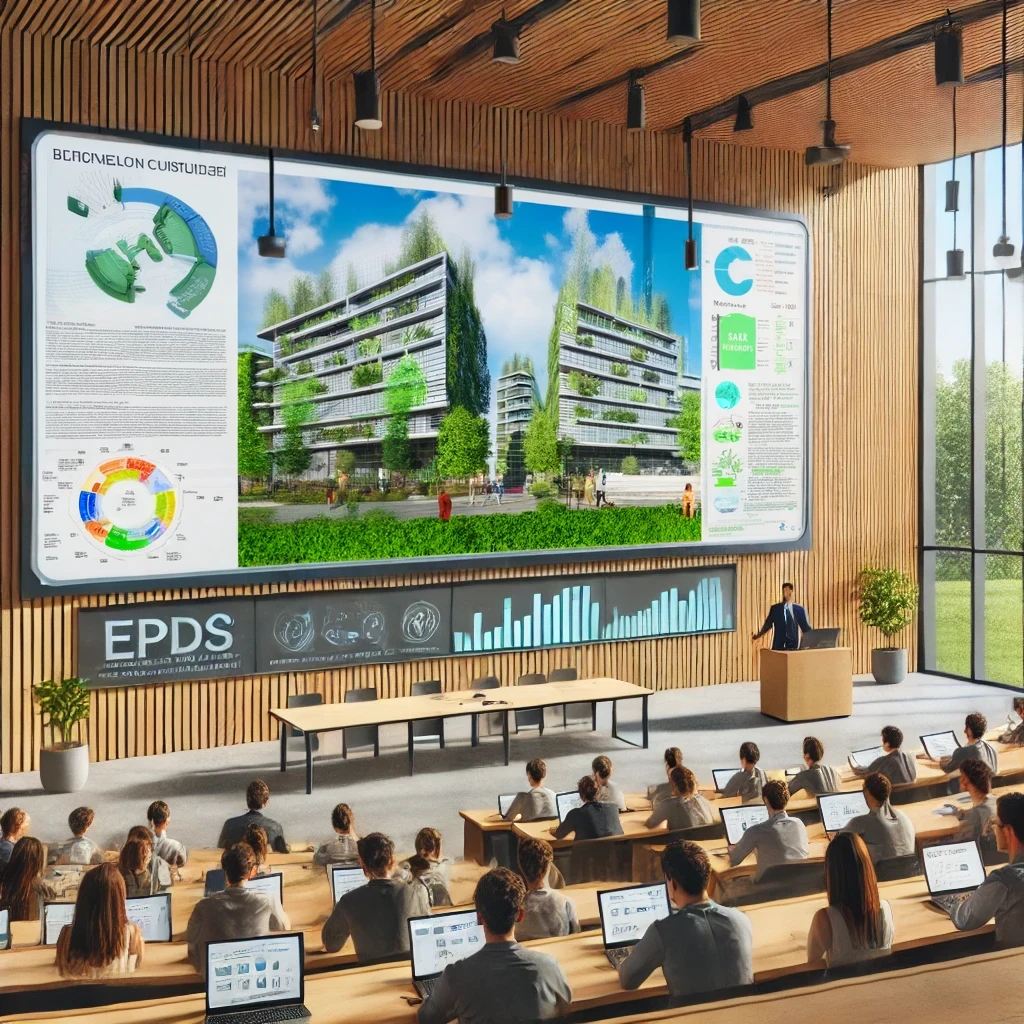
Environmental Product Declarations (EPDs) play a crucial role in this, as they form the basis for environmental product assessments over the entire life cycle of construction products and buildings. Realistic sustainability targets can only be set and successfully implemented with a solid data basis. This EPD data should be verified by notified bodies (accredited in many countries).
To this end, it is necessary to communicate the job profile of "life cycle assessor for (building) products" and the job profile of "verifier for life cycle assessments" and the necessary skills and background knowledge to a wider range of interested parties.
A pioneering training project is being launched in cooperation between the Department of Building and Design, the Department of Applied Life Sciences at the University of Applied Sciences Campus Vienna (HCW), the IBO (Austrian Institute for Building and Ecology), BAU-EPD GmbH and Makersite GmbH. The main objective is to meet the increasing demand for qualified life cycle assessors in the construction sector. To this end, the know-how generated in this project will be made available free of charge to all participating study programs at Hochschule Campus Wien and passed on to students in suitable courses. This initiative not only contributes to meeting the increasing demand for specialists in the field of life cycle assessment, but also strengthens the position of Hochschule Campus Wien as a pioneer in sustainable education in the construction industry.
A pioneering training programme is being developed, tested and implemented in a cooperation between the two departments of Hochschule Campus Wien, the IBO and BAU-EPD GmbH. The main objective is to meet the increasing demand for qualified life cycle assessors in the construction sector. The training programme developed will deal intensively with the principles of life cycle assessment for construction products with a focus on practical skills in the creation and verification of EPDs. Graduates will receive a training certificate during the project and will be able to offer their knowledge on the market. Through two courses, which are continuously evaluated and improved, around 60 people could acquire comprehensive knowledge of life cycle assessments as part of the funding project and provide valuable insights that will have a direct impact on the further development of training.
Networking students with building material manufacturers: During the training course, concrete data from industry should already be used, with a focus on products from manufacturers* in Vienna, ideally using renewable raw materials. In cooperation with the project team, life cycle assessments are to be created that can be used immediately on the market.
Springboard for prospective verifiers: The training should provide a detailed overview of the requirements for verifiers and testing personnel of notified bodies in accordance with the Construction Products Regulation.
Communicate ethical principles for environmental claims: Working as a life cycle assessor requires a high degree of overview with regard to the presentation and quantification of environmental data and environmental claims. Graduates should learn how to recognise and prevent green-washing attempts.
Head of Bachelor's Degree Program Civil Engineering and Construction Management
Senior Researcher
Senior Lecturer
Senior Lecturer
Bachelor
part-time
Master
part-time
Bachelor
full-time
Master
full-time
Master
part-time
Bachelor
part-time