
Sebastian Durstberger, MSc
Senior Lecturer

Project Duration: 07.03.2022 to 30.09.2022
An application is to be developed at the Gait Realtime Analysis Interactive Lab (GRAIL) at Hochschule Campus Wien to investigate how peripheral vision improves with the new lens compared to conventional lenses when walking in a virtual environment.
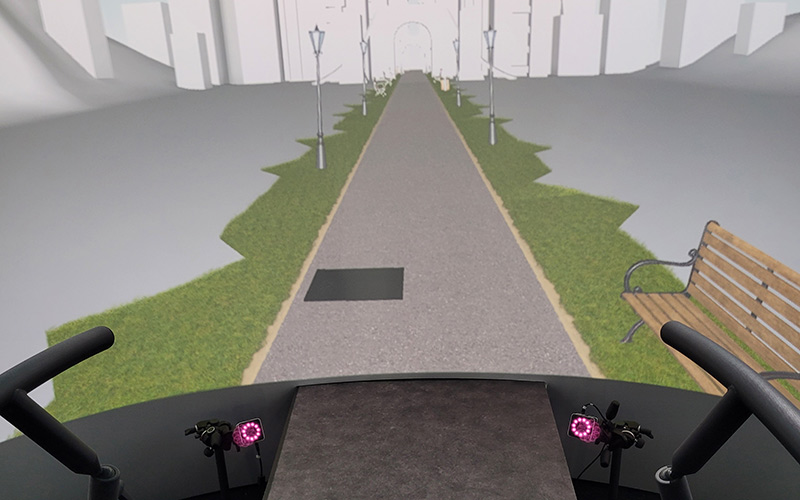
The image shows a section from the application that tests peripheral perception while walking. Numbers appear at eye level, which must be read out. This ensures that the focus remains directed forwards. The black fields appear at the edge of peripheral vision and are projected onto the screen, the stem and the treadmill. These must be avoided.
As a result of degenerative processes in the body's own lens of the eye, so-called "cataracts" often occur from the age of 60. This visual impairment is treated as standard by means of intraocular lens implantation, which is the most common surgical procedure of all. However, the implants available to date are optimised for central vision, resulting in reduced recognition and perception in the peripheral field of vision. A Spanish company (VOPTICA) has developed an improved lens to address this product issue. However, the effectiveness of improved peripheral recognition and perception has not yet been investigated with regard to locomotion in everyday life.
Consequently, an application is to be developed in the Gait Realtime Analysis Interactive Lab (GRAIL for short) at Hochschule Campus Wien, which will be used to investigate the improved peripheral vision with the new lens compared to conventional care when walking in a virtual environment. The applicability of the application will first be tested on eight healthy people using simulation glasses (simulating visual impairment). An external clinical partner (Hanusch KH) will then obtain an ethics vote on the pilot study with around eight patients. Recruitment and allocation is carried out by the clinical partner. The assessments at GRAIL and data processing are carried out at Hochschule Campus Wien. The pilot study forms the basis for planning a follow-up effectiveness study.
Senior Lecturer
Biomedical Scientist; Senior Lecturer
Head of Research Center Research Center Health Sciences; Research and Development
Occupational Therapist; Senior Lecturer (Parental Leave)
Senior Lecturer
Orthoptist; Senior Lecturer