
Effects of environmental toxins and allergens on respiratory epithelial cells

This page contains automated translations.

Project duration: 1 October 2021 to 30 September 2026

Respiratory diseases are on the rise, especially in industrialised countries. One of the main reasons for this is the increasing environmental pollution.
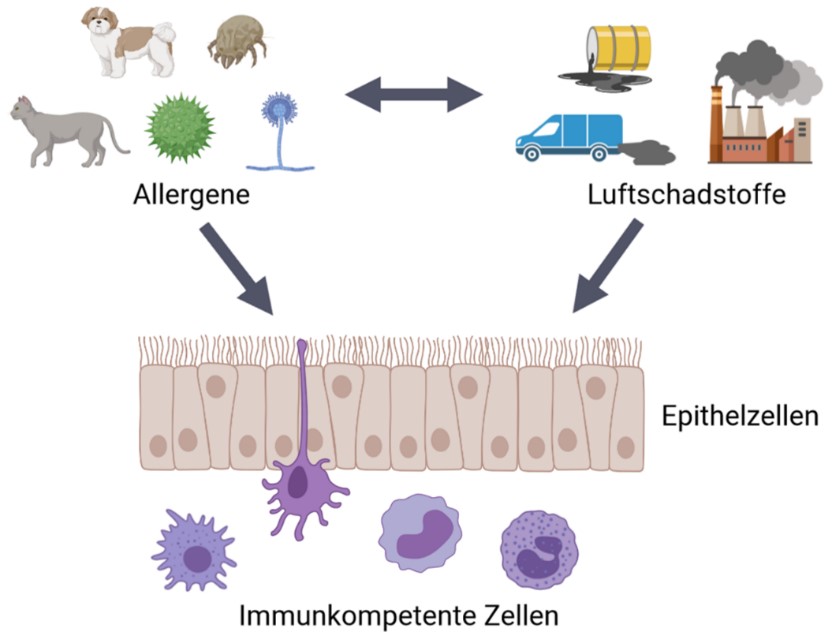
In the case of respiratory type I allergies in particular, there appears to be a direct correlation between the occurrence of various environmental factors and the increase in illnesses. Environmental toxins contribute to climate change, which can cause vegetation shifts. This exposes allergic individuals to new allergen sources. In addition, environmental toxins can alter pollen production and allergen expression in pollen. They also have a direct influence on the mucous membranes and the epithelial cells that line the mucous membranes.

One focus of the Immunology research group in the specialist area of Molecular Biotechnology is to investigate the reactions of respiratory allergens on nasal and bronchial epithelial cells.

In this project, the researchers are not only looking at already known respiratory allergen sources, such as grass pollen, weed pollen and moulds, but also at a still little-researched allergen source that is becoming increasingly important, namely nettle pollen.

The project focuses on the following research areas:

  1. Investigation of the interaction between allergens and epithelial cells in other important respiratory allergen sources (such as grass pollen, pollen from weeds, nettle pollen or moulds)
  2. Analysing the influence of particulate environmental pollutants on epithelial cells and their interaction with allergens.
  3. Evaluation of the interaction between epithelial cells and immune cells.

Research Goals

  • A better understanding of the interaction between allergens from the main respiratory allergen sources and epithelial cells
  • Insights into the influence of air pollutants on epithelial cells and their interaction with allergens
  • Understanding the effect of respiratory allergens and air pollutants on immune cells
  • A better understanding of the interaction between epithelial cells and immune cells after contact with respiratory allergens and air pollutants
  • Identification of the molecules in nettle pollen that trigger allergies
  • Recombinant production of allergenic proteins to improve the diagnosis of nettle pollen allergies

Funding Partners


MA 23 Call 30

Cooperation Partners

  • Prim.a Univ. Doz.in Dr Monika Cartellieri
    Ear, Nose and Throat Department of the Favoriten Clinic
    Kundratstraße 3, 1100 Vienna
  • IBO Interior Analysis
    Stutterheimstraße 16-18/2, 1150 Vienna
  • FH-Prof.in Dr Alexandra Graf
    Specialist area Bioinformatics, University of Applied Sciences Campus Vienna
    Favoritenstraße 222, 1100 Vienna

Project Team