


FH-Prof. Univ. Doz. Dr. Ines Swoboda
Head of Research Center Molecular Biotechnology; Senior Lecturer

Project Duration: 01.05.2021 to 02.05.2027
Allergic reactions to meat and meat products have not yet been extensively researched. For this reason, awareness of the fact that people can be allergic to meat is low. As part of a precursor project funded by the FWF, FH Prof. Univ. Doz. Dr. Ines Swoboda and her research group succeeded in identifying the first allergens from white and red meat, producing them in recombinant form and characterising them.
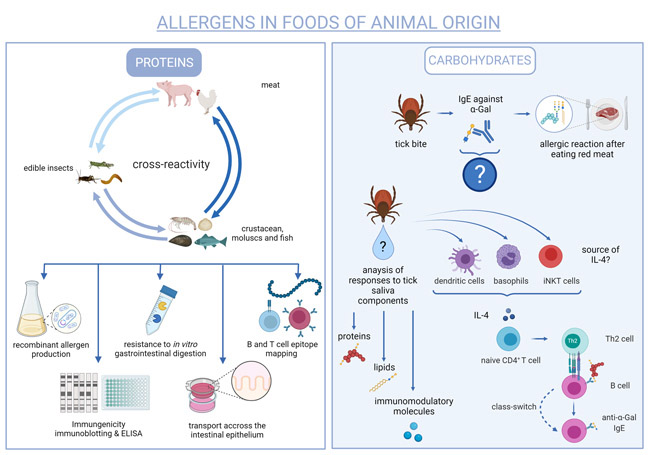
Building on the findings from the previous project, the current project, which is also funded by the FWF, focuses on the identification and precise biochemical and immunological characterisation of further meat allergens with the aim of completing the spectrum of relevant meat allergens and determining their clinical significance. The project is also dedicated to analysing the cross-reactivity between meat allergens and allergens from other animal foods (e.g. fish, seafood, insects). The knowledge about clinically relevant meat allergens and cross-reactive allergens from other animal foods will help to improve the diagnosis and treatment of meat allergies and related allergies.
Another focus of the project is research into a special form of meat allergy, known as α-gal allergy. In this unusual allergy induced by red meat, patients react with the sugar molecule α-Gal present in red meat, but the actual sensitisation to α-Gal occurs through a tick bite. In collaboration with colleagues at the Medical University of Vienna, Dr Swoboda and her team are investigating the reactions of immune cells to tick saliva and trying to identify components in tick saliva that contribute to the development of an allergic reaction to α-Gal. The hope is that a better understanding of the molecular mechanisms that lead to sensitisation to α-Gal will also help to better understand allergic sensitisation to other food allergens and thus prevent it in the future.
Head of Research Center Molecular Biotechnology; Senior Lecturer
Assistant Researcher
Senior Lecturer