
FH-Prof. Dr. Thomas Czerny
Senior Lecturer

Project Duration: 01.07.2013 to 30.06.2016
Humans are exposed to many toxic substances that trigger irritating or sensitising reactions. Due to a lack of alternative methods, animal testing is still necessary to determine these reactions. In collaboration with the Austrian Research Institute for Chemistry and Technology (ofi) and MedUni Vienna, this project is developing new in vitro methods that enable the reliable determination of irritating or sensitising properties.
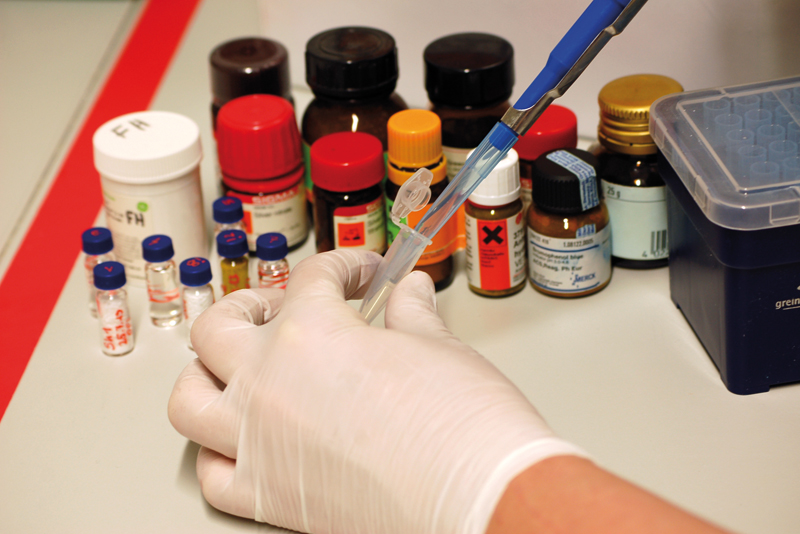
Many materials that we come into contact with can trigger negative reactions. It is often only low concentrations of ingredients or additives that have a toxic effect. It is particularly important to avoid such negative side effects with medical products or medicines. Toxic effects include sensitising and irritating properties that can be triggered by plastic additives or other additives, for example.
Due to legal regulations, animal testing must still be used to determine the sensitising and irritating properties of medical devices and medicinal products, especially biopharmaceuticals. In recent years, social pressure has increased to replace these test methods with in vitro procedures. This project is therefore developing new cell culture-based bioassays to quantitatively and qualitatively determine sensitising and irritating properties.
The cell-based bioassays must not only be sufficiently sensitive to trace components, but must also be robust, simple and cost-effective. In particular, manufacturers of pharmaceutical and medical products should be given the opportunity to test their products. The aim of this project is to develop validated methods for the qualitative and quantitative assessment of sensitising and irritating properties.
The specialist area of Molecular Biotechnology at Hochschule Campus Wien is developing bioassays that use two important cellular signalling pathways: the heat shock response as the central stress pathway of cells and the antioxidant response pathway, which is activated by oxidising chemicals. In both cases, the activity of the signalling pathways is determined using luciferase-based reporter systems that are as sensitive as possible.
Senior Lecturer