

Dipl.-Ing. Lukas Prielinger, BSc
Senior Researcher

Project Duration: 01.09.2025 to 31.08.2027
The ColourCycle research project is investigating how dyes, printing inks, and other decorative packaging elements affect the safety of recycled plastics used in food packaging. The goal is to develop safe recycling and deinking processes for use in food contact applications.
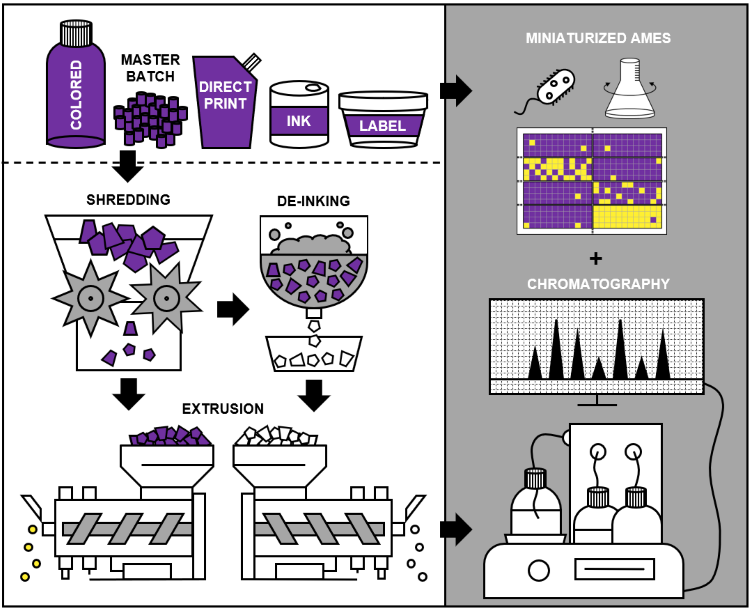
Both the EU's legal framework and consumer needs demand the use of recycled plastics in food packaging. For example, the draft of the Packaging & Packaging Waste Regulation (PPWR) calls for a mandatory recycled content in contact-sensitive packaging (such as food contact). The CORNET projects SafeCycle and PolyCycle have already carried out important preliminary work in this area: Plastic recyclates were tested with regard to their suitability for use in food packaging. Of particular relevance here is the presence of DNA-reactive, mutagenic substances, which must be classified as particularly critical in terms of health and for which very low limit values apply. In order to evaluate their presence, chemical analysis (GC-MS and HPLC-MS) was combined with in vitro bioassays (miniaturised Ames test) in the projects. It was found that polyolefin and polystyrene (PS) recyclates in particular lead to questionable results if they were primarily produced from packaging with certain colour components (printing inks, e.g. nitrocellulose-based, colour pigments or labels). In the bioassays, specific indications of the presence of DNA-reactive, mutagenic substances were found, which still have to be identified using chemical methods.
For the use of polyolefin and PS recyclates in food contact, these substances must be removed or excluded. Since decorative elements (e.g. printing inks) have a complex chemical composition and various types of colouring elements are used, the ColourCycle project aims to further investigate which coloured components in packaging can lead to the formation of DNA-reactive, mutagenic substances during recycling and how these could be removed, e.g. by deinking. For this, defined coloured and deinked samples are to be analysed using chemical analysis and in vitro bioassays in order to draw conclusions about the materials and deinking processes. In order to be able to process a small quantity of defined samples on a laboratory scale in a representative manner, a methodology is to be developed to simulate the effects of recycling processes on the material in a realistic manner. Furthermore, a challenge test for printing inks will be set up to determine the efficiency of deinking processes and thus include the removal of critical substances. These findings can ultimately be incorporated into the evaluation of recyclates in order to identify safe recycling materials and processes for food contact.
Senior Researcher
Assistent Researcher