

Mag. Dr. Sabine Gruber
Researcher

Project Duration: 01.03.2022 to 28.02.2024
In recent years, the industrial utilisation of certain insects such as the black soldier fly (BSF, Hermetia illucens) has become a promising way to convert residual biomass from agriculture and agribusiness into valuable resources for biomolecules. Of primary interest are protein, fat and chitin suitable for the feed and food industry.
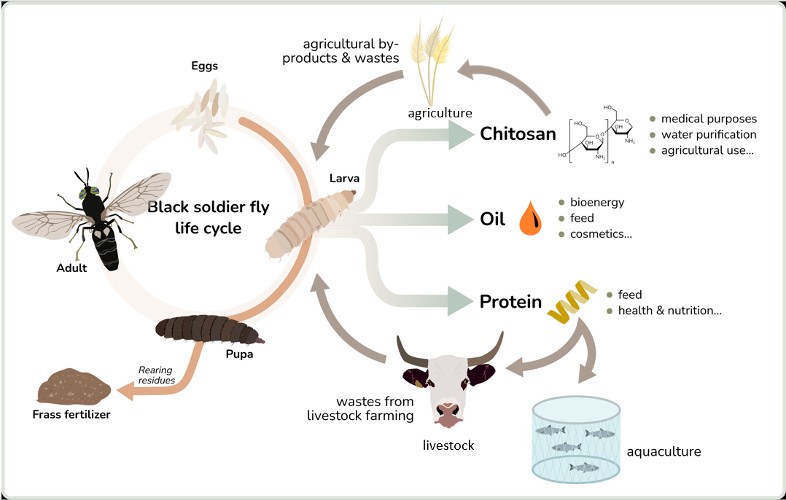
A wide range of organic residues from agro-industrial by-products to animal manure are suitable as starting biomass for this process. In contrast to other means of valorising organic residues, by interposing this insect-based bioconversion step, the cycle can be closed directly back to the source of most organic waste - i.e. the production of food and feed. In addition to producing a valuable source of nutrients for traditional livestock (e.g. pigs and poultry), rearing residues rich in insect faeces and chitin can be used as an efficient organic fertiliser. With the EU Commission's growing support for an insect-based bioeconomy and its contribution to the goals of the European Green Deal, this technology shows promising potential to conserve resources while reducing dependence on unsustainable imported feed.
The aim of the project "Expanding the value chain - biological extraction of chitosan for insect-based waste bioconversion (ChitoBSF)" is to expand and close the production cycle by integrating another valuable product, namely chitin. The highly active biopolymer chitosan is to be obtained by upcycling chitin-containing press residues from insect production, which are produced during the processing of the larval biomass. Using sustainable methods, the residual chitin from certain stages of development is derivatised into chitosan. Chitin and its derivative chitosan are industrially attractive biopolymers with a wide range of applications. Chitosan in particular has been the subject of intensive research for some time and promises enormous potential for future applications in agriculture, waste water treatment and pharmacology.
In addition to high-quality proteins and fertilisers, our aim is to pave the way for sustainable chitosan production from insect sources by improving the technological expertise of the start-up LIVIN farms AgriFood GmbH. By upcycling industrial organic residues and by-products into a food source for livestock using BSF rearing, the production cycle is to be expanded or closed by integrating chitin production from larvae. This proof of concept study expands the start-up's product portfolio and extends the core expertise of the scientific partners involved in the sustainable production of highly potent chitosan products for industrial applications.
Researcher
Researcher
Ehemalige*r Mitarbeitende*r